


County advances $14.6M sheriff tech package as critics question surveillance scope, transparency
What began as a routine software upgrade erupted into a fierce debate over mass surveillance and fiscal transparency Tuesday, as Ottawa County officials pushed forward a sweeping $14.6 million police technology overhaul.

OTTAWA COUNTY — What began as a routine software upgrade erupted into a fierce debate over mass surveillance and fiscal transparency Tuesday, as Ottawa County officials pushed forward a sweeping $14.6 million police technology overhaul to create a universal software platform.
The split vote by the Finance and Administration Committee sends the decade-long agreement — spanning Jan. 1, 2027, through Dec. 31, 2036 — to the full 11-member board of commissioners after a motion to delay action for a work session failed.
Alongside replacing the sheriff’s office aging records platform, the $14,624,663.93 package funds body cameras, Tasers, virtual reality training systems, in-car video kits, counter-drone detection sensors, live-video integration software for private security feeds, covert interview-room recording systems and optional fixed automated license plate readers, or ALPRs.
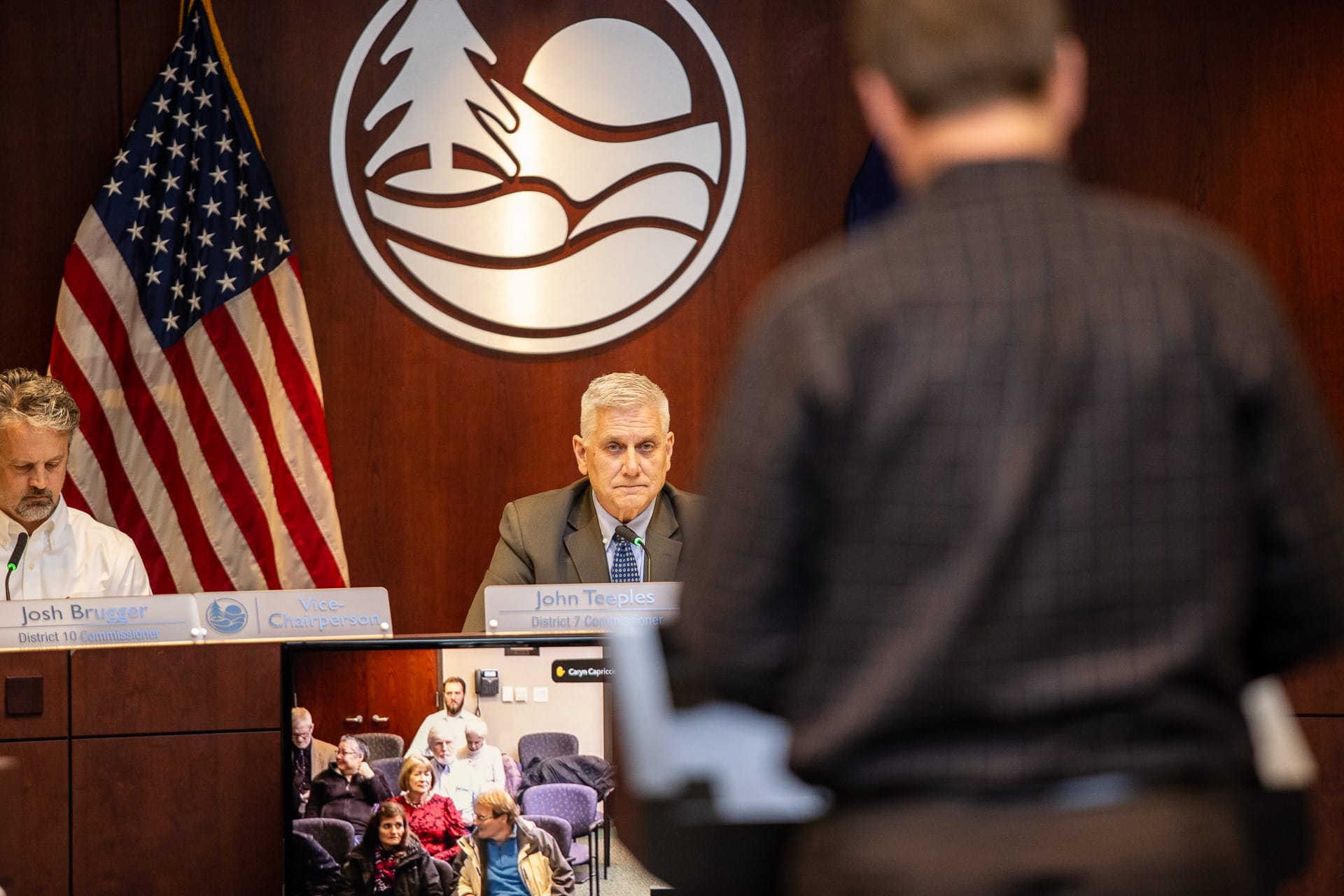
Commissioners John Teeples, Sylvia Rhodea and Doug Zylstra voted no, questioning the bundled deal that pairs a needed $2.72 million records system with body cameras, Tasers, drone detectors, live-video sharing software and optional fixed license-plate readers.
Public pushback over pricing, transparency
When the committee convened at 9:30 a.m. Nov. 10, every speaker during the opening public comment period focused on the Axon proposal.
Several residents criticized county administration and the sheriff’s office for framing a sweeping technology and surveillance purchase as a routine records software upgrade — and for omitting the $14.62 million price tag from the public agenda packet summary.
Grand Haven resident Oliver Shampine argued that the core records management software accounts for only a fraction of the total expenditure — specifically $2,720,294.27 out of the $14,624,663.93 contract value.
"The record system is only about one-fifth of the $14.6 million," Shampine, who ran for the county board in 2024 as a Democrat, told the committee, questioning whether commissioners should advance "a $14 million line item that you'll approve in a single committee meeting with no policy, no competitive bid, and no budget line."
He urged the board to separate the records management system from the rest of the hardware and software bundle, put the software out for competitive bids and establish clear privacy and surveillance policies before entering into a decade-long commitment.
Allendale resident Becky Patrick echoed concerns about transparency, telling commissioners that taxpayers should not have to comb through a 112-page contract to discover that it includes provisions for ALPRs, drone tracking and real-time video monitoring. She argued that the agenda description obscured the true scope of the transaction.
Park Township resident Ben Baker noted that nearly every other action item on the committee’s Nov. 10 agenda explicitly listed its dollar amount upfront, whereas the Axon summary left the $14.62 million figure off the public agenda overview.
Months of turmoil over license-plate cameras
The sharp public reaction to Axon’s camera provisions unfolded against a backdrop of months of escalating community friction surrounding the county’s existing Flock Safety license-plate reader network.
Funding for ALPRs was originally approved in 2024, when far-right conservatives affiliated with the political group Ottawa Impact held a majority on the board of commissioners.
In summer 2026, local opposition to the camera network spilled over from political debate into physical action. In July and August, vandals began targeting the cameras across the county, blinding lenses or destroying units altogether.
In late August, an Ottawa County man was charged with a felony for allegedly destroying a camera and its solar power panel in Holland Township.
Around the same time, online activist groups began crowdsourcing and mapping camera locations across the region to help residents track the expanding surveillance network.
That unrest carried directly into county board chambers Aug. 25, when a surge of residents turned out during public comment to speak out against the cameras, decrying them as unwarranted mass surveillance of law-abiding motorists.
In response, the board held a dedicated two-hour work session Sept. 18, during which county leaders, Sheriff Eric DeBoer and residents debated the legal and constitutional boundaries of digital privacy.
The sheriff’s office defended the technology, noting that all captured data is owned entirely by the county, is automatically deleted after 30 days and is governed by strict audit trails designed to prevent unauthorized searches or misuse.
Case for consolidation, modernization
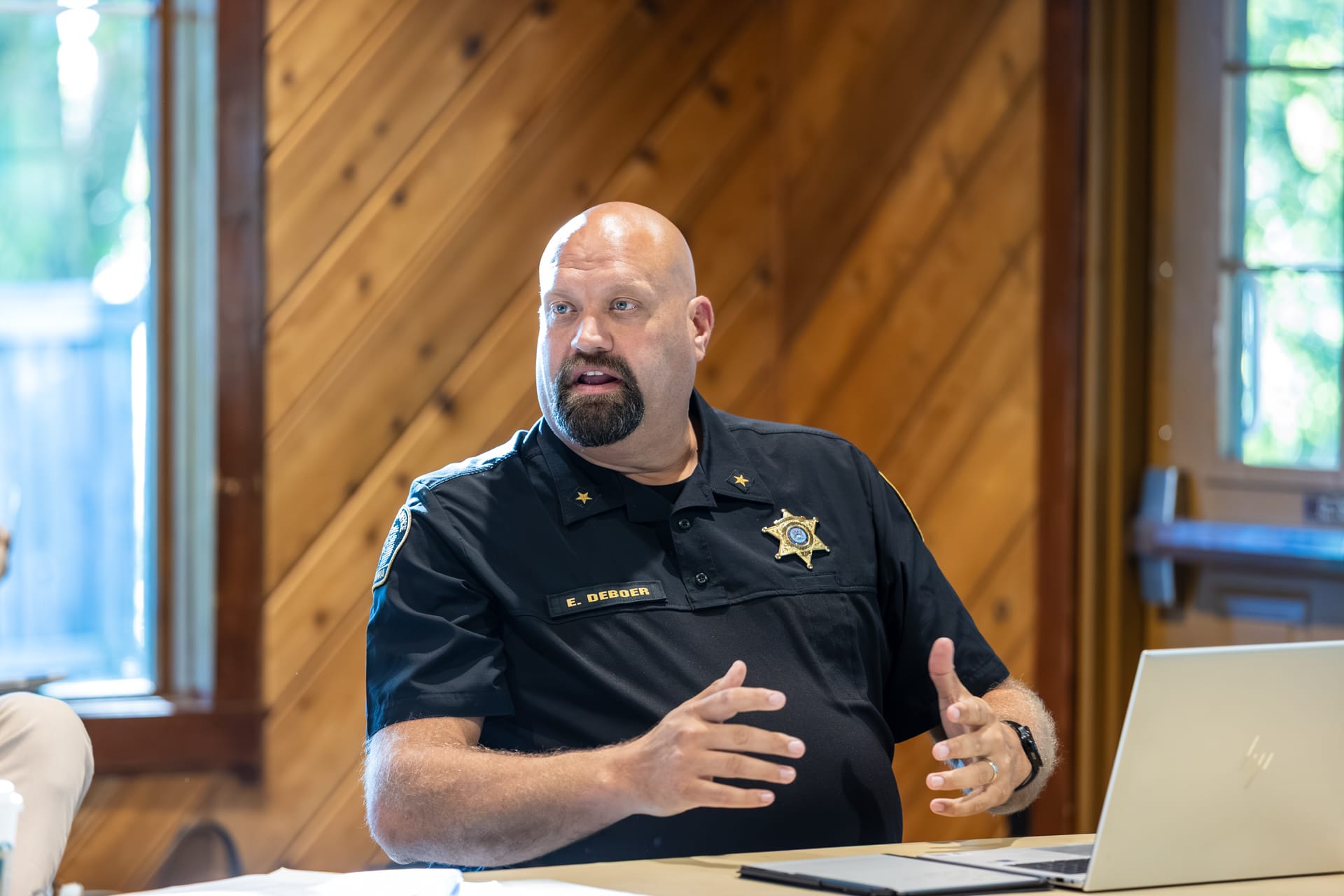
When the committee turned to the Axon agenda item following routine workforce and insurance approvals, DeBoer delivered an extensive presentation defending the proposal as the culmination of a multi-month procurement effort designed to fix critical operational bottlenecks and secure long-term price protections.
"This isn't something that's come up new. It's been an ongoing effort," DeBoer said. "We're nearing the end of a three-year or a multi-year contract with Axon for our body cams," he said at Tuesday's meeting. "We have to make a decision in three years with Axon in terms of the continuation of the body cam and other technology that we're contracting with."
DeBoer explained that the sheriff’s office currently relies on a platform provided through the Ottawa County Central Dispatch Authority, which is nearing end-of-life and can no longer keep pace with modern law enforcement workflows or data-reporting expectations.
"We utilize a current records management system, Tyler Technologies, coordinating with 911. We have come to the conclusion that it is no longer able to meet the needs of the county in terms of its capabilities," DeBoer said.
"One example that I'll point to is I often ask the sheriff for reports on various metrics, and this does not have the capability to do it. I know that's something that's important to the board — we talked about it a lot in our strategic plan," DeBoer said. "So, we're looking for a new system that provides a lot more capabilities in terms of records management and reporting out. And the idea that you're going to hear about today is to bundle what we're doing with Axon and replace Tyler with Axon, which we think is a superior product for that same system."
DeBoer detailed day-to-day operational inefficiencies caused by disconnected software platforms. Under the current setup, deputies and records clerks must manually enter and reconcile information across separate systems for patrol, jail booking, and prosecution. DeBoer told commissioners that records staff currently manage approximately 3,000 duplicate reports sitting in a manual merge queue at any given time, even as the agency processes roughly 1,300 to 1,400 calls for service every week. Furthermore, he noted that a critical data integration with the prosecutor's office was already eight months behind schedule.
By contrast, DeBoer said, transitioning to Axon Records would allow:
- Data entered in the field to flow automatically from a deputy’s mobile computer terminal into the jail tracker booking system, prosecutor's office platform, and state and federal reporting databases such as the Michigan Incident-Based Reporting System and FBI system.
- Automated matching across multiple indices to eliminate much of the manual duplication backlog and prevent data-entry errors from propagating across departments.
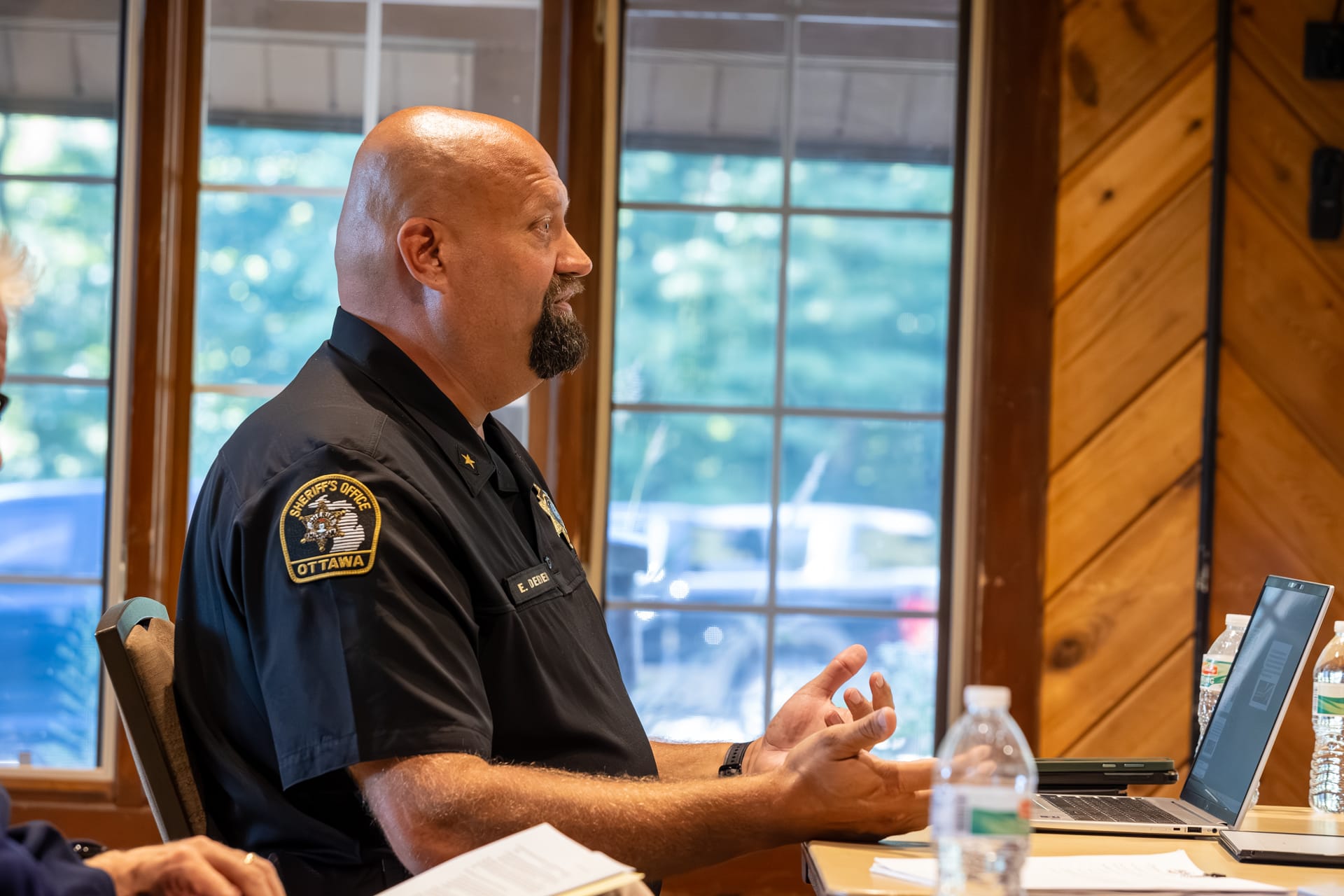
DeBoer said staying with Tyler would leave Ottawa County dependent on Central Dispatch’s contract and funding model while keeping decades of historical records sequestered in a separate, non-integrated tab rather than migrating them into the active database.
Under the proposed contract, Axon will convert and migrate up to 3 million legacy incident reports, cases, warrants, permits and property records — along with up to 30 million attachments — into five county agency instances.
To counter suggestions that the deal was rushed, DeBoer emphasized that county personnel spent seven months negotiating 22 separate iterations of the quote with Axon, driving the $20,858,766.54 manufacturer’s suggested retail price down by 29.89% — a total discount of $6,234,102.61.
"I just want to help the board understand that we've been working on just the second half of this project — just the Axon portion of it — after we decided and worked on what RMS system would meet our organizational, operational and strategic goals," DeBoer said. "Just the contracting itself, we've been working on for over seven months. During that time, four people have been tasked with going through every detail of this agreement, and what has been presented to you today is the 22nd quote that was offered by Axon."
DeBoer outlined a three-phase procurement strategy behind the agreement and welcomed scrutiny of the numbers:
"First, find an RMS that fits our operational, strategic goals. Then, get the best pricing that we can for those services. And then the third phase, which will be after execution, is to locate redundant systems that this may also replace — and we've already identified about $750,000 of possible systems that may be redundant and represent savings down the road."
"So, I'm here to ask your support on a 10-year technology agreement with Axon," DeBoer continued. "On paper, it replaces our records management system. In practice, it does much more than that: It consolidates our existing Axon agreement and the nine separate quotes under it into one.
"It allows every police agency in the county onto the same records platform — and Axon Records is not currently being offered to agencies under 100 sworn [officers]," he said. "It fixes problems between our patrol, our jail and our prosecutor's offices that have cost us time and accuracy for years."
He acknowledged, however, that the cost was a high figure.
"This is a large contract — 10 years and $14.6 million — it deserves real scrutiny, and I welcome it. My goal in the next few minutes is to show you what we are buying, what it costs and when, how we pay for it, and why we believe it's the right decision for the county."
Connecting the investment directly to the board’s own policy priorities, DeBoer added: "I also want to measure this against the strategic plan this board adopted unanimously in June — the plan that says it will guide the county's budgeting process, and I believe it should guide this decision, too. The county's mission is to deliver trusted public services, responsible stewardship, and regional leadership. This agreement speaks to all three."
Regional law enforcement collaboration
A central pillar of DeBoer’s regional leadership argument is that the county’s participation unlocks countywide records sharing for municipal and campus police departments.
Under Axon’s standard commercial rules, Axon Records is not offered to law enforcement agencies with fewer than 100 sworn officers.
By anchoring the master agreement through the sheriff’s office, Ottawa County enables Holland Department of Public Safety, Grand Haven Department of Public Safety, the Zeeland Police Department and Grand Valley State University Police Department to migrate onto the same unified records platform.
Each partner agency will sign its own independent contract with Axon while benefiting from the county’s negotiated volume discount and retaining control over its own data portability.
DeBoer noted that if Ottawa County declined to move forward, those local municipal departments would effectively be blocked from adopting the shared system.

Breaking down the $14.62M package, payment schedule
The 112-page contract terminates nine prior Axon quotes effective Jan. 1, 2027, rolling a $782,819.11 transfer balance for existing hardware and services into the new 10-year schedule. The total $14,624,663.93 cost spans several major operational categories:
- Officer Safety Plan (OSP) 10 Plus and unlimited plans ($7.68 million combined): The largest portion of the contract covers 195 OSP 10 Plus bundles ($6.37 million), 50 Unlimited (noVR) plans tailored for corrections and jail personnel ($7.48 million) and five Unlimited Plus with VR plans ($198,102). These plans provide Axon Body 4 cameras (plus Flex POV modules), Taser 10 handles and training/duty cartridges, virtual reality training headsets and controllers, unlimited cloud evidence storage, AI-assisted redaction and auto-tagging software, and scheduled Technology Assurance Plan (TAP) hardware refreshes in 2027, 2030, 2033 and 2036.
- Fleet and in-car video ($2.77 million): Funds Axon Fleet 3 dual-camera vehicle systems, interior patrol cameras, ALPR licenses for 132 fleet cameras, unlimited video storage, vehicle installation upgrades and scheduled fleet hardware refreshes in late 2031.
- Axon records management system ($2.72 million): Covers RMS software licensing starting in June 2028, professional services implementation milestones ($876,250), legacy data conversion from Tyler New World ($566,500) and 10 third-party system integrations ($472,500), Axon Standards internal affairs software and a dedicated multi-year Software Technical Account Manager ($340,842).
- Interview rooms ($318,080): Provides covert cameras, wired microphones, touch panels, installation and unlimited cloud storage for interrogation and interview rooms across initial and 2031-2032 refresh cycles.
- Real-time crime center, drones and fixed ALPRs (bundled within OSP): Includes Axon Fusus livestreaming licenses for 250 body cameras and 250 external CCTV streams; Dedrone drone-detection RF sensors, Drone Tag Remote ID kits and cloud tracking software; Axon Air DroneSense licenses; and hardware/licensing for 20 solar-powered Axon Outpost fixed ALPR camera poles.
Under the annual payment schedule, Ottawa County will pay $938,800 on Jan. 1, 2027, and $944,940.01 on Jan. 1, 2028 — amounts that match current budgeted Axon expenditures and create no immediate general-fund increase during the first two years. Payments spike to $2,812,499.95 on Jan. 1, 2029, reflecting milestone payments upon full RMS data conversion and rollout, before leveling off at $1,418,346.28 per year from 2030 through 2035 (and $1,418,346.29 in 2036).
DeBoer estimated that maintaining the status quo without replacing the records system would still cost the county roughly $9.9 million over the next decade.
Accounting for planned allocations from public-safety funding and state marijuana-tax revenues — including roughly $1.4 million toward the 2029 spike — DeBoer projected the net new impact on the county’s general fund at approximately $3.3 million over 10 years, or an average of $330,000 annually.
That projection does not factor in the $750,000 in potential savings from retiring redundant citation, crash-reporting and online-reporting tools.
Commissioners, however, pressed DeBoer on the stability of those funding offsets.
DeBoer acknowledged that Ottawa County’s marijuana-tax revenue is not legally restricted to law enforcement technology and remains subject to annual board appropriation decisions, meaning future boards could redirect those dollars elsewhere.

Vendor lock-in, termination clauses
Commissioners also scrutinized the contract’s exit clauses and bundling mechanics.
Staff noted that when Axon initially quoted Axon Records as a standalone software product without hardware bundles, the price came in at roughly $2 million per year — more than seven times the bundled annual software cost.
Integrating the records platform into the Officer Safety Plan unlocked the steep multi-product discount, though discount allocations are not interchangeable; removing major components would trigger a repricing of the remaining items.
Under the purchase agreement, all sales are final and payment obligations are non-cancelable. The contract does not include a "termination for convenience" clause that would allow the county to walk away at will.
Instead, Ottawa County can only terminate the agreement if Axon commits an uncured breach (subject to a 30-day cure period) or if the board of commissioners fails to appropriate sufficient public funds in a future budget year.
Even under the non-appropriation clause, DeBoer acknowledged Tuesday that disentangling the records system from Axon’s hardware ecosystem years into the contract would be operationally difficult.
Because Axon Body 4 cameras, Fleet 3 in-car video, Taser 10 logs and Axon Records all feed into the unified Axon Evidence cloud, attempting to remove the records module while keeping Axon cameras and Tasers would present major technical and financial hurdles.

Surveillance tools, deferral clauses, board authority
The sharpest debate among commissioners centered on surveillance capabilities embedded in the bundle — specifically Axon Fusus and Axon Outpost fixed ALPRs.
Addressing Fusus, DeBoer clarified that the platform does not give deputies unrestricted access to private cameras across the county. Rather, it allows schools, businesses and private organizations to voluntarily register up to 250 existing CCTV feeds.
Participating schools and businesses retain granular control over their streams, with no routine law enforcement viewing permitted; feeds only become accessible during qualifying 911 emergencies, such as an active shooter or violent assault in progress.
Similarly, DeBoer described the Dedrone component as a passive radio-frequency detection tool capable of identifying drone transponders within roughly 200 feet and locating the operator, rather than a radar system or counter-drone jamming device.
To address community sensitivity surrounding ALPRs, county negotiators inserted a special exception; the clause says Ottawa County will not take immediate delivery, shipment or possession of any Axon Outpost poles, solar kits or installation services upon signing. No Outpost cameras will be erected unless and until the sheriff’s office returns for formal approvals, yet keeping the line items in the contract preserves the broader Officer Safety Plan discount.
Despite that safeguard, Rhodea argued that approving a contract containing pre-priced, optional fixed cameras bundled alongside essential police equipment forced commissioners to surrender their legislative oversight.
"I hope that you see our perspective, too, in that by putting this all together, you're asking us to cede our portion of authority by putting this contract through. You kind of lose me on that point," Rhodea told DeBoer on Tuesday. "For today, I'm going to be voting no on this for that particular reason, but I'm with you on the rest of it."
DeBoer pushed back against the suggestion that the Outpost cameras were tucked into the agreement to bypass the board, pointing out that he briefed commissioners on the provisions weeks earlier.
"Ceding the authority for operational control — that's something I'm kind of a little bit cognizant of not wanting to get involved in," DeBoer replied. "So, I understand where you're concerned, but ultimately I think I've shown that I've been talking [about the fact] that this was in here. I didn't try and push it to the fine print," he said. "We talked about it three weeks ago. We're going to work through all this together."
Addressing whether the county might eventually replace its existing Flock Safety license-plate camera contract with Axon’s Outpost system — and referencing the Sept. 18 work session — DeBoer said any transition would require a security review, consultation with local police partners and a public board decision weighed strictly on operational and financial performance.
"And again, that's one of the things that we would talk about: Does it make sense to make a move? Do we lose our network? Does it lose the strength of that whole tool?" DeBoer said. "Because obviously you guys are having a conversation amongst yourselves and with your constituency about whether or not this is appropriate. ... And obviously, at this point, I'm past that, right?"
DeBoer added that he leaves the debate over the cameras' legality to the judicial system.
"I understand what's constitutional and who can make that determination, and if there's a law change or a court that rules on it, I'm completely willing to accept that. Past that, it's just whether or not this is an effective tool for the money."
To evaluate that cost-effectiveness, he pointed to recent data as proof of the system's value.
"We saw that in my work session about stolen vehicles, the outcomes that we're having, and the protection we're giving to the people of Ottawa County. That's my litmus test for if we're going to make that move or not: Does it make sense monetarily? Does it make sense security-wise? Does it make sense tool-wise?
"Ultimately, you've got your Flock contract already. It's just whether or not we would save $45,000 a year if we made the change or not."
Work session motion fails
Before voting on the contract itself, commissioners debated a motion to delay action and schedule a full-board work session to allow all 11 commissioners and the public to review a line-by-line cost breakdown and examine the surveillance tools in greater detail.
Supporters of a delay argued that a $14.62 million, 10-year commitment warranted broader review before moving forward.
"My preference is to delay it for a month and send it to a work session where we can all look at this," said Zylstra, the board's lone Democrat, who made the motion to table the issue and discuss more.
"It's the first time we've seen it, Sheriff DeBoer. I had asked for the presentation. I was not sent the presentation. I hope you understand that it's a lot of information for us to absorb and we have a work session scheduled for Friday," he said, referring to a 10:30 a.m. meeting scheduled for Nov. 13 that now includes a discussion on the Axon contract."
Opponents of delaying warned that postponing action risked missing Axon’s year-end pricing deadline — the quote expires Dec. 1 — and could disrupt planning for the four municipal and university police agencies relying on Ottawa County’s migration timeline.
DeBoer also warned that Central Dispatch’s planned migration to Tyler Cloud could eventually block software updates if the sheriff’s office remained on the legacy LeRMS platform.
"Our record system is end of life, and we have to replace it," DeBoer said near the close of the discussion.
The motion to hold a work session before committee action failed 5-2, with Rhodea supporting Zylstra's effort.
The committee then voted 4-3 to approve and forward the Axon agreement to the full Board of Commissioners, with Teeples, Rhodea and Zylstra dissenting.
DeBoer agreed to provide a clean, standalone copy of his slide presentation to all 11 commissioners and make it publicly downloadable ahead of the full board meeting.
Other committee business
Following the lengthy Axon debate, the committee worked through a packed agenda of infrastructure, health, housing and budget items:
- Rural broadband expansion: Commissioners approved forwarding a Phase Two broadband infrastructure agreement with 123Net, committing up to $3,493,095.51 in county matching funds. Combined with $3.5 million from 123Net and federal Broadband Equity, Access and Deployment, or BEAD, grant funds, the roughly $22 million project will construct more than 300 miles of fiber-optic cable in harder-to-reach rural areas, extending 250 Mbps symmetrical internet service (at roughly $59.99 per month with free standard installation) to approximately 2,200 additional residents. Phase One, which built over 325 miles of fiber, is roughly 90% complete.
- Opioid Settlement Steering Committee: The committee approved establishing a three-year Opioid Settlement Steering Committee to guide priorities for Ottawa County’s $6.2 million, 18-year opioid settlement fund (of which roughly $2.4 million has been received and only $36,000 spent to date). Following an amendment supported by commissioners, the voting panel will include one or two seats reserved for residents or individuals with lived experience of opioid harms, alongside county, court, school, public health, law enforcement and recovery representatives. The steering committee will hold no direct spending authority, with all contracts subject to competitive bidding and final Board of Commissioners approval.
- Public health clinic, jail upgrades: The committee advanced a $700,182.35 renovation contract with JKB and Associates Inc. for the county’s public health clinic, paired with a temporary relocation lease at 32900 North Wellness Drive in Holland. Moving clinical operations during construction adds roughly $60,000 in rent but cuts the construction timeline from 13 months to six while protecting patient privacy. Commissioners also approved a $183,467.08 phase-one contract with River City Flooring to replace original 1994 carpeting in designated jail and juvenile-detention areas.
- Senior housing bonds, workforce adjustments: Commissioners initiated Act 338 conduit bond financing for Rest Haven’s rebuild of its 1955 Maplewoods building and addition of 28 independent-living units at Farmstead, with bond issuance targeted for early 2027. The committee also approved transferring approximately 185 Community Mental Health employees into the county’s MERS retirement system, raised hourly retention stipends for jail custodial and maintenance workers from $1.00 to $1.50, approved 2027 health and dental renewals (including a new zero-premium high-deductible option) and added a $218,386 road-patrol deputy fully funded by Georgetown Township.
What happens next
During the Nov. 13 work session, county administrators and sheriff’s officials factored in a projected $1.4 million state grant, a $2.7 million records-management component and up to $750,000 in savings from eliminating overlapping integration software.
County staff estimated the net annual increase could be as low as $20,000 if projected efficiencies are realized.
Officials also noted that while Axon rejected a termination-for-convenience clause — making a mid-term exit costly — locking in a 10-year term protects the county from steep price hikes and major operational disruptions associated with replacing a records-management system every five years.
Addressing privacy concerns, officials clarified that the Fusus platform allows dispatchers to view live feeds from up to 250 existing cameras during active emergencies, rather than installing new cameras or accessing stored school recordings. Participation by school districts and private property owners remains strictly voluntary, with local entities controlling which cameras are shared and when.
To address board and community concerns over fixed ALPRs, legal staff introduced revised three-party contract language prohibiting Axon from delivering, installing or activating fixed "outpost" ALPRs unless the board grants separate, formal approval in the future.
“It's not supposed to deliver these cameras or install them or activate them until the board of commissioners and the sheriff in Ottawa County have said, 'Go for it,'” county corporation counsel Doug Van Essen said Friday.
Still, Commissioner Joe Moss, the president of Ottawa Impact and the former chair of the board who originally signed the Flock Safety contract in 2024, signaled that he plans to move forward at the board's full meeting on Tuesday, Nov. 17, with an amended motion that strips the ALPR provisions from the contract entirely, even though staff noted removing the cameras would not reduce the overall package price.
“In general, I don't think the government itself should be in the business of mass surveillance,” Moss said, adding that he expects broad board support for the remaining records-management, body-camera and public-safety upgrades.
Because the Friday meeting was a work session, no formal vote was taken.
Board Chair Josh Brugger directed legal counsel and administration staff to prepare vetted contract alternatives ahead of Tuesday’s regular meeting, where commissioners are expected to remove the item from the consent agenda for full debate and a final vote.
That full board meeting is scheduled for 6:30 p.m. Read the agenda and supporting packet materials here.
— Sarah Leach is the executive editor of the Ottawa News Network. Contact her at sleach@ottawanewsnetwork.org. Follow her on Twitter @ONNLeach.


