

Data-driven turtle crossing built in West Michigan to reduce roadkill
Years of volunteer-collected data have led to the installation of a new wildlife crossing designed to protect freshwater turtles from vehicle collisions along a busy stretch of highway in Barry County.

GRAND RAPIDS — Years of volunteer-collected data have led to the installation of a new wildlife crossing designed to protect freshwater turtles from vehicle collisions along a busy stretch of highway in Barry County.
The project, spearheaded by the John Ball Zoo, Grand Valley State University, and regional partners, transformed community science into physical infrastructure.
Constructed along state route M-43, the crossing features a 6-by-7-foot box culvert and fencing spanning several hundred feet to guide turtles safely beneath the road. A second culvert was also installed specifically for wildlife movement, separate from local water-management infrastructure.
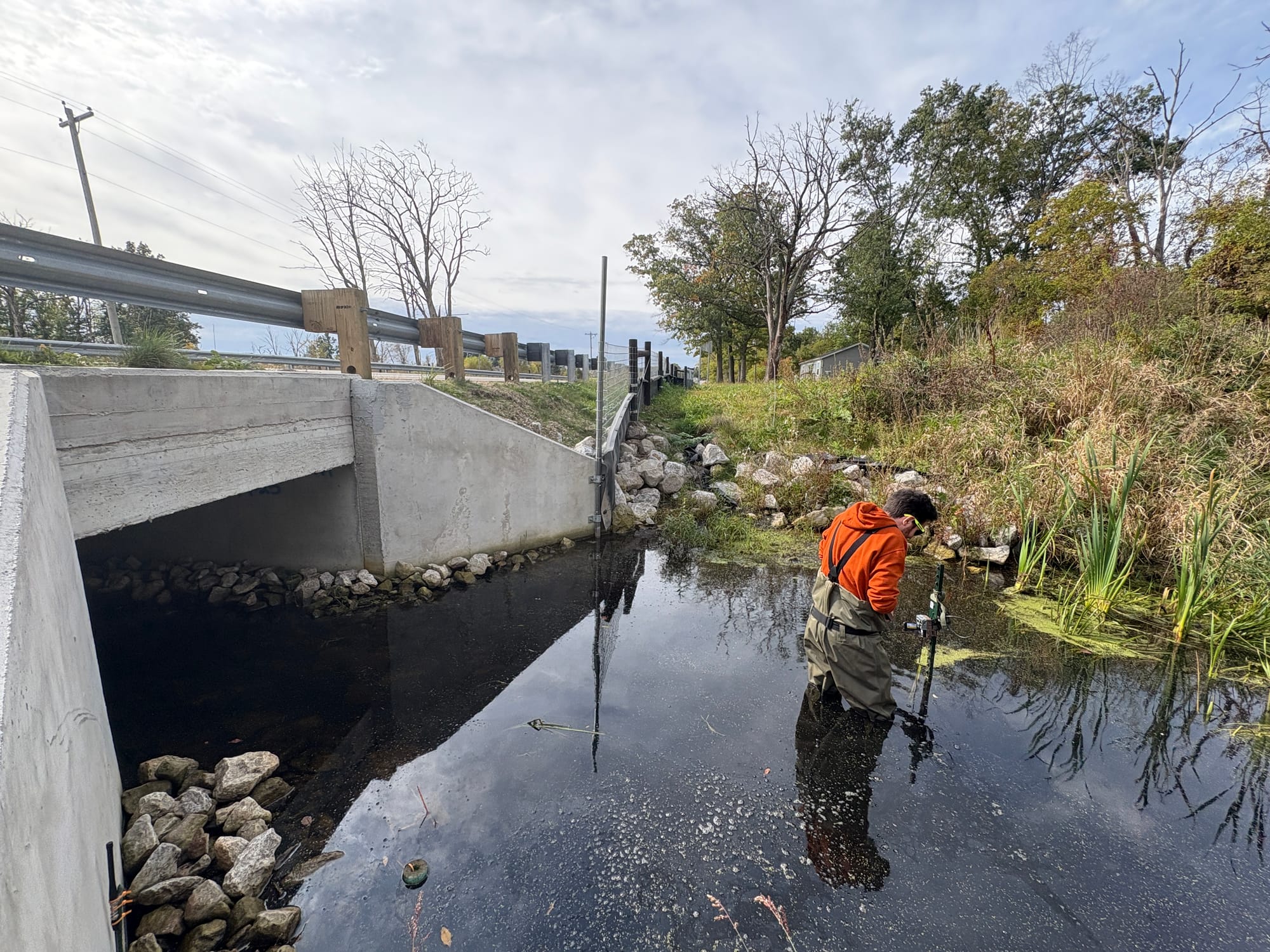
The intervention targets one of the primary threats to North American freshwater turtles: road mortality. Launched in 2023 through the zoo's Great Lakes Rare Turtle Program, the research initiative relies on volunteers to document turtle deaths across western and southwestern Michigan.
"This project shows what’s possible when community members, researchers and conservation partners work together," Travis Kurtz, community science coordinator at John Ball Zoo, said in a news release. "The data collected by our volunteers helped identify a critical location for turtles and created an opportunity to make a meaningful change."
Kurtz developed the project with Eric McCluskey, a GVSU researcher specializing in landscape ecology and turtle movement. The team mapped potential crossing sites within 50 miles of Grand Rapids using wetland data and historical records of Blanding's and spotted turtles. After GVSU and zoo staff confirmed site safety and suitability, volunteers began conducting roadside surveys.
The initiative now spans 32 active monitoring sites with 733 total observations. The M-43 corridor in Barry County emerged as a critical hotspot, accounting for 151 documented observations. At the site, turtles previously relied on an aging, partially collapsed 18-inch metal culvert to travel between adjacent wetlands, forcing many onto the pavement.
Please consider becoming a monthly donor!
When plans arose to replace the failing culvert, the team partnered with the Michigan Department of Transportation, the Barry County Drain Commission, and GEI Consultants to design a wildlife-friendly replacement.
The Great Lakes Rare Turtle Program serves as one of four primary conservation pillars for John Ball Zoo, a nonprofit organization founded in 1891 and accredited by the Association of Zoos and Aquariums.
— To submit a news tip, email newsroom@ottawanewsnetwork.org.


