

Ottawa County Sheriff's Office announces $3M tech initiative to help prevent drownings
County officials, state lawmakers, and federal representatives gathered near the Ottawa County Fairgrounds on Monday to unveil a major technological initiative aimed at aiding in water rescues.

HOLLAND — Against the late-summer backdrop of Lake Michigan, where the waters can turn from serene to treacherous in a matter of moments, county officials, state lawmakers, and federal representatives gathered near the Ottawa County Fairgrounds on Monday, Sept. 21, to unveil a major technological initiative aimed at aiding in water rescues.
Dubbed Project BEACON — an acronym for Business, Education, Agriculture, and Community Operational Network — the initiative marks a 10-year, $3 million push to modernize the Ottawa County Sheriff’s Office and its partner agencies across West Michigan.
The press conference opened on a somber note, anchoring the high-tech initiative in human tragedy.
Jon Marcus took the podium to share the story of his 23-year-old son, Nate, who drowned nine years ago following a watercraft incident near Tunnel Park. He was a Holland Christian and Calvin College graduate.
Despite being an experienced swimmer wearing a professional-grade flotation device, Nate could not be reached in time by emergency personnel.
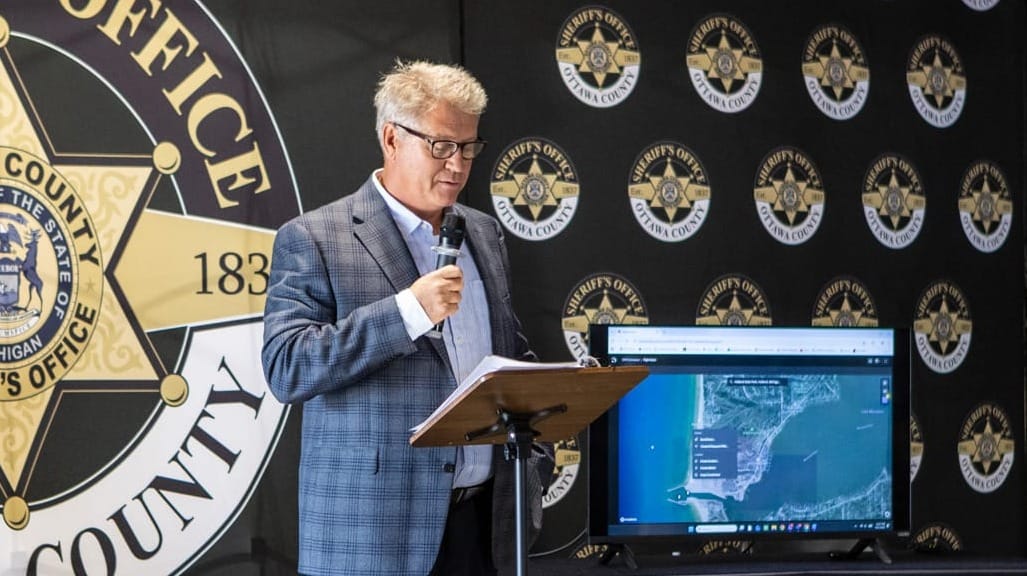
"Nine years later, we still ask ourselves these questions," Marcus told the crowd. "Could today's technology have directed the first responders to the scene more quickly, giving them a better chance to save our son?"
Sheriff DeBoer emphasized the severe reality facing local emergency teams every summer.
"Lake Michigan has taken too many lives to drowning over the past 10 years," DeBoer said. "Our marine unit alone has run hundreds of open-water rescue calls in that same stretch. Every one of those is a race against the clock, and in a few minutes, we're going to see what it looks like when we start winning that race."
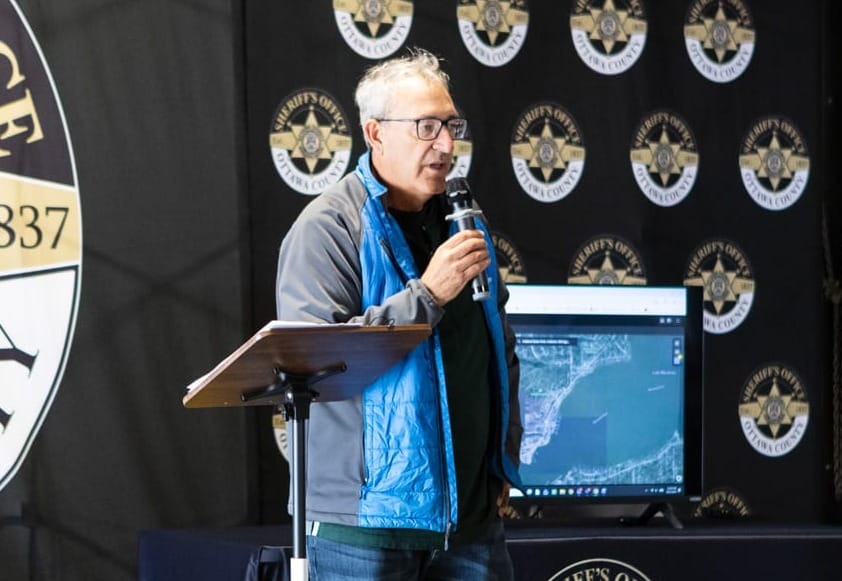
State Sen. Roger Victory (R-Hudsonville) underscored the need to pair emerging technology with public education, recalling his own experience searching for missing swimmers along the coast.
"I remember one time I was in Grand Haven and became part of one of those human chains walking down that beach looking for a lost victim," Victory said. "A lot of times you hear about a drowning ... it wasn't from our local community. They have not had the opportunity to understand the risk, the currents, the things near the piers in those areas, and that's a part of that basic core education that we've been working on."
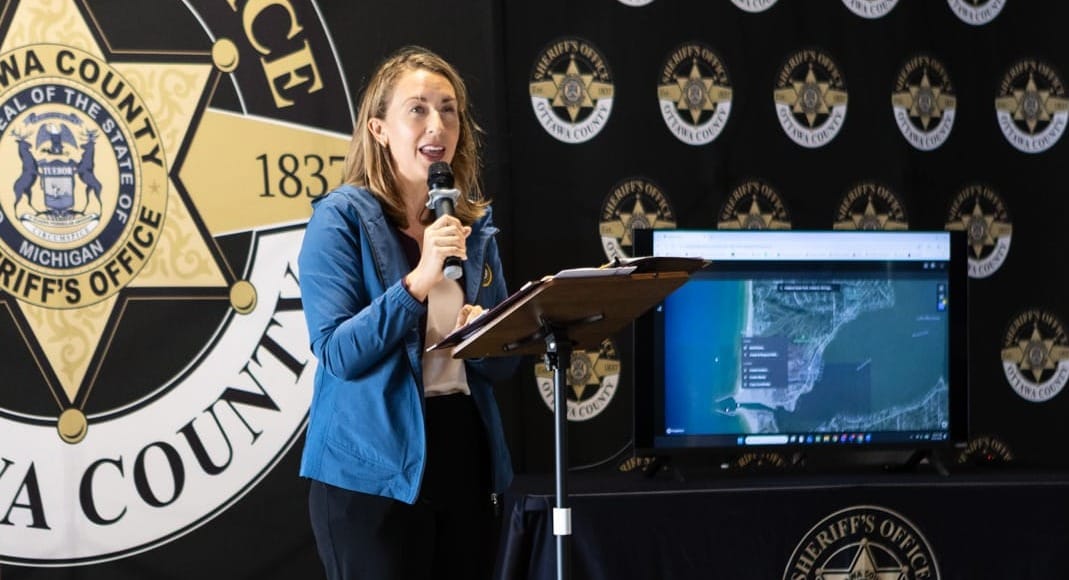
U.S. Rep. Hillary Scholten (D-Grand Rapids) reinforced the urgency, citing regional statistics: between 2016 and 2026, Lake Michigan saw 470 drownings, with Ottawa County handling 449 maritime rescues and 45 fatalities during that same span.
"Traditionally, a land-based emergency response can take more than 10 minutes," Scholten said. "The technology being evaluated here today could potentially reduce the time it takes to locate someone in an emergency to under two minutes."
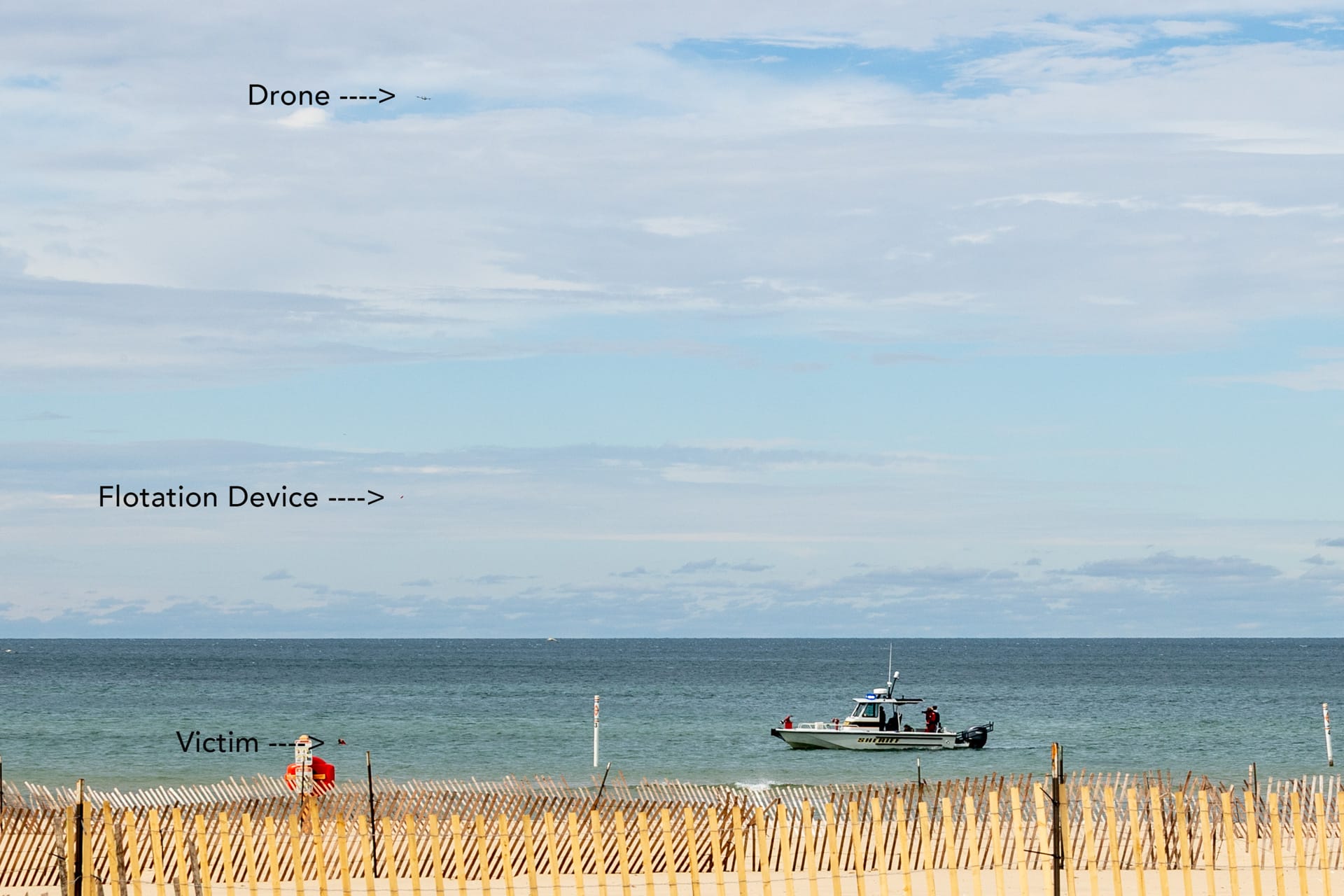
To demonstrate those capabilities, officials launched an automated "drone-in-a-box" sequence simulating an open-water rescue. Activated directly via Ottawa County Central Dispatch, an Axon quadcopter drone launched from its housing station near Big Bay to locate a simulated victim in the water.
Equipped with thermal imaging to detect body heat and high-definition optical cameras to eliminate surface water glare, the quadcopter dropped an automated, self-inflating flotation device directly on target before ground or dive units could even arrive in their vehicles.
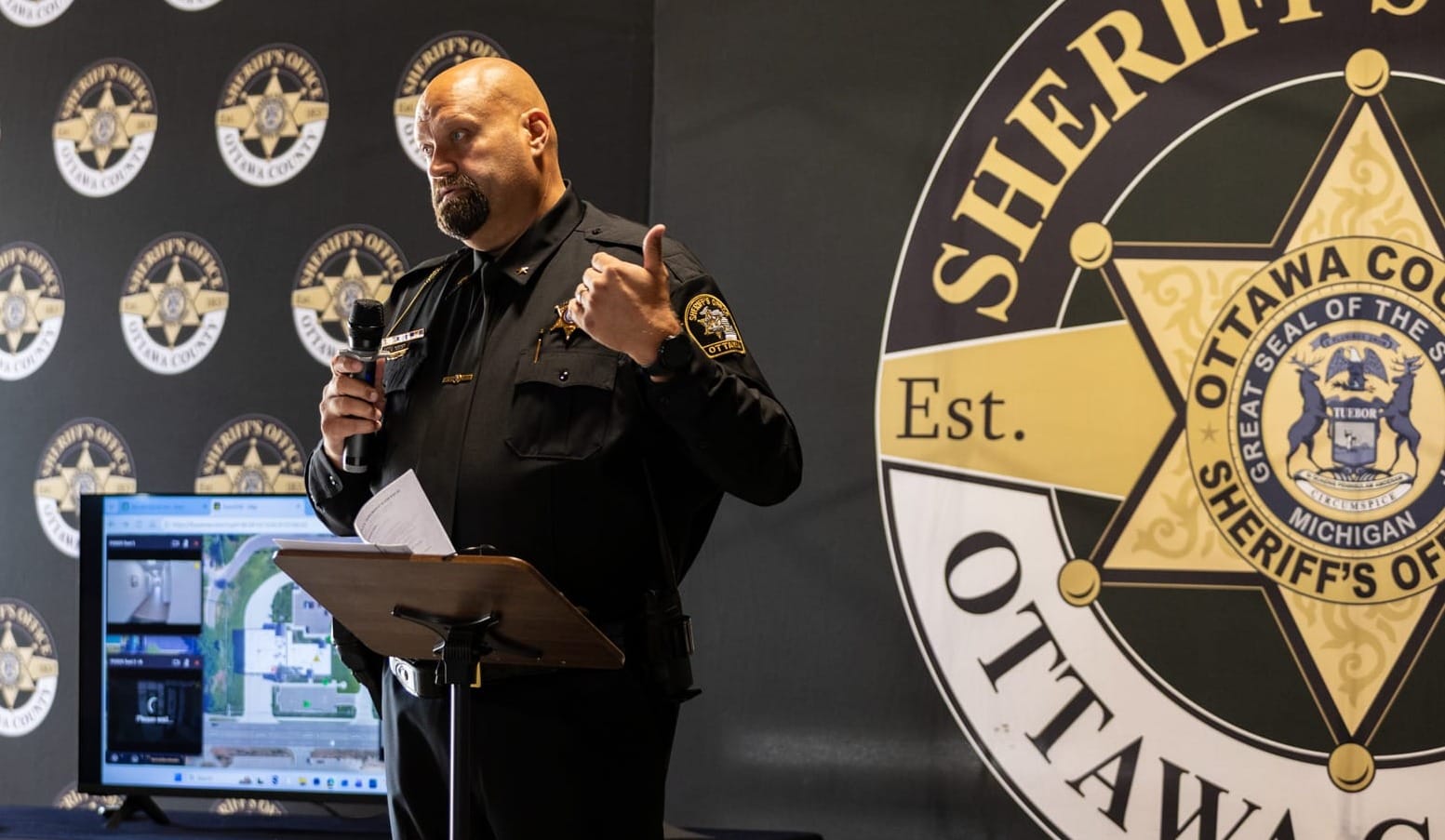
During a Q&A session following the demonstration, Sheriff DeBoer detailed the operational strategy and technical specifications driving the initiative, stressing that the system is built strictly for active calls.
"I think it's important to note on all of these incidents that this is incident-based technology," DeBoer explained. "This isn't something that's just out there doing something; it's based on a call into 911, at which time this technology can be activated."
Addressing questions about legal clearances and federal flight regulations, DeBoer clarified how the department intends to operate beyond conventional sight lines.
"Beyond visual line of sight is a waiver that we can get for a program like this," DeBoer noted. "Currently we operate under what they call a COA, a certificate of authorization that says that these are our standards, and the FAA grants us that license. We would have to modify our license to get this, and that's something that's being done all over the country."
The initial $300,000 annual budget will secure four specialized quadcopter drones deployed in dual-drone "hives" stationed near high-incident lakeshore areas like Holland State Park and Grand Haven State Park.

Although the quadcopters fly between 35 and 40 mph with a 30-minute flight time and a two-mile operational radius, future expansions envision long-range, fixed-wing models reaching 100 mph to cover inland regions like Grand Valley State University.
Beyond search-and-rescue, Project BEACON also integrates investigative tools like AUROR loss-prevention software to coordinate organized retail crime tracking across local businesses and neighboring county jurisdictions.
As public safety agencies across the country evaluate autonomous responder networks, Ottawa County positions Project BEACON as a scalable blueprint for regional cooperation — one designed to turn precious minutes into saved lives.
— Sarah Leach is the executive editor of the Ottawa News Network. Contact her at sleach@ottawanewsnetwork.org. Follow her on Twitter @ONNLeach.


