

Salting costs and plowing practices: Here’s how snow removal works in Ottawa County
This winter, the expected cost of road maintenance in Ottawa County is $2.95 million.

OTTAWA COUNTY — Maintaining snowy roads is a costly endeavor, with the Ottawa County Road Commission spending millions annually to keep residents and those passing through the area safe.
The OCRC maintains over 1,700 miles of county roads and bridges, and is contracted by the Michigan Department of Transportation to maintain the state’s highways in Ottawa County.
In addition to plowing and salting roads, the commission is exploring environmentally friendly and cost-effective methods of de-icing roadways.
This winter, the expected cost of road maintenance in Ottawa County is $2.95 million, according to Alex Doty, communications administrator for the OCRC.
The cost is dependent upon the amount of inclement weather events and duration of the winter months, which can push costs upward of $3.1 million.
“It all depends on the severity of the winter and how much time we have to spend plowing snow, and applying sand and other materials,” Doty said.
Doty noted that road maintenance materials have fluctuated in recent years, with salt being no exception. This year, a ton of salt is priced at roughly $66.10, with a set allocation of 20,000 tons of salt countywide.
The current cost is slightly higher than in recent years, with last winter’s approximate price being $63.28.
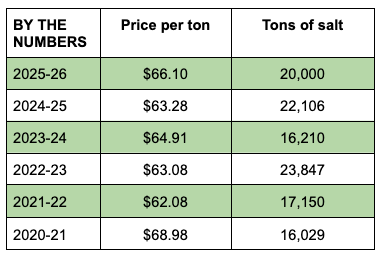
“The road commission is committed to purchasing at least 80% of allocated tonnage each year, and has guaranteed pricing for up to 130% of the salt at the contracted price,” said Doty.
Anything that is purchased beyond that allocation, the road commission could wind up paying extra in the event of a winter that necessitates large amounts of salt.
Winter road maintenance makes up about 6% of the OCRC’s estimated $50 million budget. The road commission’s primary source of funding is through the Michigan Transportation Fund, which accounts for the state’s fuel, vehicle registration and vehicle weight taxation. The funds are then distributed to road agencies, including the OCRC, cities, villages and the Michigan Department of Transportation.
Through their work, the commission aims to explore not just cost-effective methods of road maintenance, but processes that are both functional and environmentally friendly.
“The OCRC is always looking at ways to improve operations and do things more efficiently,” said Doty. “We're interested in approaches that balance environmental considerations, cost and roadway safety.”
There are a number of alternative de-icing materials used by road agencies nationwide, each with different performance characteristics, costs and environmental determinants.
“The OCRC has worked in recent years to calibrate salt spreaders on our trucks in order to maximize efficiency (of) salt usage,” Doty said. “We also utilize liquid additives that mix with road salt on our trucks, which can boost effectiveness by making salt work faster, stick better to the pavement and reduce bounce/waste.”
Please consider becoming a monthly donor!
Although there haven’t been any changes this winter to the commission’s road maintenance practices, Doty said the OCRC stays informed on industry research and emerging methods.
As to the day-to-day operations of the OCRC, Doty emphasized that road maintenance is a “24/7, weather-dependent effort focused on safety and mobility.” Winter maintenance is a large, complex operation that requires a dedicated team.
Tackling state trunklines and multi-line primary roads before subdivision streets and cul-de-sacs, the OCRC aims to prioritize higher-traffic routes first. The commission also highlighted the reason behind snow plows utilizing flashing green lights — to be more visible, as the green cone in the human eye is the most sensitive, and has the longest wavelength.
“Winter driving conditions are inevitable, and safe travel is a shared responsibility between road crews and motorists,” said Doty. “When crews must focus on high-traffic corridors first, it can take up to 48 hours to work through the entire system. We appreciate the public’s patience as crews progress safely and efficiently.”
— Contact ONN reporter Hailey Hentz at hhentz@ottawanewsnetwork.org.


