

Eviction-diversion program gets renewed funding from county to help residents stay in homes
An eviction-diversion program is getting new funding from Ottawa County as officials continue to work toward solutions that prevent homelessness.

OTTAWA COUNTY — An eviction-diversion program is getting new funding from Ottawa County as officials continue to work toward solutions that prevent homelessness.
Good Samaritan Ministries recently received approval from the Ottawa County Board of Commissioners to receive $300,000 over the next three years to continue the Ottawa County Eviction Prevention Program, or OCEPP, which works with tenants and landlords to offer repayment programming and supportive services that keep people in their homes.
The program initially began in summer 2020 to help keep residents in their rental-based homes during the COVID-19 pandemic, which disrupted many economic sectors and put individuals at risk of losing their homes.
Now, as those programs and funding expire, Good Samaritan said the aid is critical for people who are one emergency away from defaulting on their rent.
"It started through COVID-19 with (American Rescue Plan Act) dollars for the first term of funding ... but as we've kind of gotten through programming, we're still seeing the need," said Brenna Zawacki, director of Good Samaritan's Housing Services program.
Good Samaritan, which was founded in 1969, is committed to ending poverty and homelessness, in partnership with our community, by leading the way in providing affordable housing solutions and supportive services, according to the group's website.
Concerning statistics
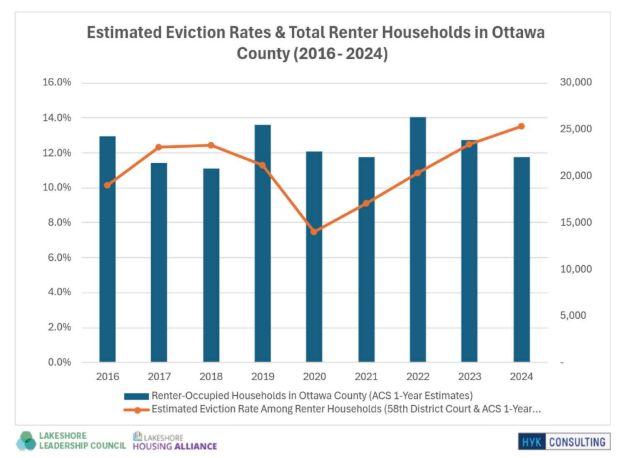
Eviction rates have been on the rise in Ottawa County since 2020, with the filing rate steadily increasing between 2022 and 2024 from 10.8% to 13.5% of all renter households, according to Good Samaritan.
It's estimated that more than one in 10 renter households receive eviction filings each year, or about 2,900-3,000 households.
Good Samaritan said the majority of reasons people fall behind in rent include medical bills (30%), a reduction in work hours (20%) and loss of employment (17%), according to the clients they served from October 2022 to December 2025.
In addition to rental assistance, participants also receive financial counseling and coaching.
Last year alone, Good Samaritan’s program helped keep 3,320 people from being evicted.
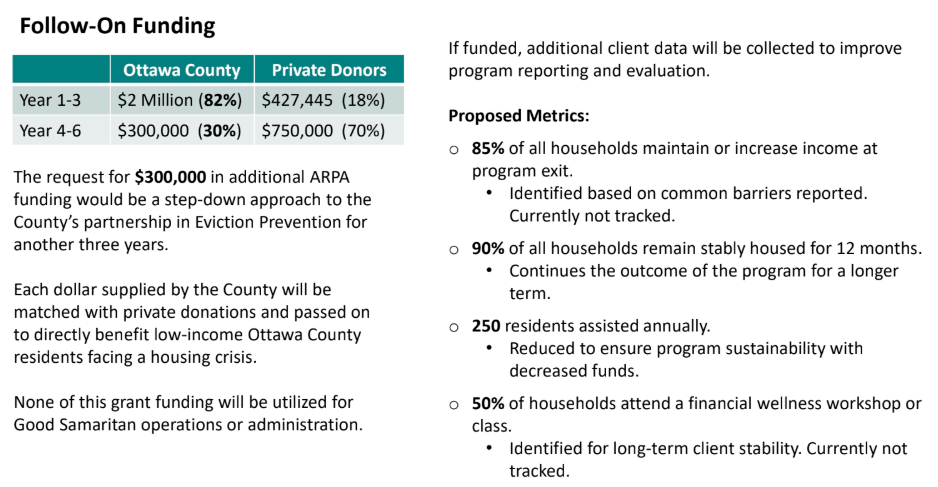
Between fall 2022 and December 2025, 85% of all households that Good Samaritan assisted maintained or increased their income after completing the program, with 90% of all households remaining stably housed for 12 months.
"We try to pace ourselves, because really, with the amount of need, we could go through that money extremely quickly," Zawacki said. "We don't want to add more people into the system. We've got plenty of people already experiencing homelessness."
What Good Samaritan is doing
Good Samaritan is among several agencies nationwide focused on ending homelessness to incorporate tools aimed at preventing homelessness. Similar models across the U.S. have a 95% success rate in avoiding evictions due to non-payment.
Zawacki said the residents who are served often are in a position where they experience an unexpected financial scenario, such as a car breaking down or an emergency medical bill.
"The paycheck-to-paycheck thing is the majority of what we see for those that we serve in this program; any kind of unexpected event that happens outside of what they normally are able to pay will get them behind, and they don't have that extra savings or family support to lean on to get them caught back up. So that plays a huge factor," she said.
Volatile economic factors, such as inflation and tariffs imposed by the Trump Administration, have forced costs up, making it harder for the residents Good Samaritan serves to make ends meet.
"Everything is obviously expensive right now," Zawacki said, "and then we're seeing cuts to [the Supplemental Nutrition Assistance Program] food assistance as well, so where they were getting assistance and resources from benefit programs, now they're having to come out of their own pocket for those things. So there's an adjustment, for sure, now that a lot of pandemic programs are winding down that people were on."
There is a particular need for seniors, Zawacki said, because they're "getting priced out of units they've been renting for a really long time."
"We see a lot of people on fixed incomes, so Social Security or Social Security disability, that just don't have any opportunity to increase their income," she said. "And so as rent increases, it's outpacing what they're making. So there are a lot of scenarios like that which are really unfortunate.
Wages also aren't keeping pace with increasing costs for households, Zawacki said.
"Rent prices are outpacing wage increases," she said. "Hours get cut and people get behind, or a medical event happens. You don't have paid vacation or something to take off for a surgery or a medical event — there's a lot of different circumstances.
"We see a lot of families that take out payday loans or ruin their credit in the process of doing that, and then it's just creating room for another crisis to happen."
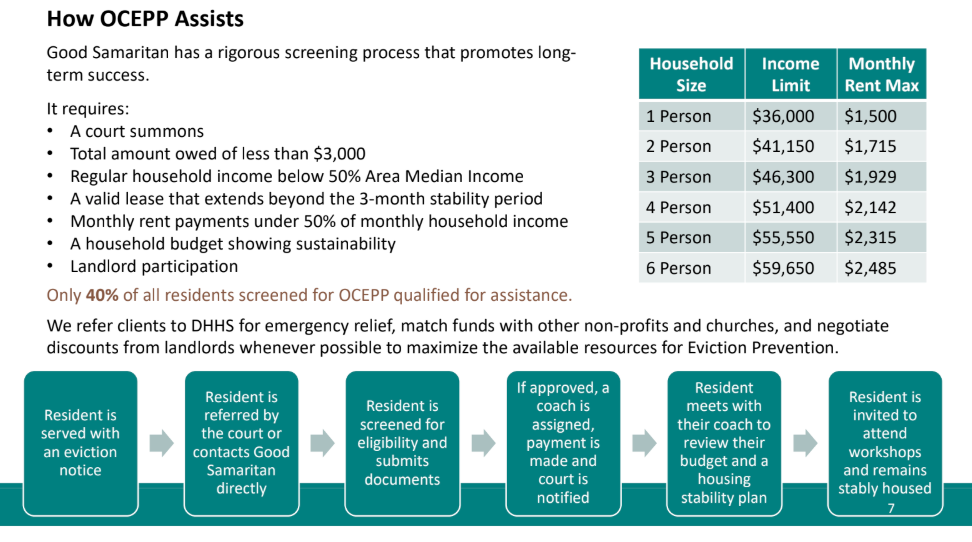
To qualify for eviction-prevention services, a person must:
- rent in Ottawa County, Michigan
- have a household income that is at or below 50% of our area’s average median income
- have received a notice to quit or a court-ordered summons
- have a written or verbal lease agreement in place
- not owe more than $3,000 to the property owner
Funding evolution
The county initially approved $2 million in ARPA grant dollars to Good Samaritan in August 2022, which was intended to be used for three years.
In November, the organization requested additional funding for the next three years — a total of $300,000 — as it works toward securing long-term funding from other sources.
"We put forward a proposal to the county for additional funds to continue on, so we're going to start with a set amount the first year, and then look to obtain something more sustainable through private donors and other sources of funding," Zawacki said. "But we just feel it's really important for the county to still be a part of that support."
"We were asking for $100,000 for the next three years — that's only 15% of what you contributed with ARPA dollars previously," Good Samaritan Executive Director Erin Kamhuis told commissioners at the Nov. 11 Finance and Administration meeting.
"These funds would be matched with private dollars. They'll be sent directly to Ottawa County landlords and they will stop an eviction process for both the landlord and the tenant," she said. "None of the dollars that you would contribute would be retained by Good Samaritan.
Kamphuis said Good Samaritan serves households that are at or below 50% or the area median income.
"In Ottawa County, that's about $50,000 or $24,000 if it's a single earner income," Kamphuis said. "The housing needs assessment says that 50% of renters in Ottawa County meet these wage guidelines and they're already facing a shortage of rental units available to them in that price point."

Kamphuis said programs like at Good Samaritan help alleviate the problem before it gets to crisis level.
"We believe prevention like this is key to preventing homelessness before it happens. Some of the reasons we believe this is because it decreases stress on both the families who are experiencing that eviction process and the system that's in place to help them once they fall into homelessness," Kamphuis said.
"It keeps people in an affordable rental unit. It avoids a court process. It keeps households working and their kids in school. It's cost-effective — only $1,400 per person. If you compare that to some of the costs that people face for emergency shelter — rapid rehousing — it is much higher, and we have a 99% success rate. That's something we're really proud of in keeping people stably housed, so, I'm hoping that you will consider joining us for another three years in this process."
The ask received pushback from some commissioners, primarily the far-right conservatives on the board.
"I applaud the effort. I'm just not sure it's worth continuing," Commissioner Joe Moss said.
Moss leads the far-right faction on the board known as Ottawa Impact.
"You're helping, but at the end of the day, is it really helping? Is it just delaying, postponing an issue that's going to happen no matter what for most of these folks?"
Zawacki said the feedback was helpful in better understanding what information the commissioners needed.
"Our executive director, Erin Kamphuis, has been spending a lot of time talking with each of them," Zawacki said. "She took everything that they said to heart and went back and found the information that they wanted. So they had a lot of questions. They wanted to see data."
When the issue came back before the board on Feb. 26, it was approved unanimously by all 11 commissioners, after several adjustments were made to the agreement, including structuring the funding to be $150,000 in the first year, $100,000 in the second year and $50,000 in the third year.
"Erin did a commendable job in attempting to respond to all the questions and concerns that were raised and we spent a lot of time working on a revised agreement that hopefully reflects some of the concerns that this body raised," County Administrator Patrick Waterman said at the Feb. 26 meeting.
Zawacki said the unanimous vote was the result of diligence and education.
"What we tried to emphasize is that this is a one-time thing. It's not just throwing money at the issue and hoping that it just resolves itself," Zawacki said. "There is a lot of background, one-on-one support that's happening, a lot of life skills work. We really do try to address the root causes of the issue. I think that's important to emphasize ... that this is not something where we're just seeing people cycling through our programs."
Commissioner Doug Zylstra celebrated the vote after the Feb. 26 meeting, saying the program is vital in assisting residents.
"Today, the board took a decisive step towards making our community a place where a financial emergency doesn't have to mean losing your home. By approving continued investment in Good Samaritan's Eviction Diversion Program, we are sending a clear message that we believe in catching people before they fall," Zylstra said on X. "Too many families are one unexpected crisis away from losing everything — and Good Samaritan is there in those moments, providing the kind of timely, compassionate support that can change the entire trajectory of a family's life."
Today, the Board took a decisive step towards making our community a place where a financial emergency doesn't have to mean losing your home. By approving continued investment in Good Samaritan's Eviction Diversion Program, we are sending a clear message that we believe in… pic.twitter.com/lEiexWOsHk
— Commissioner Zylstra (@OCCommZylstra) February 26, 2026
For more details about Good Samaritan’s OCEPP or to apply for assistance, head to the Eviction Prevention page or call our offices in Holland or Grand Haven at (616)392-7159.
— Sarah Leach is the executive editor of the Ottawa News Network. Contact her at sleach@ottawanewsnetwork.org. Follow her on Twitter @ONNLeach.


