

Federal judge dismisses lawsuit against MSU Extension from ex-county official, appeal filed
A federal judge has dismissed a lawsuit filed by a former Ottawa County commissioner who claims the Michigan State University Extension Office wrongfully terminated him over pressure leveraged by then county board chair and current state office seeker Joe Moss.

LANSING — A federal judge has dismissed a lawsuit filed by a former Ottawa County commissioner who claims the Michigan State University Extension Office wrongfully terminated him over pressure leveraged by then county board chair and current state office seeker Joe Moss.
Christian Kleinjans filed a federal lawsuit in June 2024 in the U.S. Western District Court, claiming MSUE violated his First Amendment rights.
Kleinjans alleged that Moss pressured MSUE in 2023 and 2024 to transfer or fire the nutrition instructor — who at the time worked in Ottawa County — or the school's contract would not be renewed.
The county paid out over $112,000 in December 2025 for Moss' role in Kleinjans' firing as current commissioners lobbed criticism at the former chair.
Read More: Ottawa County settles with Kleinjans for $112,500 after both sides agree to mediator's proposal
"Of all the cases that were filed against the county that we dealt with last year, the Kleinjans case ... I saw that case as an absolute abuse of power," Commissioner John Teeples said at the board's Jan. 27 meeting.
Teeples served as board chair through 2025 and has a background in law and mediation.
"There was no legal justification for Commissioner Moss and Commissioner [Allison] Miedema to go to Michigan State, except to interfere in some way with Kleinjans' employment, one way or the other. I would have definitely sued the county. I would have definitely sued Joe Moss, and I would have definitely sued Allison Miedema for that interference," Teeples said.
Teeples: Of all the cases that were filed against the county that we dealt with last year, the Kleinjans case was from day one, because I saw that case as an absolute abuse of power, there was no legal justification for Commissioner Moss and Commissioner Miedema ...
— Sarah Leach ☮️ (@ONNLeach) January 28, 2026
Moss announced this week that he is running for the Republican nomination for the 89th District in the Michigan House of Representatives. He will face Patrick Kapenga in the August primary.
A Democrat has not yet filed for that race; the filing deadline for candidates is April 21. (Click here for a current list of all candidates who have filed to date.)
How we got here
Moss is the founder and president of far-right political group Ottawa Impact, which ran a slate of candidates in 2022 motivated by frustrations with the county and state over COVID-19 mitigation measures in 2020 and 2021.
They went on to achieve a controlling majority of the county’s top governmental body and elected Moss as chair.
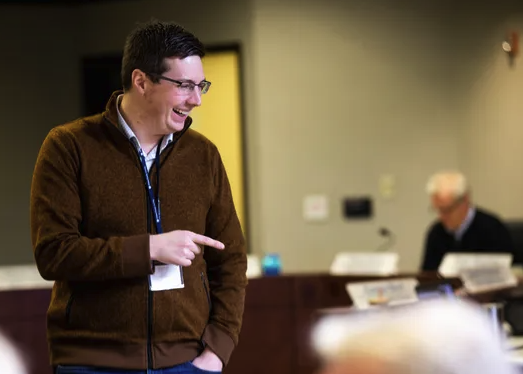
After taking office in January 2023, OI commissioners pushed through a series of controversial decisions, resulting in numerous lawsuits against the county. Those decisions included an unsuccessful attempt to fire the county health officer — who sued and later settled with the county — and cutting the public health department’s budget.
Read More: Judge orders Ottawa County to pay $188K for health officer's legal fees after yearlong lawsuit
After being seated, “they immediately began making … charitably speaking … aggressive decisions,” Kleinjans said during testimony for the lawsuit in August 2024. “It was a different interpretation of freedom than what we were operating under before.”
Kleinjans said Moss fixated on him in November 2023 after Ottawa Food — a collaboration of over 45 local agencies that provides access to healthy, local food — announced it was suspending operations after the board made deep cuts to the county’s public health department.
At the time, Kleinjans was a member of the Ottawa Food Advisory Board and was interviewed for a FOX-17 news article about the announcement.
Shortly after the interview aired, Ottawa County Democrats announced that Kleinjans would be their candidate in a special recall election targeting then-OI commissioner Lucy Ebel.

Moss then contacted MSUE officials, requesting that they prevent Kleinjans from continuing work in Ottawa County.
Moss told the officials that several of Kleinjans’ social media posts around December 2023 were “false and inflammatory” because they said, among other things, that “children in District 2 are going to go hungry bc (sic) Ottawa Food will be eliminated” and that “District 2 families that are struggling will lose access to dental care for their children.”
At the same time, the annual approval for MSUE’s contract with the county was removed from full board consideration, despite receiving unanimous approval from the county’s Finance and Administration committee just weeks previously.
The contract, often referred to as a “memorandum of understanding” or MOU, obligated the county to pay $272,572 to MSUE for fiscal year 2025 — fiscal years are Oct. 1-Sept. 30 — to provide office space, utilities, clerical support and funding for an MSUE educator, which covers a 4-H programming coordinator.
“Moss and Miedema decided to hold up the MOA indefinitely to leverage MSU[E] into moving Mr. Kleinjans out of its Ottawa County operations,” former Ottawa County administrator John Gibbs said in a deposition for the case.
As board chair in 2023-24 and overseeing a controlling majority of the board, Moss had the political power to prevent the contract from coming up for a vote.
“Moss and Miedema instructed me to advise MSU[E] that the MOA was being held up indefinitely.”
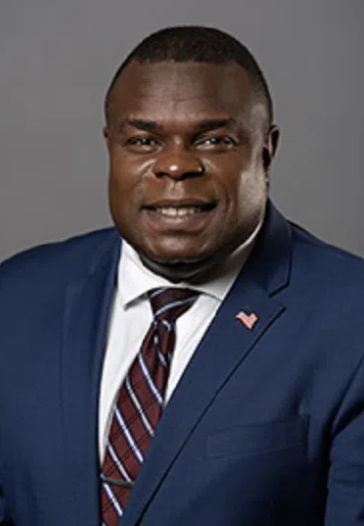
The perceived threat to the MOU led to a series of meetings and emails between MSUE leadership and Moss, where the university declined to change Kleinjans’ employment status.
Moss and Miedema “mentioned several possibilities that might be able to help the [MOA approval] process along,” such as transferring Kleinjans to another
county, former MSUE District 7 director Scott Korpak testified as part of the litigation.
The commissioners also “mentioned that the space that MSU[E] had was a desirable space and that they had another department or other departments that were growing,” which Korpak said he interpreted as a threat to take away MSUE’s free county office space.
“Our Extension leadership and university counsel reviewed your request to have us relocate Christian, and have determined that we are unable to implement requests that would violate an employee's rights to participate in political activities outside of their workdays and hours,” James Kelly, district director for MSUE, wrote in an email to Moss on Jan. 5, 2024.

Emails show that this reporter, who was then employed at The Holland Sentinel, requested comment on the delayed approval of the MSU Extension’s contract with the county.
That prompted Kelly to urge Moss to approve the contract so the dispute wouldn’t be made public.
“Hi Joe. It seems the issue of our delayed contract becoming a more public issue is on the verge of breaking out. We had a request from the Holland Sentinel to provide some insight as to why our contract was being delayed. They referenced in their email both the connection with Ottawa Food and the connection to Christian's candidacy as the potential reason for the delay,” Kelly wrote to Moss on Jan. 8. “I would love to be able to respond to that request saying that the contract is due to be on the upcoming agenda and that we do not anticipate any issues at this point.
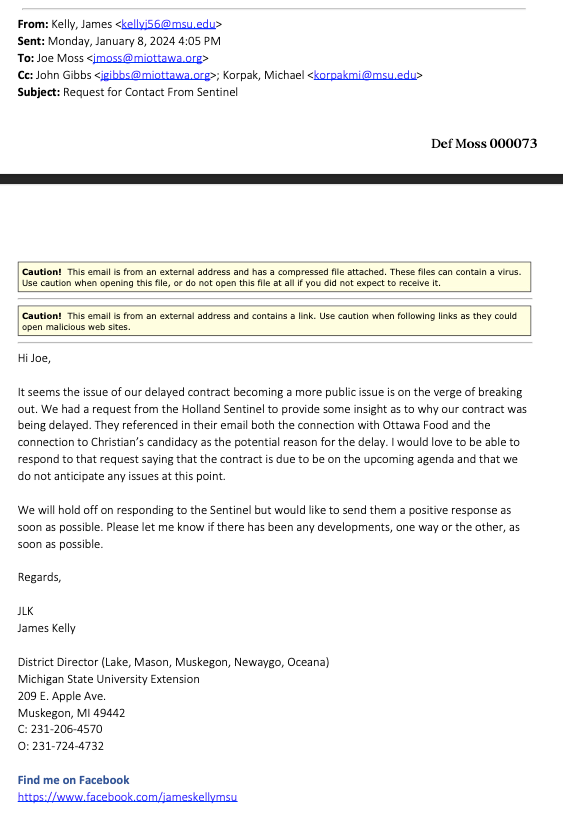
“We will hold off on responding to The Sentinel, but would like to send them a positive response as soon as possible. Please let me know if there has been any developments, one way or the other, as soon as possible.”
The MOU was then put on the board's next meeting agenda and approved Jan. 24, 2024.
Kleinjans went on to win the special election to unseat Ebel on May 7, 2024.

Just 16 days later, MSUE told Kleinjans he could no longer work there and serve as a county commissioner, citing a conflict outlined in Michigan’s Incompatible Offices Act. They told him he could take a leave of absence until the November 2024 election — Kleinjans filed in April for re-election on the chance that he would be successful in the special May recall contest — and resign if he won.
Kleinjans refused; MSUE then fired him in early June. Kleinjans then unsuccessfully filed a grievance with the school.
Kleinjans lost his bid for re-election in November 2024 to Republican Jordan Jorritsma by just 237 votes.
A lengthy lawsuit
Federal Judge Hala Y. Jarbou ruled in August 2024 that Kleinjans was not entitled to a preliminary injunction that requested that he be immediately restored to his MSUE position and awarded back pay.
However, Jarbou said it is “undisputed that the OI majority sought political retribution against Kleinjans” because of his comments about OI and involvement in the recall effort of Ebel.
Shortly after Jarbou’s ruling, Kleinjans amended the lawsuit to add Moss as an individual defendant for his alleged role.
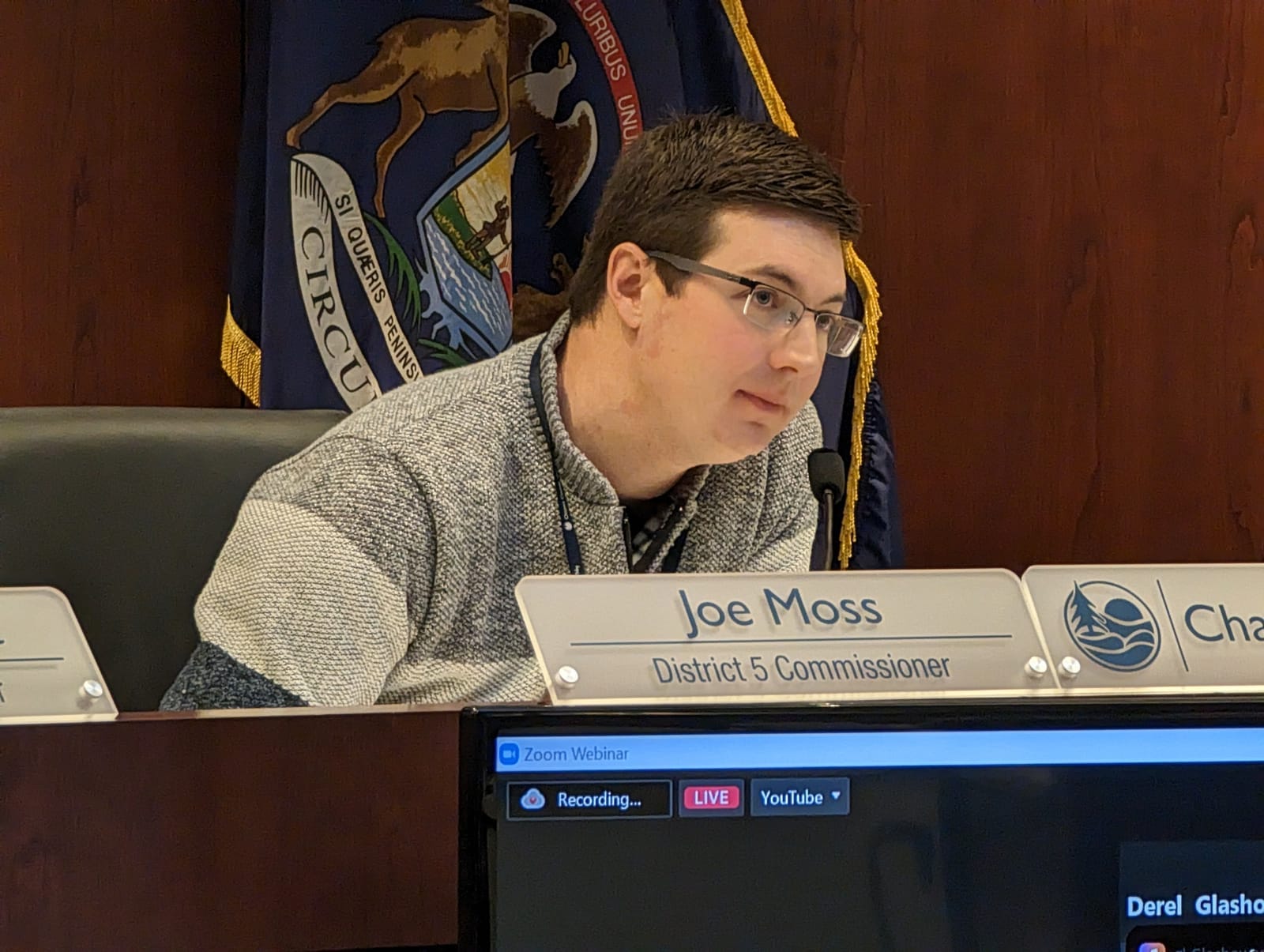
Meanwhile, the board of commissioners saw a new moderate Republican majority assume power in January 2025, and OI went from six seats on the 11-member board to a four-seat minority.
In December 2025, the board voted to pay Kleinjans $112,000 to settle his claim against Moss, marking the seventh and final litigation stemming from the tumultuous two-year tenure of OI's control of the board.
The claim against MSUE, however, remained active, and ttempts at mediation late last year were unsuccessful.
In an opinion issued March 16, Chief Judge Hala Y. Jarbou of the U.S. District Court for the Western District of Michigan's Southern Division said the university established that it would have terminated Kleinjans regardless of his protected activity, and no reasonable jury could find otherwise based on the record before the Court.
"Defendants do not dispute that Kleinjans’ political activity was protected by the First Amendment and that terminating him was an adverse action. Instead, they argue that he fails to establish a causal connection between his protected activity and his termination," Jarbou wrote in her opinion.
"Kleinjans contends that his public advocacy, his campaign, and (most of all) his election victory caused Defendants to terminate him because they were concerned that Moss would retaliate against MSUE for Kleinjans’ political positions. Defendants argue that they instead terminated Kleinjans due to legitimate concerns about his ability to occupy both a Board seat and his MSUE position," she wrote.
Kleinjans' attorney, Sarah Riley-Howard, confirmed Friday, March 27, that she filed an appeal challenging Jarbou's ruling to the Sixth Circuit of the U.S. Court of Appeals.
"We were grateful that the opinion recognized the substantial evidence that 'Moss attempted to exert pressure on' Michigan State University Extension officials to retaliate against Chris because of his exercise of important First Amendment rights to free speech and political activity, and that he only caved in when you were asking questions about his motives in reporting on your news story," Howard told ONN on Friday.
"But we disagree with the opinion’s conclusion that the evidence only supports the inference that Defendants had a motive to retaliate, not that they actually did so. Having lived through the Ottawa Impact majority period, we are well aware that MSU Extension had very real reasons to worry about Moss’ continuing disfavor and future non-transparent attempts to retaliate against those with whom he disagreed," she said.
"We think a jury at least should have weighed in on this, so we have decided to take this important constitutional issue to the appeals court."
What happens next?
A key question is whether the statements Moss made to MSUE officials affected the university’s decision to fire Kleinjans when it did.
MSUE claims that because the school refused Moss’ requests and fired Kleinjans months after the county re-approved the MOU, the commissioner’s actions didn’t dictate the employment decision.
The school said the decision to fire Kleinjans “was premised entirely on concerns relating to potential conflicts of interest” and compliance with the Incompatible Public Offices Act, which regulates how many and what type of roles public officers or employees may hold.
Kleinjans and Howard point to deposition testimony indicating that MSUE actually made the decision in December 2023 that if Kleinjans were elected, he would be fired.
Audio recordings Kleinjans made with MSUE leadership leading up to his termination indicate that school officials had long-term concerns even if the MOU were to be approved.
Read More: Was Ottawa County's newest commissioner punished for running?
In a November virtual meeting with Kleinjans, assistant director of MSU Health and Nutrition Institute Erin Moore characterized the political climate in Ottawa County as “dire” regardless of whether Kleinjans pursued the elected office.
“If this were any other county, any other part of the state, where it was just a little less contentious, we wouldn't be talking about us being defunded because of your interaction with politics,” she tells Kleinjans on the recording. “But that is our reality right now … is that there is a vengeance-type of relationship that this board has with the only power that they have with this money, and that is to defund those that are ‘against them.’”

On Dec. 7, 2023, Kelly summarized notes for other MSUE leaders via email, saying: “It is likely that the majority of commissioners would follow the lead of Joe Moss and only support the MSU Extension MOA if Christian is removed from Ottawa County. … They claim he is damaging the community, that he has proven himself to be a liability, and until MSU can show they can be trusted to handle his indiscretions appropriately, they will not have the support of the board.”
During an April 1, 2025, deposition, Moss confirmed that he sent an email to former interim administrator Jon Anderson shortly after Kleinjans was elected to the board of commissioners that he had been assured by MSUE back in December 2023 that if Kleinjans were to be elected, the university would fire him.
“Commissioner Miedema and I were told by the directors of MSU Extension, who had conferred with their corporate counsel, that it was forbidden for an elected commissioner in Ottawa County to also be employed by MSU Extension and that they would have to separate if Christian was elected,” the email read.

Moss said MSUE leadership and its attorneys occurred in December 2023 or January 2024 — just before the MOU was re-approved by the county.
Howard told ONN on Friday that MSUE officials testified that the decision to fire Kleinjans was based on advice from the university's lawyers, but that Jarbou later allowed the school to drop that defense. That decision prevented Howard and Kleinjans from taking testimony and evidence — through the legal discovery process — to further examine internal communications on how the decision was made.
Howard also noted the MSUE had never previously prematurely fired an employee for violating the Incompatible Offices Act. She said her client had the right to the opportunity to serve in both roles and that the act should have been enforced only if and when an issue arose.

To succeed in a court appeal, a party involved in the litigation must prove that the lower court committed a significant reversible error of law or abuse of discretion. The appellate court does not retry the case or reconsider witness credibility; it only reviews the record to determine if legal mistakes were made.
The next step after the appeal filing will be a brief from Howard on the merits of how Jarbou erred in her ruling. Then, MSUE will have the opportunity to respond.
If oral arguments are scheduled based on the briefs, they would take place in Cincinnati, Ohio, before a three-judge panel.
That process typically takes 7-12 months to complete, Howard said.
— Sarah Leach is the executive editor of the Ottawa News Network. Contact her at sleach@ottawanewsnetwork.org. Follow her on Twitter @ONNLeach.


