

Reports: Lakeshore Advantage notes multi-year momentum as regional industrial growth cools
West Michigan’s economy continues to show positive momentum, though recent data indicates that regional industrial growth may be beginning to cool.
OTTAWA COUNTY — West Michigan’s economy continues to show positive momentum, though recent data indicates that regional industrial growth may be beginning to cool.
According to the latest monthly survey released by Grand Valley State University, the region’s industrial market posted another month of positive growth in October, but several key indicators are starting to soften.
Brian Long, director of supply management research at GVSU’s Seidman College of Business, reported that while primary metrics remain in positive territory, purchasing managers across the region are signaling a slight deceleration.
“Much as we had hoped, our October survey of the industrial market in West Michigan remained positive, although some of our statistics weakened,” Long said, noting that both business and consumer confidence have eased.
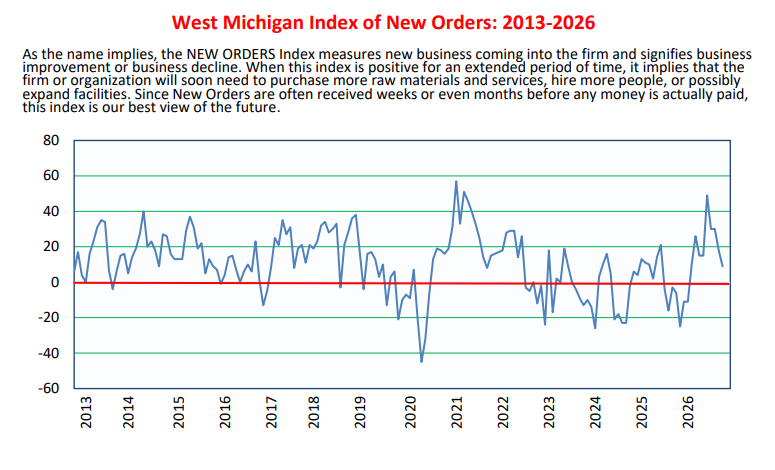
Two key metrics tracked by GVSU — new orders and production — slipped in October:
- New Orders Index (measures whether customer demand and new order volumes for goods and services are increasing or decreasing compared to the previous month): Dropped to +9, down from +18 in September.
- Production Index (measures the real, price-adjusted production output of manufacturing, mining, electric and gas utilities): Slipped to +13, down from +18 in September.
- Employment Index (measures the change in the total cost of labor for businesses over time): Held steady at +6, matching September.
- Lead Times Index (tracks whether the speed of vendor and supplier deliveries is accelerating or decelerating compared to the previous month): Increased to +47, up from +30 in September.
Long pointed to persistent fuel costs as a major pressure point for local manufacturers and consumers.
“Of course, the rising cost of gasoline affects the industrial market, but it's really the cost of diesel that affects the cost structure of most industrial firms,” Long said. “As the old saying goes, ‘If you bought it, a truck brought it,’ and three-fourths of Michigan's freight comes by truck. It’s going to take several months before petroleum prices really come back down.”
Long added that recent Midterm Election results could play a critical role in shaping trade relations, particularly with Canada.
“Elections do have an impact on the industrial market, and what I'm hoping for is a softening of trade relations with Canada,” Long said. “Because of automotive, Michigan has probably been hit the hardest of all the states, largely because of the large amount of cross-border trading that has evolved starting with the North American Free Trade Agreement over 20 years ago.”
Lakeshore Advantage highlights strong multi-year growth
Despite short-term cooling in industrial metrics, the broader multi-year outlook for Ottawa and Allegan counties remains robust, according to the 2026 Business Insights Report released by Lakeshore Advantage.
The economic development organization’s report is based on a strategic sampling of 140 business executives representing approximately 700 primary employers — companies that export goods and services outside the region. Half of the surveyed companies employ fewer than 50 full-time workers.
Lakeshore Advantage noted that the findings offer "a snapshot of what we heard, highlighting regional employers' outlook and guiding action to support growth, innovation, and opportunity across Allegan and Ottawa counties."
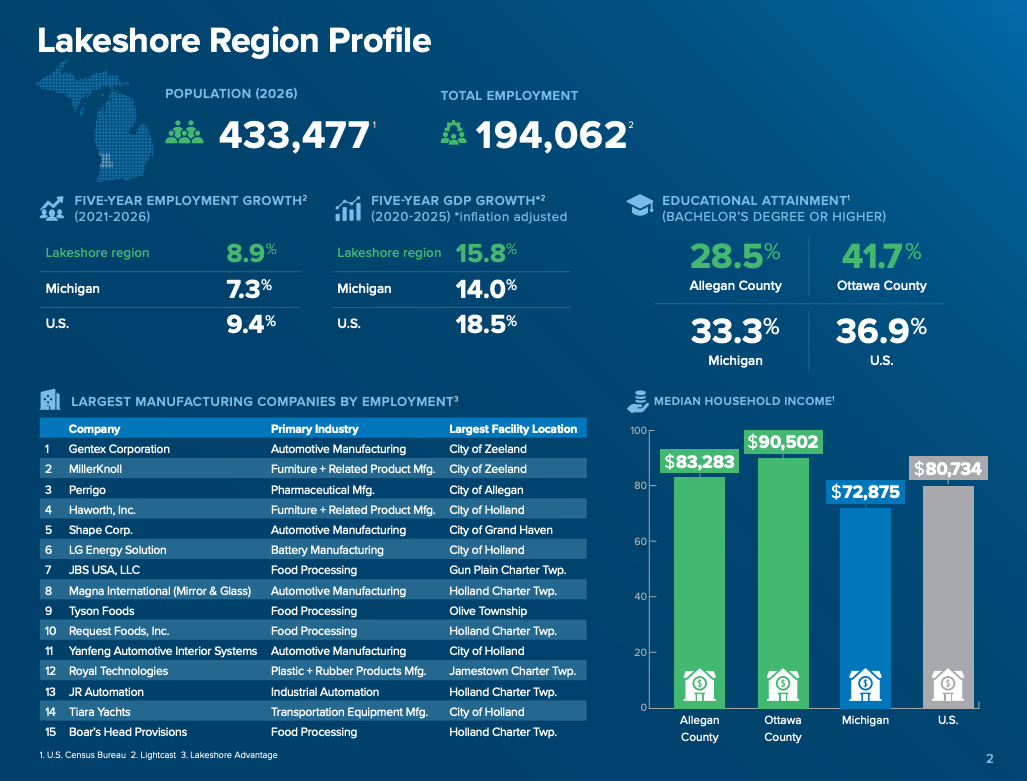
Between 2021 and 2026, the Lakeshore region achieved an 8.9% increase in employment growth, outpacing statewide growth of 7.3% in Michigan and nearing the national rate of 9.4%. Total employment across the two counties reached 194,062 within a total population of 433,477.
"Businesses tell us again and again that this is a great place to operate and grow," said Mandy Cooper, interim president and senior vice president of strategic growth at Lakeshore Advantage. "They value the workforce, the business community and the support they find here. Maintaining that momentum means investing now in the talent and infrastructure companies will need to grow here in the future."
Sales, market share rebound
Lakeshore Advantage highlighted Ottawa and Allegan counties as high-momentum areas, driven by geographic and industry diversification as well as workforce quality.
"Our top strengths were our business community support — companies value relationships with each other, local units of government and local supply chains," said Grace Maiullo, director of marketing and communications at Lakeshore Advantage. "The next top strength was the workforce and talent that is here."
Recent financial metrics show solid stability across the Lakeshore:
- Sales growth: 56.8% of companies reported increasing sales, and 37.4% reported stable sales. The share of businesses reporting declining sales fell sharply from 15.4% last year to 5.8%.
- Market share: 49.6% of companies reported an increase in market share, up from 46% last year.
- Expansion plans: After declining to 32.8% in 2025, 35.5% of companies now report plans to expand over the next three years.
Additionally, local businesses are ramping up investments in research and development (R&D). Top spending sectors include professional and technical services, electrical equipment manufacturing, beverage manufacturing, machinery manufacturing, and furniture manufacturing.
"We are seeing more spending on R&D, which could be due to more readiness to invest in diversifying the market," Maiullo said.
Emerging growth drivers, industry constraints
While regional growth is supported by several core sectors, each faces distinct operational constraints:
- Smart manufacturing: Generates $4.4 billion in annual gross regional product (GRP) and supports over 27,000 regional jobs. Key constraints include specialized talent shortages, market pressure, and site availability.
- Food production and agribusiness: Generates $1 billion in annual GRP and accounts for 4,500 regional jobs. Key constraints include market demand, competition, and workforce availability.
- Advanced energy storage: Generates $331 million in annual GRP and accounts for 1,700 regional jobs. Key constraints include workforce availability, labor costs, housing affordability, and market pressure.

Barriers, long-term outlook
Both the GVSU survey and the Lakeshore Advantage report emphasize that sustained expansion will require addressing structural headwinds.
Workforce availability remained the single most cited barrier to growth in 2025 and 2026, appearing in roughly 50% of responses in the Lakeshore survey. Outside competition, shifting customer demand, and international trade vulnerabilities — including tariffs, currency fluctuations, and global supply disruptions — also pose challenges.
Furthermore, while 69.8% of Lakeshore companies launched new products or capabilities over the past three years (down from 75.6% in 2025), only 23.1% plan to diversify into additional industries, reflecting a more cautious approach to market expansion.
As West Michigan navigates a combination of cooling short-term industrial indicators and strong long-term fundamentals, economic leaders stress the need to address core infrastructure needs — including housing availability, industrial site capacity, water access, and energy grid resilience — to maintain regional competitiveness.
— Mallory Burt is a reporter for Ottawa News Network. Contact her at newsroom@ottawanewsnetwork.org. Sarah Leach is the executive editor of the Ottawa News Network. Contact her at sleach@ottawanewsnetwork.org. Follow her on Twitter @ONNLeach.


