


The 'Wright' stuff: 155-acre farm becomes 10th ag property to be protected from development
On Oct. 27, 2026, Ottawa County officially closed on a permanent conservation easement for the acreage through its Purchase of Development Rights Program.

WRIGHT TWP. — For Wayne Molyneux, the greatest appeal of working the land has always been the independence.
"You don't have anyone telling you what to do, and when. You get to make your own hours ... well, the crops do that," Molyneux mused. "You got to get to it whenever it works for them."
Like so many Ottawa County growers of his generation, Molyneux was born into the lifestyle. Raised on a nearby property, his family managed dairy cows, steers, pigs and field crops. "I farmed all my life with my dad," he recalled.
In 1986, Molyneux struck out on his own, acquiring two parcels in Wright Township from the Stroven family. Over the next four decades, he saw the industry evolve while raising livestock, managing cash crops and raising a family on the land.
Now, 40 years into his career, Molyneux is taking a definitive step to safeguard the property's future. On Oct. 27, 2026, Ottawa County officially closed on a permanent conservation easement for the acreage through its Purchase of Development Rights Program.
"You look out around the County and see development all over," Molyneux said. "I didn't want that here."
Preserving prime agricultural land
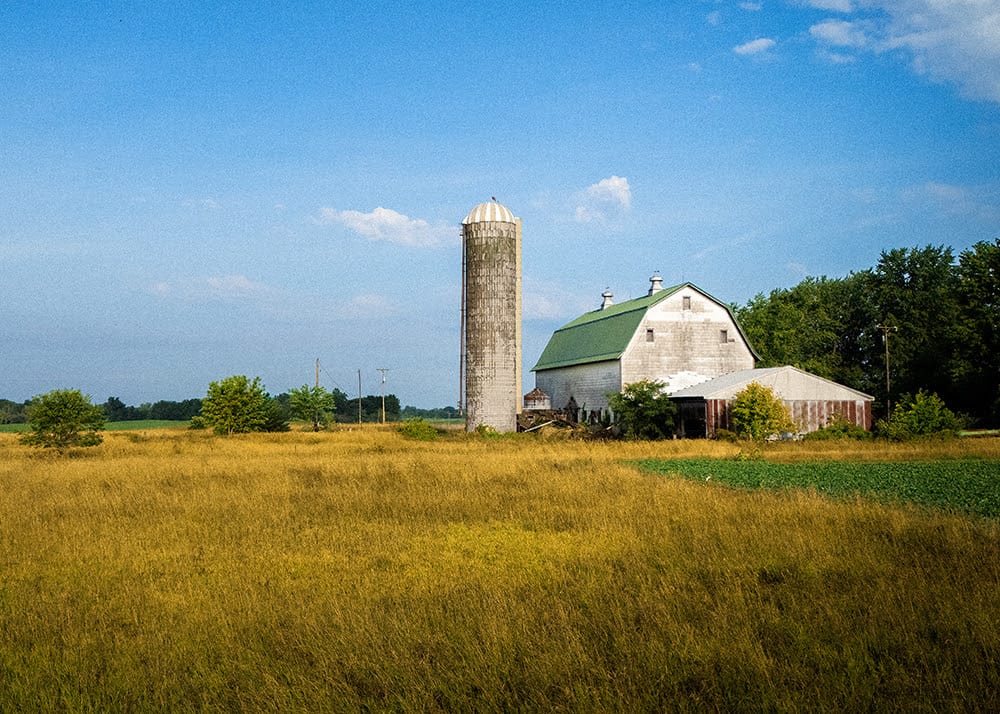
The Molyneux property marks a major milestone for Ottawa County's Farmland Preservation Program: It is the 10th farm protected under the initiative and, at roughly 155 acres across two parcels, the largest to date.
The property earned high priority for preservation due to its soil quality. The Natural Resources Conservation Service classifies 100% of the farm's soil as "prime," meaning it possesses optimal physical and chemical characteristics for agricultural production.
Funding for the acquisition was secured through matching grants from the federal Agricultural Conservation Easement Program and the state-level Michigan Agricultural Preservation Fund.
"The PDR program is completely funded through private donations, grants, and landowner contributions," said Farmland Preservation Analyst Julie Lamer. "These types of grants ensure family farms like the Molyneuxs can be protected."
Decades of adaptation, local history
When Molyneux and his brother first acquired the property in the mid-1980s, they maintained the previous owners' model — raising a small herd of cattle alongside corn and hay. Over time, they diversified into livestock and alternative crops.
"I was probably one of the first around to plant barley. I used to use that to feed pigs, instead of corn," Molyneux said.
Today, the Molyneux brothers focus primarily on crop rotation, alternating between corn and soybeans harvested and sold to Zeeland Farm Services. Molyneux also leases approximately 38 acres to a neighboring farmer.
Beyond its agricultural output, the farm carries historical significance. Designated as a Michigan Centennial Farm, the property and several of its original structures — including Molyneux's residence — date back to the 1870s.
In the late 2000s, the farm briefly served as a Hollywood filming location. Crews used the historic home and surrounding acreage to shoot scenes for the time-travel sports film "Touchback," starring Kurt Russell and Brian Presley.

Securing the next generation
For Molyneux, the decision to enter the PDR program ensures that the land's agricultural legacy will remain intact regardless of future ownership changes. He plans to pass the property to his son, Joshua Molyneux of Sparta, with the hope that his grandchildren will eventually take over operations.
By placing the land under a permanent conservation easement, the property can never be subdivided or converted for commercial residential development.
"If the grandkids end up with it years from now and they don't farm, they can't try to plot it all off," Molyneux said.
Learn more
- Documentary feature: Wayne Molyneux and other local producers are featured in "Protecting Paradise," a new short documentary exploring local preservation efforts. Produced by DSI and county videographer Scott Vandenberg, the video is available on Ottawa County's official YouTube channel.
- County agriculture impact: According to the 2022 USDA Census of Agriculture, Ottawa County farmers generate more than $726 million in agricultural products annually.
- Farmland preservation program: To read more about local conservation easements, advocacy and agricultural economic development, visit miottawa.org/farmland.
— Submitted by Ottawa County. To submit a news tip, email newsroom@ottawanewsnetwork.org.


