

Neighborhood group preparing to file federal lawsuit against Park Twp. over short-term rental issue
A high-stakes constitutional showdown is brewing in an Ottawa County vacation haven as property owners prepare to take their fight over short-term rentals to federal court, alleging a decades-long "bait-and-switch" by local government officials.

PARK TWP. — A high-stakes constitutional showdown is brewing in an Ottawa County vacation haven as property owners prepare to take their fight over short-term rentals to federal court, alleging a decades-long "bait-and-switch" by local government officials.
The Park Township Neighbors, a nonprofit coalition representing affected homeowners, is finalizing a federal lawsuit charging that the township’s sudden enforcement of a 50-year-old zoning ordinance violates the Due Process clauses of the U.S. and Michigan Constitutions.
The legal escalation marks a breaking point in the small Park Township community where residents say they were given the OK to invest on their rentals based on explicit, written assurances from township staff—only to have the "legal goalposts" moved overnight.
“If residents and property owners cannot rely on official emails, letters, statements and sworn depositions from township officials, then what can be trusted?” said Jeremy Allen, president of Park Township Neighbors. “We are filing this federal lawsuit to say that they're violating our constitutional right to due process.”
A paper trail of permission
The core of the federal challenge rests on a prolific trail of internal communications and official correspondence spanning nearly 25 years. According to documents obtained by PTN through Freedom of Information Act requests, township officials consistently confirmed the legality of short-term rentals to anyone who asked.
In July 2014, former Zoning Administrator Ed de Vries told a resident in writing: “We do not license, regulate, or inspect rental housing.”
Two years later, in 2016, de Vries reiterated that the township "does not address rental properties" and saw no violation in short-term leasing.
Even as recently as May 2020, when a resident asked if a permit was required for a vacation rental, Zoning Administrator Emma Posillico replied: “Park Township does not require a permit for a short-term vacation rental.”
“We’ve got examples of just a complete s-show over there,” Allen said during a recent community meeting, reflecting on the contradictory guidance. “For 50 years, the township has not only allowed this, but their employees have regularly opined that the zoning ordinance did not prohibit it.”
The township’s pivot arrived in the form of a 2024 ordinance amendment that explicitly banned rentals of fewer than 29 days in residential zones. This followed a ruling by Ottawa County Circuit Court Judge Jon Hulsing, who determined that a 1974 ordinance had technically banned STRs all along by omitting them from approved uses. Hulsing dismissed decades of contrary advice from township staff as the result of “ignorance, indifference or incompetence.”
'Moving the goalposts'
For homeowners like Allen, the township's legal victory feels like a betrayal of the community's social contract. Allen recalls pulling a permit for a $100,000 renovation in 2015, during which a township employee congratulated him on his new vacation rental.
“She said, ‘Oh, that's so great. My parents live on that street... it'll be so great to have a place where my kids can go stay with their grandparents,’” Allen recalled. “They gave us permits to do a downstairs remodel knowing exactly what it was for.”
The township has justified the crackdown as a necessary move to protect neighborhood character from a "huge issue." However, PTN’s analysis of township data paints a different picture. According to FOIA records, there were only 14 complaints regarding STRs between 2019 and 2021—a period of record-high travel.
Furthermore, 2023 census data shows that STRs account for less than 1.5% of the township's 8,270 housing units. In contrast, vacant second homes owned by affluent out-of-towners account for more than 10%.
“It’s not as though it’s this explosive five out of every 10 houses ... we’re talking about one out of 100,” Allen said.
Township says it’s protecting residents
For Park Township Manager Bill Cousins, the tension surrounding short-term rentals in this coastal community isn’t a matter of being "anti-tourist." It is, he says, a matter of preserving the "residential community" that 19,000 residents call home.
As the township moves to enforce an ordinance updated in 2022, he recognizes that the rift has widened between local officials and the Park Township Neighbors. Cousins, however, describes the move not as a "bait and switch," but as a necessary response to a changing culture of vacationing that has pushed residential neighborhoods to a breaking point.
"It wasn't that (suddenly) everything changed,” said Cousins in an interview with the Ottawa News Network. "It’s been brewing for a couple of years and the number of complaints were starting to grow more and more."
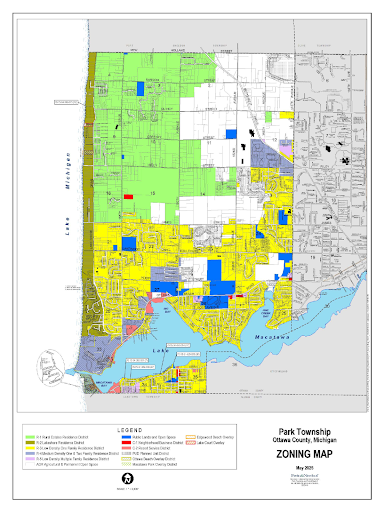
At the center of the dispute is where these rentals—defined as stays shorter than 28 days—can legally operate. Under current zoning, short-term rentals are restricted to the C-2 Resort Service District, a zone primarily located along the north and south sides of Lake Macatawa.
"We’re glad to have them there," Cousins said of the rentals in the C-2 district. "We enjoy having those folks come and stay and spend a day or a week or a month on the lake and enjoy what we have to offer."
The problem, according to Cousins, arises when those operations bleed into R-1 and R-2 residential districts. He paints a picture of narrow lots with 60 feet of frontage and modest driveways, suddenly overwhelmed by a "party" atmosphere.
"The reason that this even became a problem is people who are renting those homes would come and bring their neighbors and friends and cars and children," Cousins said. "Now we’ve got six or eight wave runners sitting in the front yard, cars all over the place... they’re out at 1 a.m. and 2 a.m. at the fire pit and grilling and making noise. In those neighborhoods, that just gets old."
Cousins emphasized that the township has no issue with traditional month-long rentals, which remain "totally allowed" in all residential districts. The friction point remains the "two and three-day renters" who, he argues, lack a vested interest in the quiet enjoyment of the neighborhood.
"I know where I can go to borrow that cup of milk or sugar," Cousins said, describing the ideal residential scenario. "But now... the houses on both sides are being rented every weekend by different people who come to have a good time. But they don’t realize they’re making a lot more noise than the people who used to live in that house full-time. The neighborhood is no longer a neighborhood."
Please consider becoming a monthly donor!
Responding to claims from the Park Township Neighbors that the township previously allowed these rentals without interference, Cousins noted that while there may not have been "major action" prior to 2022, the township never promoted the activity.
"Today, the renters are more apt to bring another family with them, or a whole group... they’re there to have a really good time, and it disrupts the neighborhood," he said. "We're just trying to rein that in."
The cost of the conflict
The legal battle has already come with a steep price tag for local taxpayers, Allen said. He estimates the township has spent upwards of $400,000 in legal fees to defend the ban and litigate against the roughly 80 remaining rental owners.
The anticipated federal lawsuit will argue that the township cannot retroactively enforce a narrow interpretation of an old law to strip residents of property rights that were recognized for half a century, Allen said.
Park Township Neighbors is also appealing the circuit court decision to the Michigan Court of Appeals, though Allen admits the group is focused on the federal level due to a "patchwork" of unfriendly state-level rulings, Allen said.
“All along, Park Township Neighbors has been asking current township leadership to simply do the right thing by honoring what previous township administrators and employees have told property owners for decades,” the group has stated.
— Heather VanDyke covers northern Ottawa County for the Ottawa News Network. Contact her at hvandyke@ottawanewsnetwork.org.


