


Ottawa County advances ethics code barring public complaints
Despite a unanimous committee vote on Nov. 10, dissension remains over a controversial new Ottawa County Code of Ethical Conduct that prohibits residents from directly filing misconduct complaints and leaves it entirely to the board chair's discretion whether an allegation is ever heard in public.

OTTAWA COUNTY — Despite a unanimous committee vote on Nov. 10, dissension remains over a controversial new Ottawa County Code of Ethical Conduct that prohibits residents from directly filing misconduct complaints and leaves it entirely to the board chair's discretion whether an allegation is ever heard in public.
Although the county's existing Code of Ethics is poised to be retired following a line-by-line review led by Commissioner John Teeples alongside Commissioners Doug Zylstra and Allison Miedema, the revised rules double down on internal gatekeeping.
Under the new language, "Board Members have the sole responsibility (on their own accord or on behalf of a constituent) for reporting concerns about code of conduct violations exhibited from a fellow Board Member," while leaving whether a complaint receives a public hearing "[a]t the discretion of the Board Chair," who decides if the matter is placed on the board's regular meeting agenda (unless the chair is the subject of the complaint, in which case it routes to the vice chair).
Current Board Chair Josh Brugger — who faced one of three ethics complaints filed in late 2025 while serving as vice chair — defended the commissioner-only filing requirement, arguing that allowing residents to submit complaints directly would bog down county business.
"I understand that there are those who believe that Joe and Jane Public should be able to file a direct complaint against any Commissioner they believe has violated one of the tenets and that we would have to then address that complaint," Brugger said.
"As passionate as members of the public are and as hostile as some are toward elected officials, if that were the policy, we’d spend all our time dealing with complaints for one perceived slight or another," Brugger said. "There are reasons to file a complaint to be sure. But, if a member of the public cannot convince even one Commissioner that they have a legitimate complaint, then I don’t know what to tell them."
The board first adopted a Code of Ethics Policy in November 2005. Since then, the only ethics complaints filed against commissioners were three in 2025 — one against Brugger and two against Commissioner Joe Moss, who served as chair in 2023 and 2024.
Brugger added that adopting an updated code of conduct remains a positive step for the commission despite ongoing disagreements over its enforcement mechanics.
"Any written policy of this nature will never appease everyone," he said. "For members of an elected body of this size and at this level to strive to adopt and then to abide by an ethics/code of conduct policy at all, I can’t help but be encouraged."
Committee members praised the streamlined text during the afternoon session for being shorter, clearer and more concise than previous drafts before passing it 5-0 to the full board.
"I appreciate you guys working on this. I think it's strong," Commissioner Jordan Jorritsma said at the committee meeting.
"I think this is a great example of the board coming together and coming out with a better product," Commissioner Jacob Bonnema agreed ahead of the vote.
However, in a subsequent interview on Saturday, Zylstra clarified that while he did provide feedback — as Teeples noted during the Planning and Policy Committee meeting — he opposes the new language on the complaint-handling process and unsuccessfully pushed to preserve residents' ability to file complaints and prevent the board chair from holding sole gatekeeping power.

"I was pleased that many of those changes were made, or many of those sections were changed," Zylstra said about suggested wording changes he made. "I did work with Commissioner Miedema and Commissioner Teeples to clean up that language to make it acceptable."
Zylstra said some of his suggestions on "acceptable conduct" in the policy were adopted, where commissioners are expected to act in the public's interest, comply with the law, engage in meaningful deliberations with respect and civility, approach issues fairly and impartially, avoid conflicts of interest and not disclose confidential or privileged information.
"Acceptable conduct, I am OK with that, but I am not OK with the process for alleged policy violations," he said.
Zylstra, the board's lone Democrat, said he proposed two specific amendments to Teeples during their discussions, both of which were rejected:
- Preserving direct resident access: "I suggested that we have direct access for residents and commissioners, very similar to what we have now, that any person can make a written complaint alleging a violation of provisions," Zylstra said. "That complaint would be submitted to the board chair — or to the vice chair if the complaint concerns the chair — and shall be provided in writing to every board member within seven days of receipt."
- Guaranteeing public board consideration: "The second one was guaranteed board consideration, which would say basically every complaint submitted in accordance with this section shall be placed on an agenda of a regular or special board meeting no later than two months after its receipt," he said.
Zylstra said he plans to propose his amendments when the policy reaches the full board on Tuesday, Nov. 17.
"Obviously, John didn't agree with them, and they aren't in the final draft," Zylstra said. "Those are the two points that I feel strongly about, and John didn't think they should be in there, and they aren't in there. ... I understand you don't like it, so that's fine. We just take it to the board, and we'll seek to amend it."
He argued that, without direct resident access and mandatory agenda placement, the policy falls short of safeguarding dissenting commissioners and constituents.
"I understand the Code of Ethics is there to uphold the integrity of the board as a whole, but if the code is to have real value, it must also protect individual commissioners, particularly those in the minority, as well as individuals and members of the public. And, for me, that requires a guaranteed right for anyone to bring a complaint before the full board for consideration."
Teeples told ONN on Sunday that Zylstra did push for those two points during discussions.
"During the P&P meeting, I was trying to be careful not to mischaracterize Doug’s support for the ethics policy," Teeples said. "While he suggested other edits, such as pertaining to 'consensus,' which were edited out from the earlier draft, Doug certainly wanted a direct public complaint line to the board rather than through a commissioner."

Teeples noted that Zylstra signaled early on that the omitted provision could cost his final vote.
"When Allison [Miedema], he and I finished working through the draft edits, Doug said he was not sure he could vote to support the policy because his one remaining suggested edit was not endorsed," he said.
Despite that disagreement, Teeples defended the finished product as a substantial upgrade over the county's existing rules.
"The bottom line for me is that finally, after months/years without a workable policy, and lots of changes, the county should now have an ethics policy that better defines breach of ethical conduct, provides due process, is protective of the public’s recourse and seeks to prevent abuse. While not perfect, it is far better than any such policy which previously existed in Ottawa County, to my knowledge," he said.
Brugger agreed, saying no policy or process will reflect what everyone wants.
"John absolutely made an effort to involve both Commissioner Zylstra and Commissioner Miedema in the process," Brugger said. "As I understand it, some of all three of their suggestions/concerns were included/addressed in the revision that passed out of committee; some were not."
He said despite removing language to "seek consensus," that's exactly what the policy provision reflected.
"One of Zylstra’s primary concerns was the inclusion of the word 'consensus' in the original draft. At his request, it was dropped.
He explained that in the context of the board's work — specifically the policy drafted by Miedema, Zylstra and Teeples — consensus means finding a solution everyone can live with rather than relying on a strict majority.
"If anything, the removal of the word consensus is proof that an effort to build consensus was made," Brugger said. "If Commissioner Zylstra was aiming to have all or a majority of his suggestions included at the expense of the other team members' suggestions, I can understand why he might say the process was not to his liking."
Zylstra pushed back on that characterization, saying he appreciated working alongside his fellow committee members to shape a proposal for the full board to consider.
"I enjoyed the process of working with Commissioners Miedema and Teeples, and thought that was a good model for us. Working together to get a product that the board and individual commissioners, including those who were part of the process, can then weigh and vote accordingly,” he said.
The November committee vote followed months of friction over how the board polices itself and whether earlier drafts of the new policy stifled political dissent.
During a Sept. 15 committee review, an initial administration draft — modeled after a county road commission policy — drew sharp pushback from both residents and commissioners over language requiring board members to "establish consensus" and "respect and adhere to the result of board votes," alongside the commissioner-only complaint filing rule.
Zylstra, who is not a member of the Planning & Policy Committee, stepped up to the public comment podium during that September meeting to denounce the original draft, arguing that "disagreement is an essential part of representative government" rather than an ethical violation.
Read More: Moss, Brugger face separate ethics complaints from residents
Allendale Township resident Rebecca Patrick — who filed the complaint against Brugger in late 2025 — similarly warned that requiring consensus threatened constitutionally protected speech, saying commissioners should welcome dissent "unless you live in Russia, China or North Korea."
Meanwhile, Port Sheldon Township resident Dan Zimmer — who filed one of two complaints against Moss in 2025 — criticized the board-only reporting rule for making the commission its own "gatekeeper" and urged the creation of an independent, multidisciplinary ethics panel.
County Administrator Patrick Waterman countered at the time that establishing consensus meant proactive deliberation rather than unanimity, while Teeples noted that routing complaints through elected officials mirrored legislative norms — before the committee tabled the draft to rework Miedema's proposed substitute language.
The push to overhaul the ethics policy also grew out of stalled efforts to investigate the three resident-filed ethics complaints against Moss and Brugger under existing rules requiring a three-fourths majority vote (9 of the 11 commissioners) to form a special investigative committee — a threshold Zimmer previously likened to "the fox guarding the hen house."
- The Moss complaints: Zimmer and Holland resident Luke Sanner filed two separate complaints against Moss, the founder of Ottawa Impact, over his conduct as board chair in December 2024, when the former board majority approved $275,000 in last-minute severance agreements ($175,000 for former interim administrator Benjamin Wetmore and $100,000 plus five months of benefits for executive aide Jordan Epperson). Following the public release of closed-session minutes and statements from a human resources attorney disputing Moss' characterization of legal exposure, Zimmer alleged "abuses of public trust and orchestrated manipulation to achieve a premeditated result under false pretenses," while Sanner argued that "over a quarter million dollars in taxpayer money was given away under false pretenses." Moss maintained the attorney's statements contained "serious errors" and that the board's vote naturally concluded the matter.
- The Brugger complaint: Patrick filed a complaint against Brugger — then vice chair and head of the Appointment and Alignment Committee — alleging he attempted to make her appointment to county boards contingent on curbing her social media criticism. In an email exchange regarding landscaping removal at the county's Fillmore Complex, Brugger asked if Patrick was "willing to work through the board apparatus to have concerns addressed before going to social media," adding that "[s]ounding off on social media ought to be, in my mind, the last resort and not the first." Patrick called the message "an attempt to interfere with my freedom of speech," whereas Brugger said his email had "nothing to do with politics" and simply reflected a principle of hashing out disagreements directly first.
The full board, on Nov. 25, 2025, voted down both motions to form special investigative committees under the county's current Code of Ethics by identical 10-1 roll call margins — with Zylstra the lone dissenting vote — falling well short of the nine votes required under the policy.

Overhauling departmental annual reports
The committee's main policy discussion on Nov. 10 centered on how county departments compile their annual reports and share that information with commissioners and the public.
Committee Chair Jim Barry proposed suspending either the entire rule or its oral-presentation requirement for 2027. Instead, staff would focus on building a shared online dashboard to track key performance indicators and compiling a consolidated countywide written report covering 2026 accomplishments, grants, programs and hires.
Expected around June 2027, the unified report would be paired with live dashboards, allowing commissioners to track longitudinal performance data year-round.
"I want to kind of level the playing field so you're getting a consistent piece of professional reporting every year, and then the dashboard will be any point in time you want to check in and see how we're doing on any given project," Waterman explained during the discussion.
While commissioners generally supported reducing duplicative staff work and improving data consistency, several expressed concern over losing face-to-face contact with department heads and opportunities to publicly recognize staff.
Barry offered to work with board leadership to explore optional department showcases and bring a formal proposal back to the full board.

Housing board debate and other approvals
A proposal to add an 11th seat — designated for community advocacy — to the Housing Advisory Board sparked debate over committee vetting and precedent.
Miedema, also a member of Ottawa Impact, questioned the need for expanding the board without identifying a specific gap in qualifications.
"I did not hear a rationale given for a specific need or expertise that's currently missing," Miedema said. "And I think that is something we should consider before just adjusting these. If we just unnecessarily add an additional seat without that understanding, it creates opportunities for all kinds of other issues."
The amendment ultimately passed and advanced to the full board, with officials noting that any prospective appointee would still undergo the standard application and vetting process.
In other business, the committee unanimously forwarded:
- Email retention: A revised email retention and archiving policy establishing a two-year minimum and four-year rotation schedule, replacing a seven-year practice. Information technology staff noted the update aligns with state requirements and helps manage roughly 13 terabytes of stored data without requiring staff to clutter their inboxes, as messages are captured prior to delivery.
- Trail easements: A $1 easement agreement with JKVK Enterprises for the Middle-Macatawa Connector Trail and a $4,500 easement agreement with Huntington National Bank for the Alabama Explorers Trail.
Community Action Agency updates
The committee also heard an update from the Ottawa County Community Action Agency, which reported stable federal funding and an immediate focus on ramping up household weatherization efforts.
The agency announced several upcoming initiatives, including four mobile-home repair education sessions launching in late January, free home-energy education visits in partnership with Zeeland Board of Public Works featuring energy-saving kits worth nearly $200, and the return of its annual Walk for Warmth on Feb. 20, 2027.

Ongoing debate over Flock Safety, surveillance cameras
Near the end of the session — which immediately followed a Finance and Administration Committee meeting focused heavily on Flock cameras — Barry addressed the county's Flock Safety license-plate reader cameras, explaining that while Brugger had emailed commissioners seeking input on a review process, he had not set a timeline or issued a formal committee directive.
Read More: County advances $14.6M sheriff tech package as critics question surveillance scope, transparency
Declining to launch a rushed policy debate without proper public notice and due diligence, Barry recommended placing Flock cameras on the next posted agenda.
That explanation failed to satisfy Grand Haven resident Oliver Shampine, who accused officials during public comment of sending the surveillance issue "in circles" in hopes it would quietly die.
Criticizing county transparency, meeting schedules and fiscal restraint — claiming recent legal spending could exceed $50,000 — Shampine called for a genuine policy discussion rather than a "fake conversation."
The committee ultimately took no action on the cameras.
The debate over automated license-plate readers continued at a Nov. 13 full-board work session, where commissioners examined a sweeping $14.6 million, 10-year sheriff's office technology contract with Axon that includes optional fixed "outpost" license-plate readers alongside a new records-management system, body cameras, Tasers and live emergency video sharing through the Fusus platform.
During the Friday work session, county administrators and sheriff’s officials projected that, with a $1.4 million state grant, a $2.7 million records-management component, and up to $750,000 in savings from eliminating redundant software, the net annual general-fund increase could be as low as $20,000. Officials also emphasized that Fusus participation by schools and private property owners is strictly voluntary and limited to active emergencies, while locking in a 10-year term shields the county from steep price hikes and major operational disruptions.
To address community and board pushback over fixed license-plate readers — following months of controversy over the Flock Safety network originally approved in 2024 — legal staff introduced revised three-party contract language prohibiting Axon from delivering, installing or activating fixed cameras without separate, future approval from both the board and the sheriff.
“It's not supposed to deliver these cameras or install them or activate them until the board of commissioners and the sheriff in Ottawa County have said, 'Go for it,'” county corporation counsel Doug Van Essen said Friday.
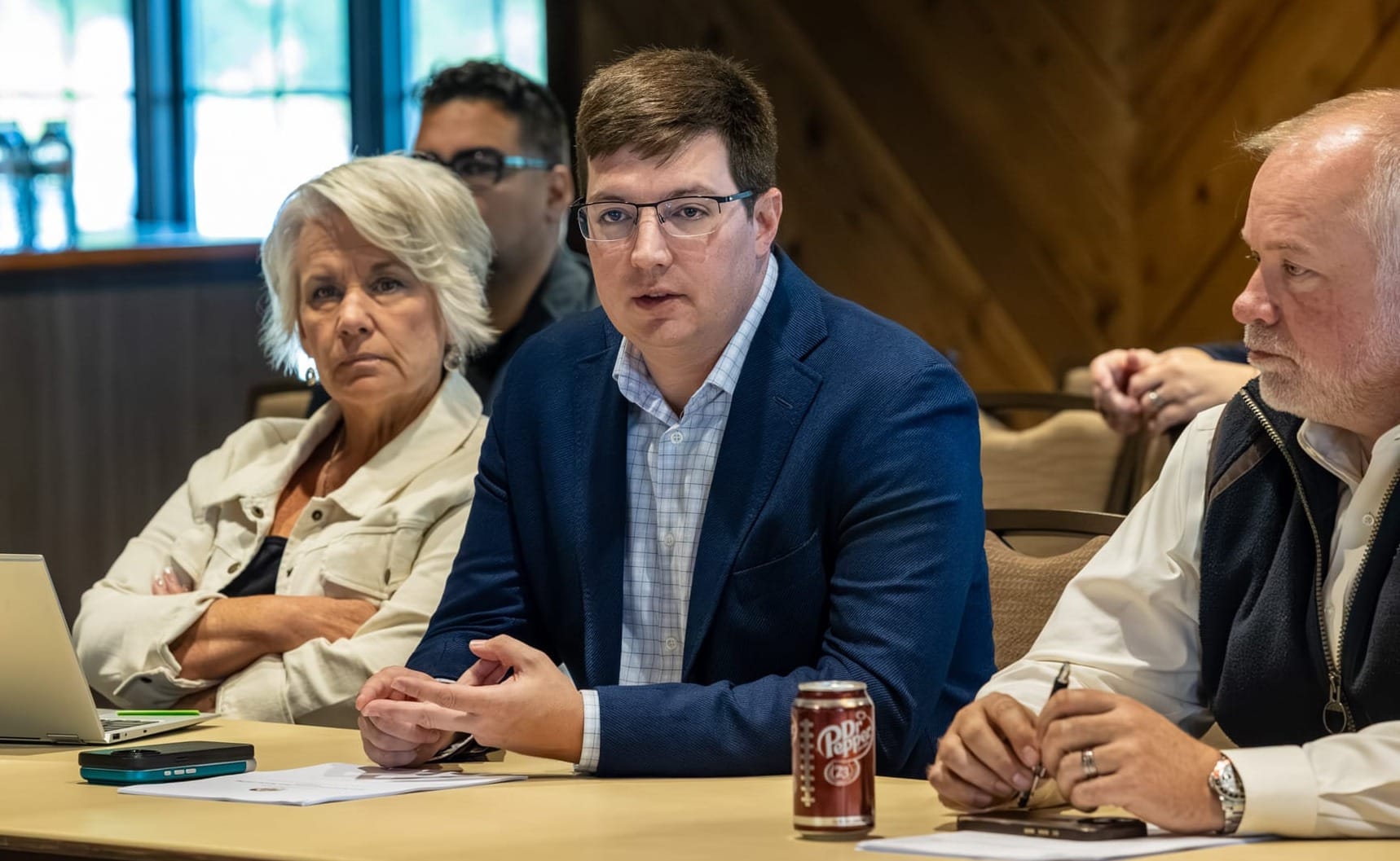
Still, Moss — who signed the original Flock Safety contract in 2024 while serving as board chair — signaled that he plans to introduce an amended motion at the next full meeting to strip the license-plate reader provisions from the Axon contract altogether, even though staff noted removing the cameras would not reduce the overall package price.
“In general, I don't think the government itself should be in the business of mass surveillance,” Moss said, adding that he expects broad board support for the remaining records-management, body-camera and public-safety upgrades.
Because the Friday session was a work session, the board took no formal vote.
Brugger directed legal counsel and administrative staff to prepare vetted contract alternatives ahead of Tuesday’s full board meeting, where commissioners are expected to pull the item from the consent agenda for full debate and a final vote.
That full board meeting is scheduled for 6:30 p.m. Tuesday, Nov. 17. Read the agenda and supporting packet materials here.
— Sarah Leach is the executive editor of the Ottawa News Network. Contact her at sleach@ottawanewsnetwork.org. Follow her on Twitter @ONNLeach.


