

Ottawa County finance committee tackles $13M CMH loan, tech audits, Pride debate
In a 3-hour session marked by cultural debates, system overhaul costs and financial restructuring, the Ottawa County Finance and Administration Committee cleared the runway on Sept. 15 for administrative transformations, including a $13M credit line to the county’s shifting mental health operations.

OTTAWA COUNTY — In a marathon three-hour session marked by cultural debates, system overhaul costs and complex financial restructuring, the Ottawa County Finance and Administration Committee cleared the runway on Sept. 15 for a series of major administrative transformations, including a $13 million credit line to back the county’s shifting mental health operations.
The committee’s wide-ranging decisions approved nearly the entirety of a dense agenda, setting up new technology investments, organizational audits and the formal adoption of the county’s fiscal year 2027 operating budget.
Culture battles hit line-item claims
The session got off to a contentious start over a single $157 vendor booth fee for the Ottawa County Department of Public Health at the Grand Haven Pride event.
Commissioner Sylvia Rhodea pulled the line item from the package of expenses listed under "accounts payable" that county commissioners are required to approve, arguing that taxpayer funds should not support events featuring drag performers where children are present, citing a past board resolution aimed at protecting "child innocence."
"My concern arises out of the fact that we did pass a resolution to protect childhood innocence," Rhodea said. "Again, we have an event where we have drag queens and children at the same place. It's not really necessary to ... be expending taxpayer dollars to support that event and to signal that we support drag queens and children being in the same vicinity with our health department right there present with them."
Beyond the registration cost, Rhodea noted the hidden price tag of county resources, including staff time and mileage, questioning why public health leadership prioritized a controversial venue over other local gatherings.
"It is a statement of where our public health is choosing to put their time," Rhodea added. "For instance, are they at a Christ is King festival? Are they at art fairs? There are so many community events that our public health could also be at, but they intentionally choose to be at this one event, which is controversial. ... If public health refuses to abide by policies and directions set by the board of commissioners, then we probably need to look to the state legislature to make some changes."
Public health officials and administrative leadership pushed back, clarifying that the booth was entirely funded through non-taxpayer grant money with zero Ottawa County general fund dollars used. They emphasized that the table was designed specifically for localized disease prevention outreach.
Other commissioners echoed that public health must maintain the operational discretion to provide sexually transmitted infection testing, education and risk reduction to targeted, high-risk populations.

Later during public comment, the county's chief medical officer, Dr. Gwen Unzicker, offered a firm defense of the health department’s presence, reminding the board that public health outreach and disease prevention represent standard healthcare, not the "sexualization of children."
"Public health happens where people are," Unzicker said, noting that department staff attended 94 community outreach events in 2025, reaching more than 5,400 residents across schools, workplaces, farmers' markets, and health fairs. "Protecting and promoting health for all means directing our resources and our services to the communities where the need is greatest."
Unzicker directly challenged assertions that field outreach at Pride events compromised child safety, linking localized education directly to critical medical outcomes.
"Sharing information that helps people prevent disease is not sexualization of children," Unzicker testified. "It does not support it, it does not normalize it, and it does not encourage it. This is the kind of health care that keeps babies from being born with syphilis — an infection that has been rising across the state and the country, and still takes the lives of babies. Preventing that kind of harm is protecting the health and well-being of our children."
Unzicker also highlighted the professional obligations of health personnel, emphasizing that all field staff are legally mandated reporters trained to identify and report child abuse.
"The phrase 'sexualization of children' is a serious one, and it has been repeatedly, implicitly applied to our work without ever being clearly defined," she told commissioners. "Our staff are people who have spent their careers protecting this community, and they and their work deserve to be described fairly and accurately."
The debate over the Pride vendor booth stood alongside broader health department initiatives on the agenda, including the approval of a 1.5-year, $150,000 contract extension with Grand Valley State University to expand community health worker coverage from 8-29 hours weekly — an initiative fully backed by GVSU revenue at zero cost to county taxpayers.
The general claims package — totaling over $28.7 million — ultimately passed, with the separated $157 vendor booth fee approved in a 6-1 vote, Rhodea casting the sole dissenting vote.
Multi-million dollar software, law-enforcement audits
Moving into broader county operations, commissioners greenlit significant operational expenditures aimed at addressing legacy system failures and updating public safety infrastructure.
The board approved $167,110 for Matrix Consulting Group to execute a top-to-bottom organizational review of the Sheriff’s Office and jail operations, funded entirely through vacant position savings. To modernize administrative operations, officials authorized a combined $449,635 across two five-year software and implementation contracts with Workday, replacing a previously failed budget software system.
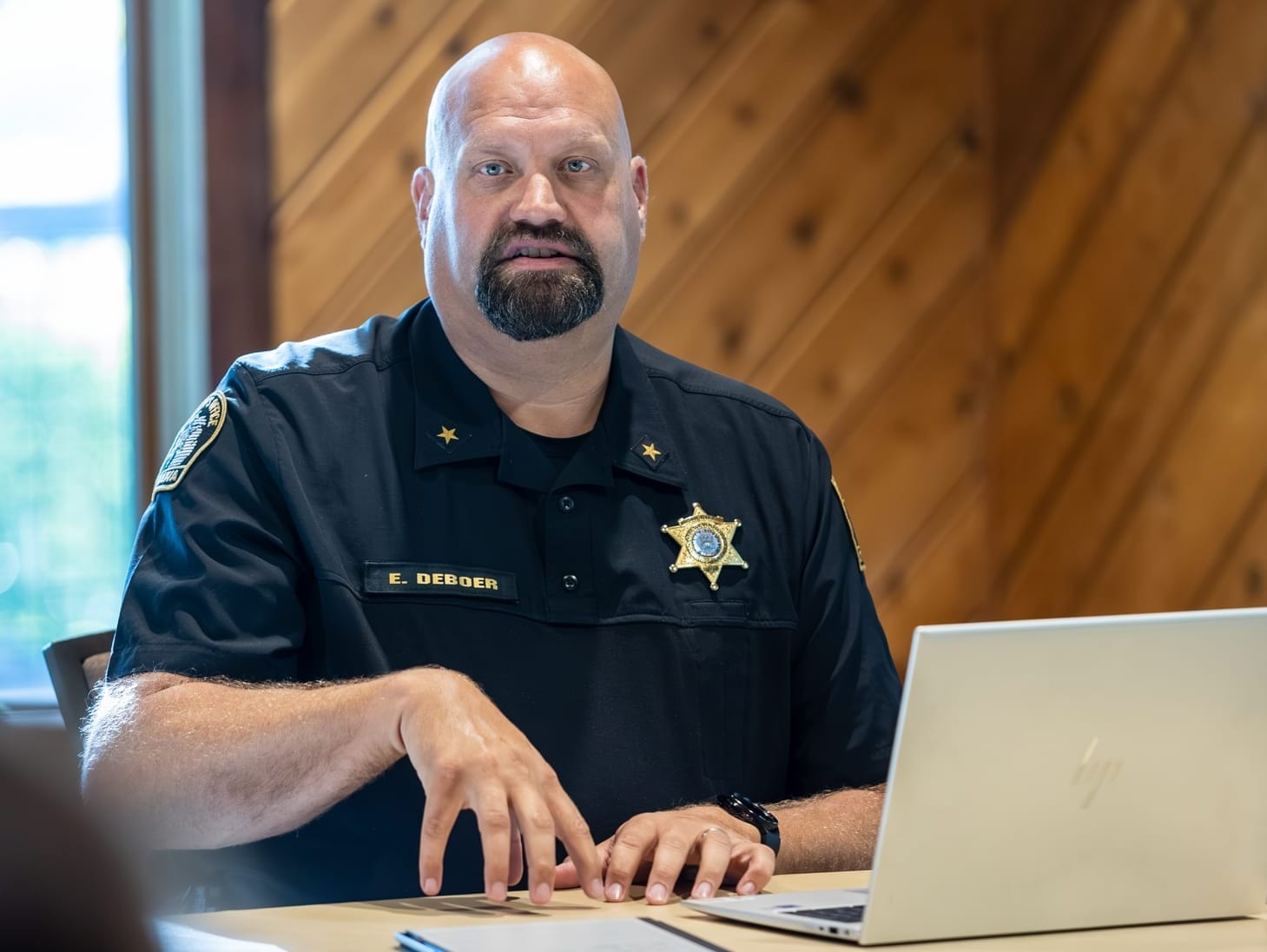
"There are a number of things within our agency that I would love to see an outside brain look at and give us some ideas — stuff that we haven't thought of," Sheriff Eric DeBoer said during the meeting. "Matrix had a significant background with departments my size and with my complexity."
The county also moved to streamline specialized services. Commissioners replaced a retiring detective position with a three-year, $45,600 third-party digital forensics contract expected to save up to $20,000 annually.
Meanwhile, a $144,712 assessment by Mission Critical Partners to evaluate aging courtroom recording systems across county facilities drew skepticism from Commissioners Jordan Jorritsma and Jacob Bonnema — both mainstream Republicans — over its high price tag, but ultimately passed in a 5-2 vote.
Courtroom technology assessment sparks debate
A proposal to modernize audio/visual and recording technology across Ottawa County’s courtrooms sparked an intense debate over consulting expenses, procurement pitfalls, and operational vulnerabilities during the Finance & Administration Committee meeting.
At issue was a $144,712 contract with Mission Critical Partners to assess, scope, and draft an RFP for replacement recording systems across 10 to 11 courtrooms in Grand Haven, Holland and Hudsonville.
Court representatives explained that existing courtroom recording systems — last refreshed in 2017 — are reaching the end of their useful lives, face hardware obsolescence, and suffer from network connectivity and hardware integration issues.
"Our court recording systems ... are all approaching elderly status basically for IT equipment," court staff explained. "They're no longer making some of it, so it's hard to get pieces to fill it back out. The first part of that is determining exactly what we need, what best practices are out there, and what we should be looking for."
Court officials highlighted that hardware fragility has created recurring operational emergencies, noting that any failure in recording infrastructure immediately halts judicial proceedings.
"Whenever a court system goes down, it's an emergency as we see it," court staff told the board. "We are having a lot of issues with equipment that was installed that frankly is very fragile. If you sneeze at it, it will break. ... We didn't know that was a problem with that particular piece of equipment because the vendor recommended it, and it's been an absolute nightmare since. We've had to replace equipment piecemeal because it did not have the capabilities we thought it would have, and we're hoping by doing this on the outset we avoid those problems in the future."
The $144,712 price tag for consulting and project oversight drew sharp pushback from several commissioners, who questioned why internal IT staff could not handle the procurement or why the county could not issue a direct vendor request.

"That feels high to me," Jorritsma said. "I can buy it as a private consumer very inexpensively. ... I didn't need to hire a consultant for $144,000 to say: 'You need to buy this.' It just seems like a lot of money."
Fiscal Services and IT leadership defended the expenditure, pointing out that prior un-scoped A/V procurements resulted in vendor confusion, mid-project change orders and cost overruns that ultimately doubled initial estimates.
"When we originally refreshed the courtrooms, we didn't really have a scope," Fiscal Services explained. "The complexity of this technology is not something we have the expertise in in our IT. ... This vendor was actually forbidden to respond [to the ultimate hardware bid] because their job is to make sure that what they have scoped works for the courts."
Supporting commissioners aligned with county administration, comparing Mission Critical Partners to a third-party construction manager overseeing a complex public works project to guarantee quality control.
"If this goes for another 10 years and we get this work done, that's a 10-year payback of $14,000 to $17,000 a year on something that the experts in this room are telling us we don't know the latest technologies for," Commissioner John Teeples, a moderate Republican, argued. "To me, that's probably a good bang for the buck ... so that we don't get into these pitfalls and, when the bidders come, they know what they're bidding on and we know what the standard of performance is."
The committee ultimately approved the $144,712 contract in a 5-2 roll-call vote, with Commissioners Jorritsma and Bonnema dissenting.
CMH Authority bridge loan approved
The most intricate debate of the morning revolved around the financial scaffolding required to transition the county's Community Mental Health operations into an independent Community Mental Health Authority, effective Oct. 1.
To ensure continuous cash flow during the transition, the committee approved a transition agreement and a three-year revolving promissory note offering up to $13 million in credit to the new authority at a 3% interest rate through Oct. 1, 2029. To secure the loan, the county established a pledge against future CMH millage revenues and placed a lien on $5 million in fund balances.
Voters approved a 10-year renewal for the countywide CMH millage in August, which is expected to generate $5.6 to $5.7 million annually.

Commissioner Doug Zylstra, the lone Democrat on the committee, raised concerns over pledging voter-restricted millage dollars as security, which corporate counsel Doug Van Essen then explained:
"Imagine if you had a CD of $4.8 million and the bank was willing to loan you credit, but wanted to hold the CD in its possession to secure the line of credit," Van Essen said. "We've given [CMHA CEO Dr. Michael] Brashears that $4.6-$4.8 million, but he's given it right back to us to hold on to.
Drawdowns on the credit line are strictly restricted to core operational costs, including payroll, MERS retirement contributions, and essential IT, HR and facility leases.
The transition package passed 6-1, with Zylstra as the dissenting vote.
Under the rollout plan, 185 county mental health employees will officially migrate to the new authority on Jan. 1, 2027, to avoid mid-year tax and healthcare disruptions.
Following the CMH transition agreement, the committee formally adopted the fiscal year 2027 appropriations act.
Public Defense budget deficit alert
Closing out the meeting as a discussion — non-action — item, Chief Public Defender Phil Sielski briefed commissioners on a brewing legal fight with the Michigan Indigent Defense Commission.
Ottawa County initially submitted a $7.7 million grant request to fund fiscal year 2027 public defender operations. Under state law, the county's local funding share is statutorily capped at $942,000, leaving the state legally obligated to fund all remaining compliance costs.
However, the MIDC acted in June to reduce the state recommendation to $5.9 million — a $1.8 million cut aimed primarily at fringe benefits, attorney contracts, and expert witnesses.
"Their biggest area which they gave us a cut was in the area of fringe benefits, which to me was extremely ironic," Sielski told the committee. "Once the salaries are incurred, the fringes are just a function of the salaries that you're paying."
Sielski emphasized that regardless of the final state grant figure, Ottawa County's financial risk remains insulated.
"Worst-case scenario, the statute provides in several places that the county cannot be required to expend more than its share ... capped at $942,000," Sielski noted. "If the county in effect is fronting the state for those expenditures, they're going to have to reimburse us."
The MIDC justified its spending reduction by pointing out that Ottawa County had only spent 34% of its budgeted allocation through the second quarter of fiscal year 2026, assuming the department was systematically overfunded.
Public defense leadership explained that the low spending rate was driven by an unprecedented cascade of staff resignations that began in June 2024, creating rolling vacancies faster than positions could be recruited and filled.
Between late 2024 and early 2026, more than 10 attorneys left the office due to out-of-state moves, private practice opportunities, and judicial appointments — including former Chief Assistant Anna White's appointment to the 58th District Court bench.
"Their justification ... was that we had a significant unexpended balance," Sielski explained. "We had a series of vacant positions which began in June of '24 ... rolling in sort of faster than we could fill them. ... Two of those positions were senior-level trial attorneys, which we don't just have a bench that I can say, 'All right, you're in.' We have to recruit and find people that are qualified to handle those kinds of cases."
County Administrator Patrick Waterman confirmed the hiring bottleneck reflects a statewide public defender shortage rather than local budget manipulation.
"If you are not able to fill those positions and accumulate vacancy savings ... the state looks at that and says, 'Oh, you're overfunded,'" Waterman said. "The reality is they're not able to fund the positions that they really need to do the work. So, it's a penalty from the state."
With three vacancies remaining, the office expects to be fully staffed by Dec. 1.
Sielski noted that his office is appealing the reduction through a formal third-proposal strategy to avoid exposing the county to an estimated $84,000 to $100,000 budget shortfall.
Rather than pushing the dispute into formal state mediation, Sielski is focusing on defending essential operational charges like facility lease costs and office phone lines.
To reconcile the remaining shortfall, the county plans to hold MIDC officials to their verbal commitments to monitor actual quarterly expenditures. As vacancies are filled and spending on fringe benefits, conflict counsel and expert witnesses ramps back up to historical levels (which averaged 94% to 100% prior to 2024), the county will apply for mid-year supplemental budget amendments.
Commissioners expressed caution that drastically lowering the initial request might give Lansing bureaucrats the false impression that the local budget was padded.
Sielski assured the committee that actual mid-year spending will vindicate the original $7.7 million assessment.
"By the second quarter, it will show that the numbers we presented were accurate," he said.

Other business
On the public safety and preparedness front, commissioners approved two key state and federal grant measures to support local operations:
- Emergency Management Performance Grant Work Agreement: The committee authorized the annual state work agreement required to secure approximately $15,000 in FY2025 pass-through funding, supporting ongoing countywide emergency preparedness and response capabilities.
- Edward Byrne Memorial Justice Assistance Grant ($48,389): Approval was granted to apply federal justice assistance grant funds toward the procurement of a second mobile Community Safety Trailer. Equipped with high-mast lighting and surveillance cameras, the unit will be deployed by the Sheriff’s Office for event security, disaster response, and localized crime deterrence.
- The board added non-lobbying safeguards to a three-year, $360,000 operational agreement with the Ottawa Conservation District, explicitly banning the use of county dollars for regulatory advocacy.
- Commissioners also approved a retroactive $58,091 agreement with the U.S. Geological Survey (USGS) to support airborne geophysical mapping of Ottawa County’s underground aquifers. The high-resolution mapping project—aimed at assessing long-term groundwater sustainability—carried a total cost of $77,000, with the Michigan Department of Environment, Great Lakes, and Energy (EGLE) covering the remaining $20,000 balance.
— Sarah Leach is the executive editor of the Ottawa News Network. Contact her at sleach@ottawanewsnetwork.org. Follow her on Twitter @ONNLeach.


