

Surveillance vs. rights: Inside Ottawa County’s debate over Flock Safety camera use
Over two hours, county leaders, law enforcement officials and local residents dissected the technical mechanics, legal vulnerabilities, real-world case results and administrative oversight of an automated surveillance that helps solve crime.

JENISON — Inside the Grand Ravines Lodge on Friday, Sept. 18, a public debate unfolded over the boundaries of modern law enforcement, constitutional privacy, corporate data ownership, and government transparency.
The Ottawa County Board of Commissioners convened a work session to examine the county’s network of Flock Safety automated license plate readers, or ALPRs.
Over two hours, county leaders, law enforcement officials and local residents dissected the technical mechanics, legal vulnerabilities, real-world case results and administrative oversight of an automated surveillance that helps solve crime.
Public comment: Concerns over 'mass automated surveillance'
Members of the public opened the meeting with sharp opposition, arguing that passive, continuous vehicle tracking fundamentally alters the relationship between citizens and the state.
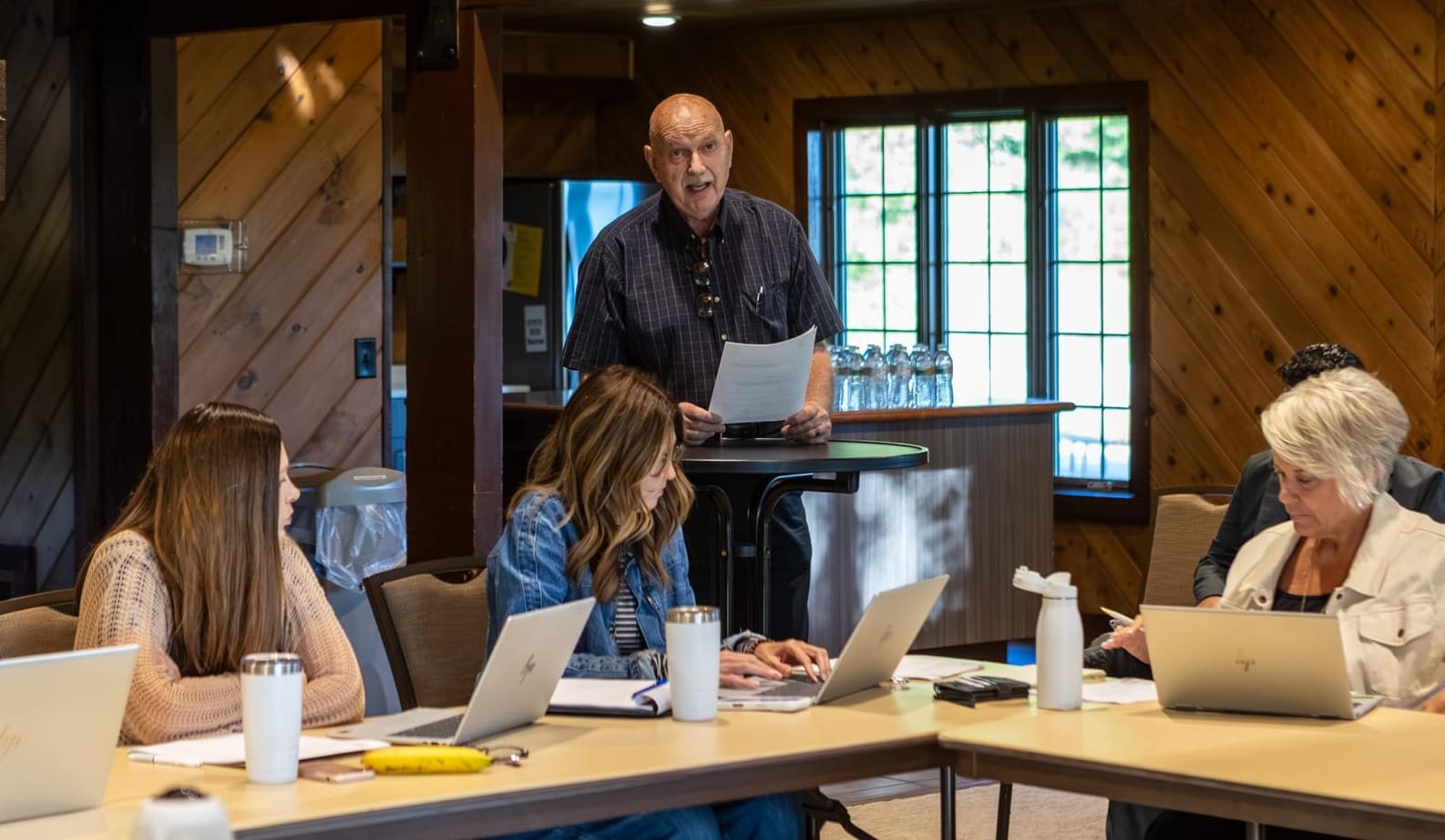
Dan Zimmer, of Port Sheldon Township, questioned the reach and long-term implications of systemic data accumulation on everyday drivers, warning of commercial profiling and incidental data collection.
"My first memorable encounter with a Flock camera was several years ago, getting a bill statement complete with a vehicle photo for a toll road charge. I had wondered: Is that data stored and archived? For how long? Who has access to that data? Under what circumstances? What company or agency has ownership of collected data? Can data be sold? Is data subject to FOIA? Are flat cameras programmable to be used as plate readers, facial recognition or both? Who decides?" Zimmer said.
Zimmer said that, although police use the information to identify and arrest suspects, there are tens of thousands of innocent civilians whose data potentially might be at risk.
"Case in point: Analyzing 25,000 plate numbers to find the plate number of the getaway car, what becomes of the data for the 24,999 vehicles that interfaced with AI but were eliminated?" Zimmer asked. "They also captured cars' make, model, color, identifying features such as dents and bumper stickers. So a Flock camera company could categorize drivers by sports team, political affiliation, NRA or other bumper sticker decal. Where does the extent of incidental systemic data end?"
Kayla Swain, of Crockery Township, framed the technology as a direct threat to constitutional principles.
"Sheriff DeBoer recently suggested that community pushback against Flock Safety cameras is just based on 'misinformation.' Respectfully, the public understands this technology perfectly. Our opposition is not a misunderstanding; it's a defense of our fundamental liberties," Swain said. "Mass automated surveillance completely flips the American justice system on its head."
A Spring Lake Township resident targeted the legal framework, drawing comparisons to constitutional precedent on geofencing, behavior mapping and historical location tracking:
"In this report, the police department has categorized these systems as taking individuals' single photos. ... However, this is a system that goes beyond taking individual pictures. It creates whole networks and maps that are accessible ... across the board and accessible as noted to other agencies as well," he said. "In setting up a broad network of all of these items talking to each other, it is doing more than individual traffic cameras themselves. ... It ends up adding some risks."
Read More: Ottawa County Sheriff pushes back on camera misconceptions, welcomes board scrutiny
Read More: Amid ‘mass proliferation,’ Flock cameras emerge as key election issue; candidates seek safeguards
Why it matters
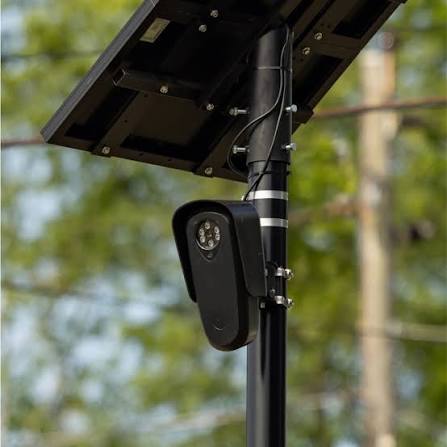
The legal showdown over Flock Safety’s sprawling surveillance network is rapidly intensifying, pitting neighborhood safety against the boundaries of modern digital privacy.
Over the past several years, the tech company's automated license plate readers have quietly blanketed thousands of American intersections. But a wave of recent federal rulings, state-level constitutional battles and high-profile police scandals have brought the technology to a critical legal tipping point.
At the heart of the corporate-legal clash is a fundamental constitutional question: Does tracking a vehicle's movement across a city, county or statewide network constitute a warrantless search under the Fourth Amendment?
For years, courts leaned heavily in favor of law enforcement, relying on decades-old precedents that drivers have no expectation of privacy on public streets. That legal armor held strong in early 2026, when a federal chief judge dismissed a landmark challenge against the City of Norfolk, Virginia.
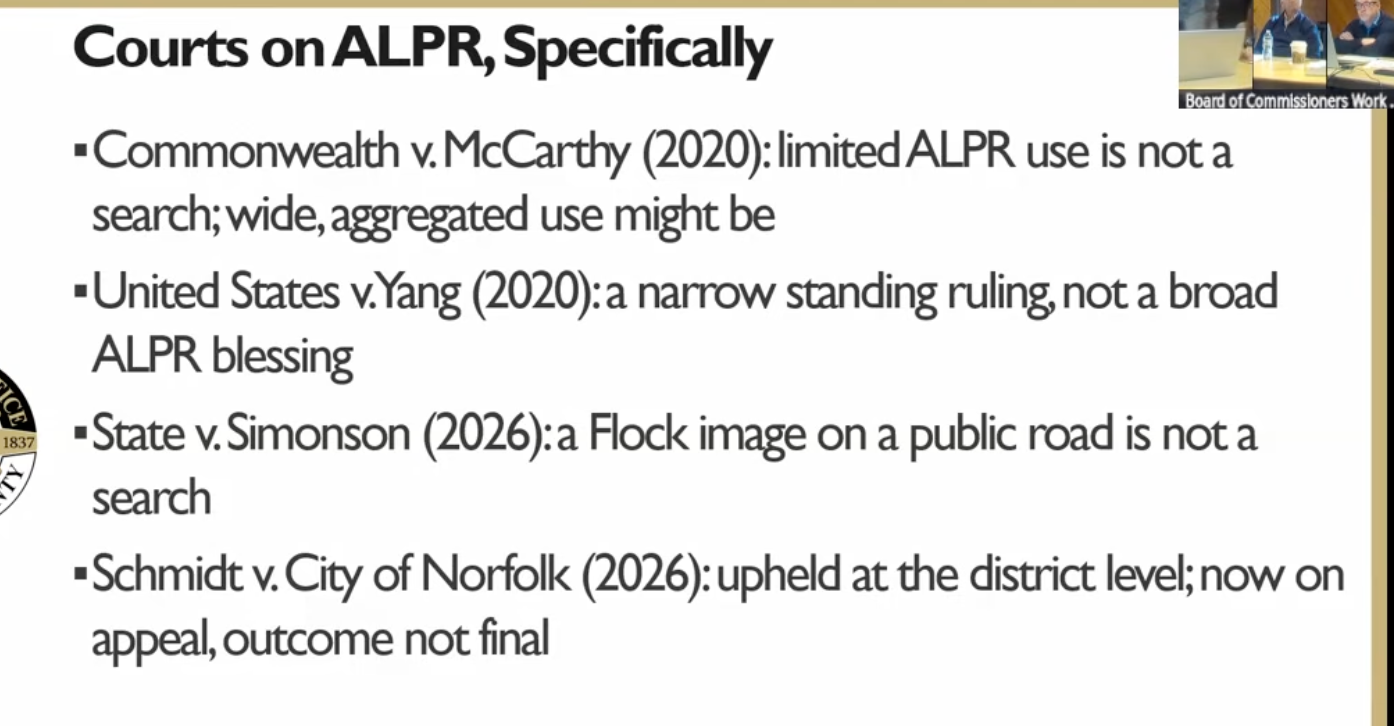
The court ruled that because the city’s 175 camera clusters deleted data on a rolling 21-day basis, they didn't fundamentally violate a citizen's civil rights.
Months later, the Virginia Court of Appeals reinforced that shielding, declaring that photographing public roads does not equal "near-perfect surveillance."
Yet, civil liberties groups have refused to back down.
The Norfolk case was immediately appealed to the Fourth Circuit Court of Appeals, setting up a high-stakes showdown that could eventually reach the U.S. Supreme Court.
Meanwhile, new battlegrounds are opening under state laws.
In Colorado, residents filed a major lawsuit against the Boulder Police Department, bypassing federal courts entirely to argue that the dragnet violates stricter privacy protections enshrined in their state constitution.
The corporate terrain shifted drastically underneath Flock Safety in August. A massive, nationwide federal class-action lawsuit moved the battlefield from abstract constitutional theory to concrete, real-world harm.
The suit spotlighted dangerous technological errors — citing a California police audit showing that up to 71% of automated stolen vehicle alerts were flat-out wrong, resulting in innocent drivers being pulled over at gunpoint. It also detailed severe systemic abuse, highlighting recent criminal investigations into police officers who allegedly used the Flock database to stalk and harass romantic partners.
Faced with mounting litigation, political backlash and state governors ordering pauses on new installations, Flock Safety announced in August sweeping, unilateral changes to its system — drastically slashing its default data retention period from 30 days down to just seven, and adding strict mandatory tracking codes to stop unauthorized police searches.
While Flock pitches these overhauls as a commitment to ethics, critics view it as a corporate damage-control maneuver meant to defuse the very lawsuits that threaten to dismantle their business model.
Operational boundaries, safeguards
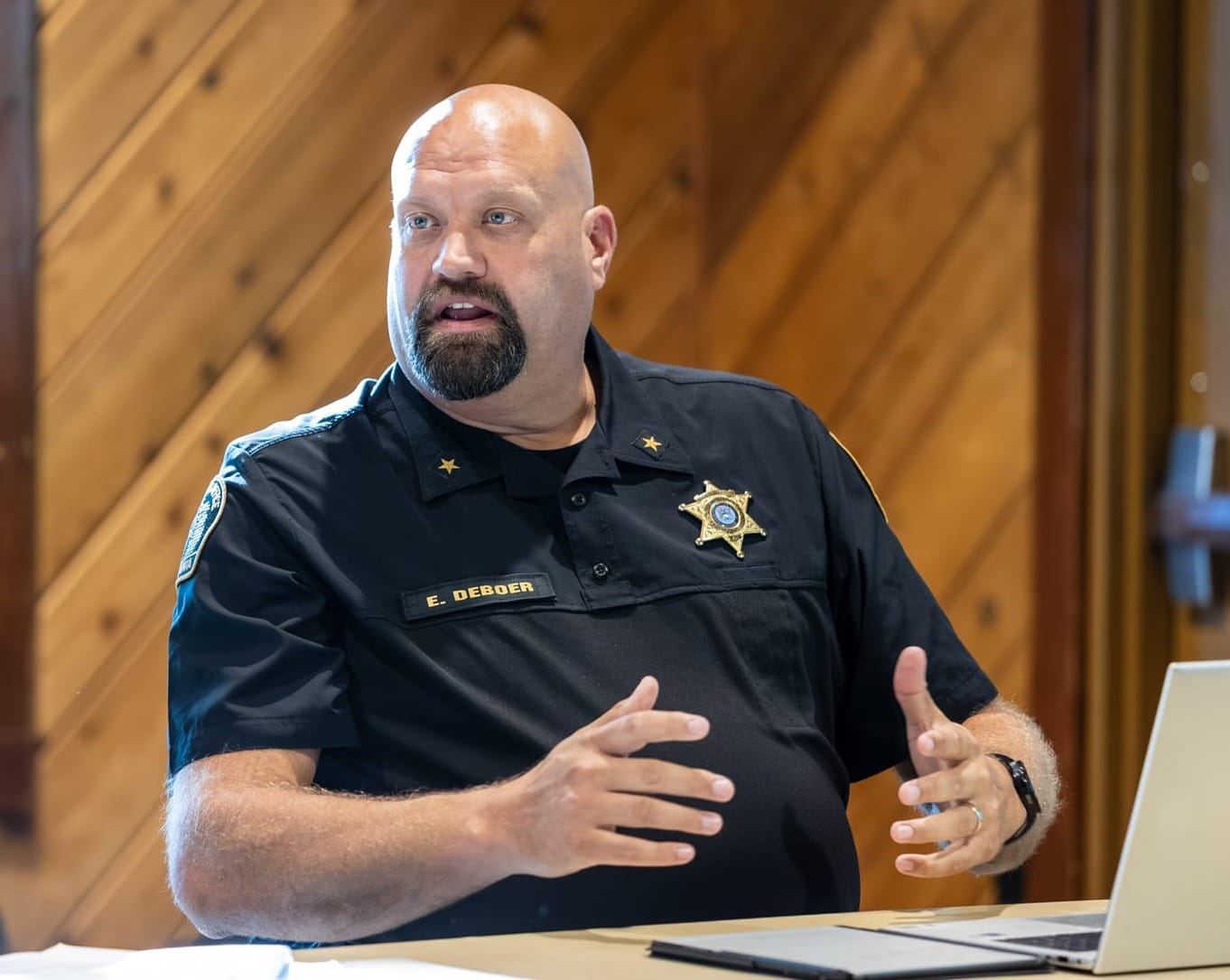
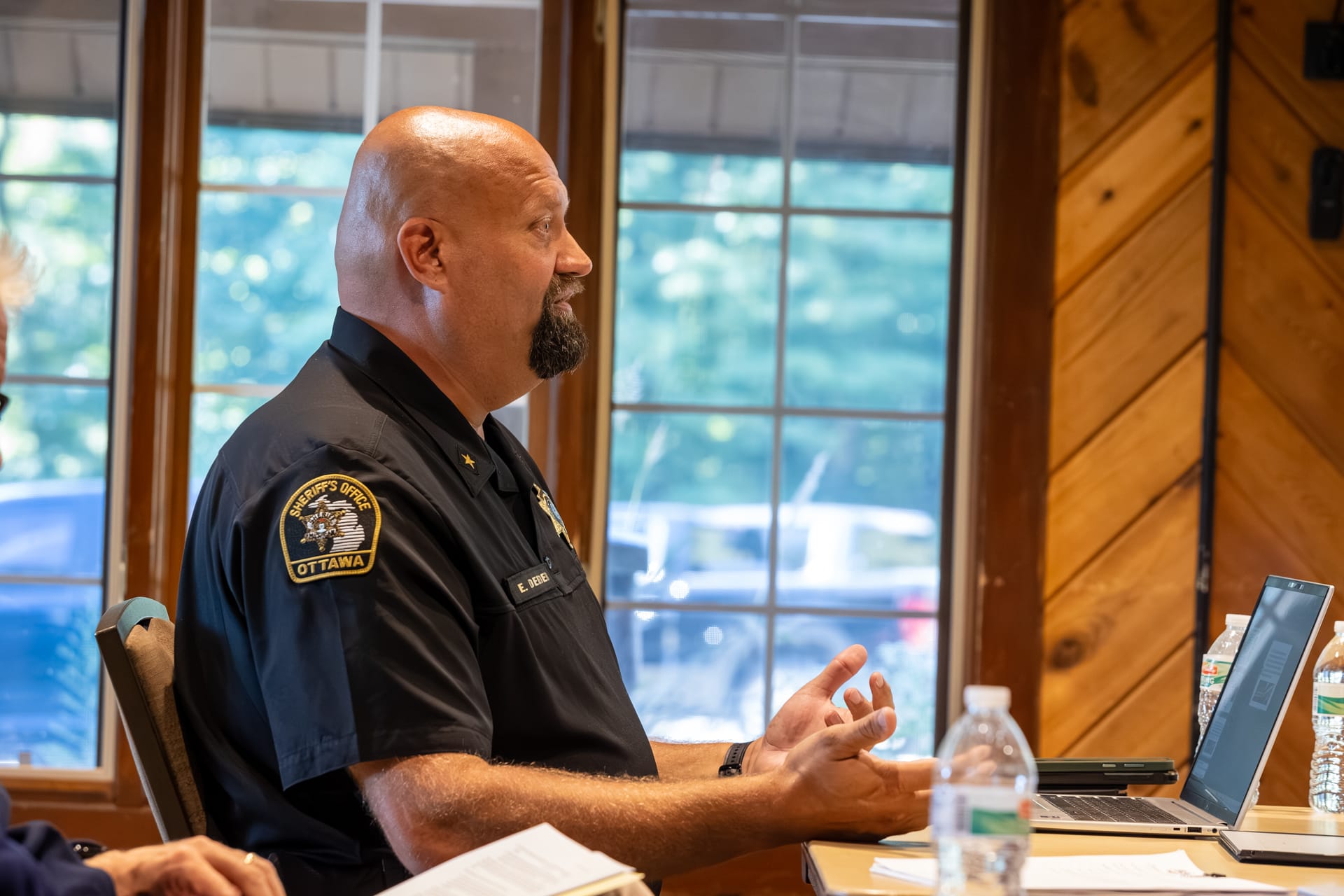
Ottawa County Sheriff Eric DeBoer addressed the commissioners and the public on Friday, setting a collaborative tone by acknowledging the validity of the public's concerns before walking through the department's technical parameters and administrative safeguards.
"Even the people that stood to disagree with me in theory, you should know that I agree with you. I agree with a lot of what your concerns are. I mean, there wasn't really anything said that hadn't gone through my head," he said. "So as we go through this, I hope you'll see that the thought process and the actual data shows that these were considered. ... I'm not coming here in a defensive posture. I'm here just to talk about what the system is."
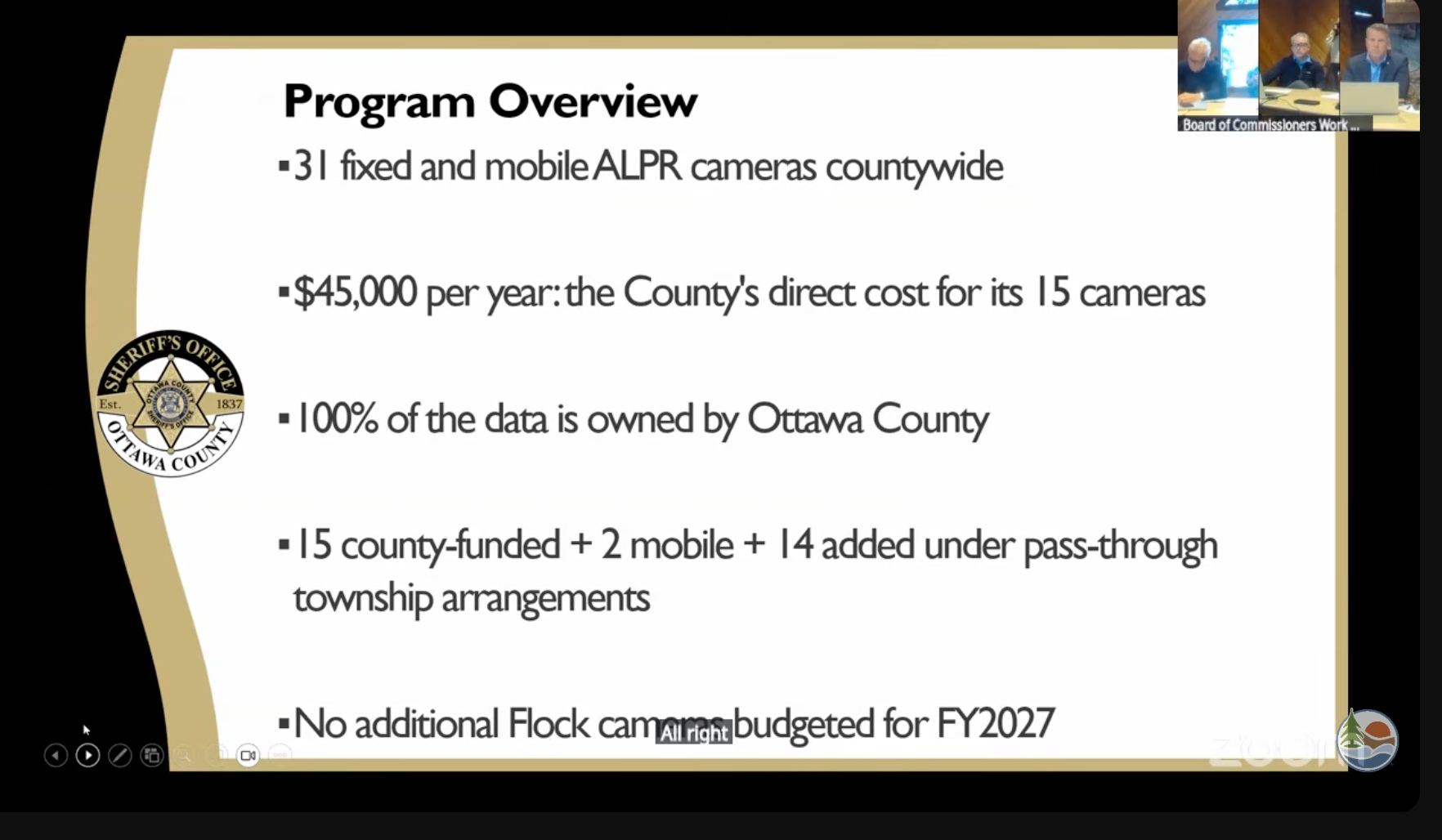
Addressing the core concerns, DeBoer detailed the strict operational limits governing Ottawa County's ALPR network. The county currently operates 31 active fixed and mobile cameras, comprising 15 county-funded units, two mobile deployment units, and additional devices added through municipal township contracts.
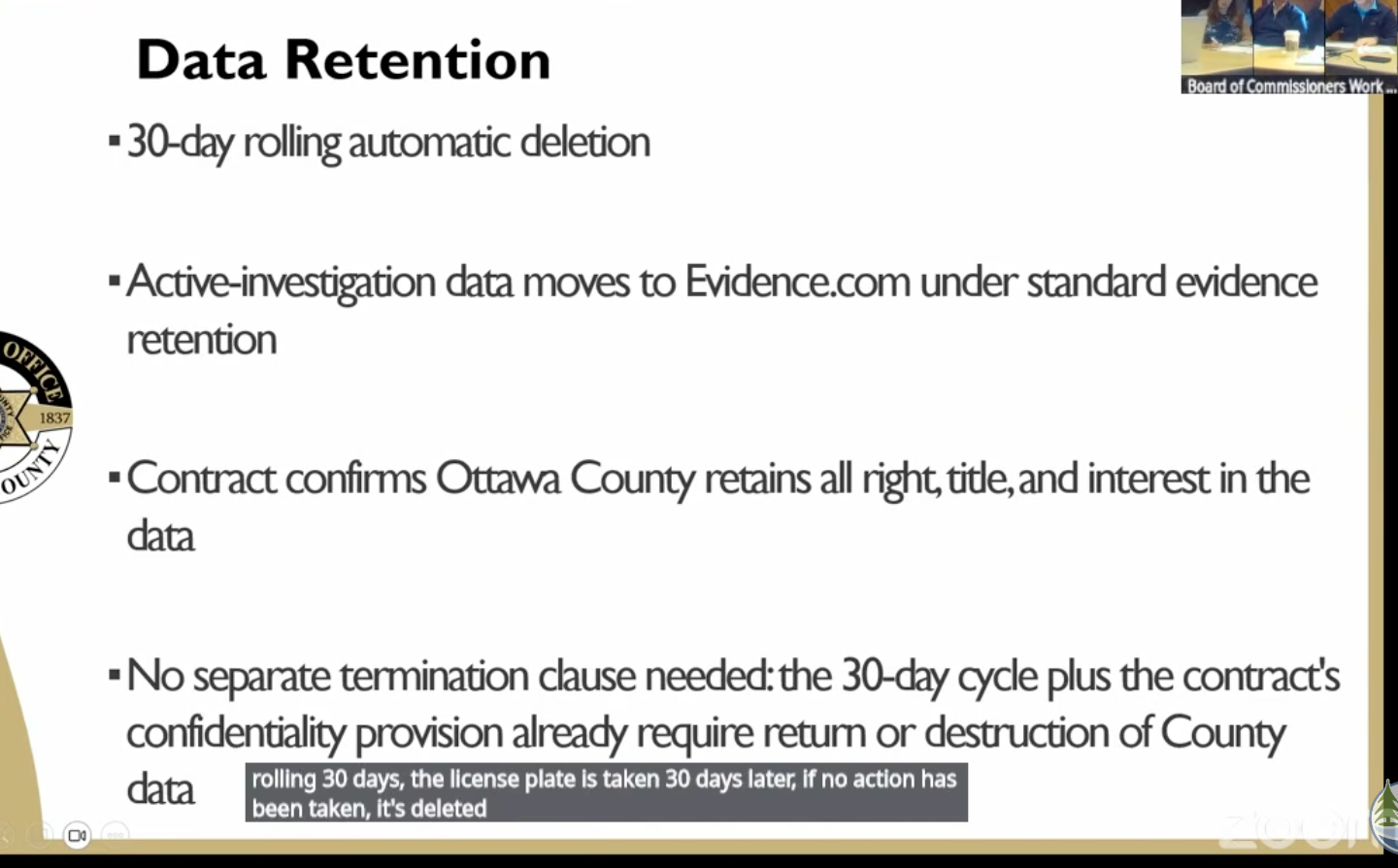
The entire network operates under a strict rolling 30-day data retention window, automatically and permanently scrubbing unflagged reads from the system, DeBoer said. Under the county's master service agreement, 100% of the data remains strictly county property, explicitly forbidding commercial sales, generalization or monetization by the vendor.
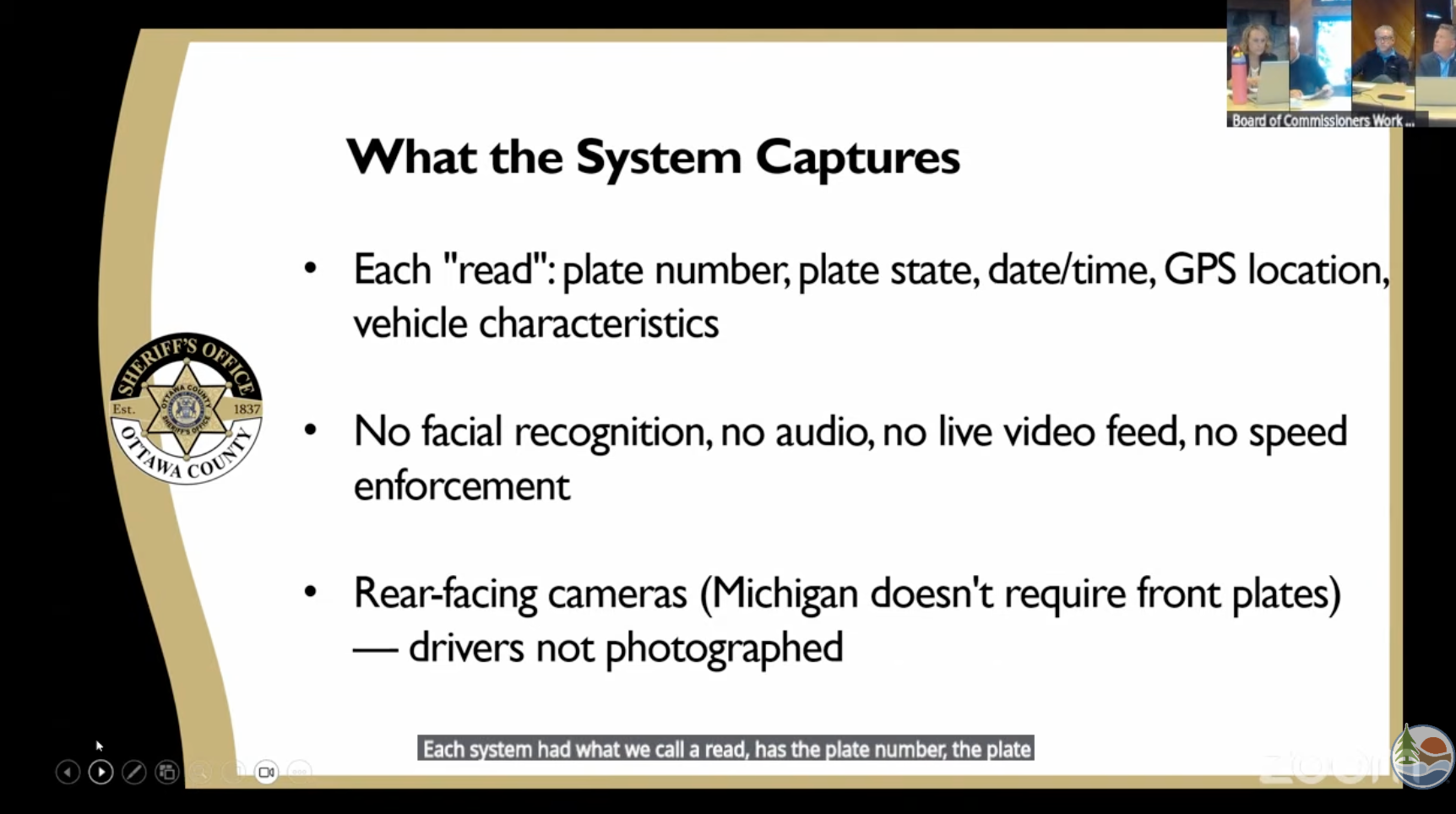
The cameras are also limited to capturing rear license plates on public roadways, possessing no facial recognition capabilities, no live audio or video streaming, and no ability to perform speed enforcement.
DeBoer said the lion's share of the data is not viewed by human eyes.
"Only 0.04% of footage is seen by police," he said.
Sheriff report screenshots
Program scale, ownership, technical constraints
DeBoer also clarified the specifics surrounding the equipment's financial arrangements.
"The actual camera count is 31. The cost to the county specifically is $3,000 per camera per year at $45,000. In our master service agreement, 100% of the data is owned by the Ottawa County Sheriff's Office," he said, stressing that the agreement says "they cannot sell our data, they cannot sell generalized data, and they cannot sell aggregated, anonymized data. That's why we actually have to pay for it."
Although the financial and legal terms establish who controls the technology, the actual data collected by the cameras is narrowly focused. According to DeBoer, the system captures only specific, non-intrusive vehicle details rather than individual personal information.
"Each system has what we call a read. It has the plate number, the plate state, the date and time, and the GPS location of that camera, and the vehicle characteristics ... make, model ... color, and distinguishing facts," DeBoer said. "There is no facial recognition software in that system. There's no audio, there's no live feeds, and we have no ability to do speed enforcement with these.
He pointed to Michigan law, which does not require vehicles to have front license plates, meaning the most useful information comes only from the back of cars.
"These cameras are set up to hit the rear of the vehicle ... so you're not going to see faces unless someone's sitting up and looking the wrong way," he said.
Data retention, verification, internal audits
Addressing privacy concerns and human error, DeBoer emphasized the rolling 30-day retention schedule, auditing procedures and officer verification requirements.
"Our settings are 30 days. So what happens in ... the license plate is taken, 30 days later, if no action has been taken, it's deleted off the system, never to be seen again," he said. "If the sheriff's office has an active investigation where that picture of that license plate is needed for evidence, we get what is called a certified copy. We put that into our digital evidence server and it's kept there and 30 days later it's still deleted off the Flock system."
Beyond who can log in, DeBoer emphasized that the vast majority of captured records are never accessed by officers at all.
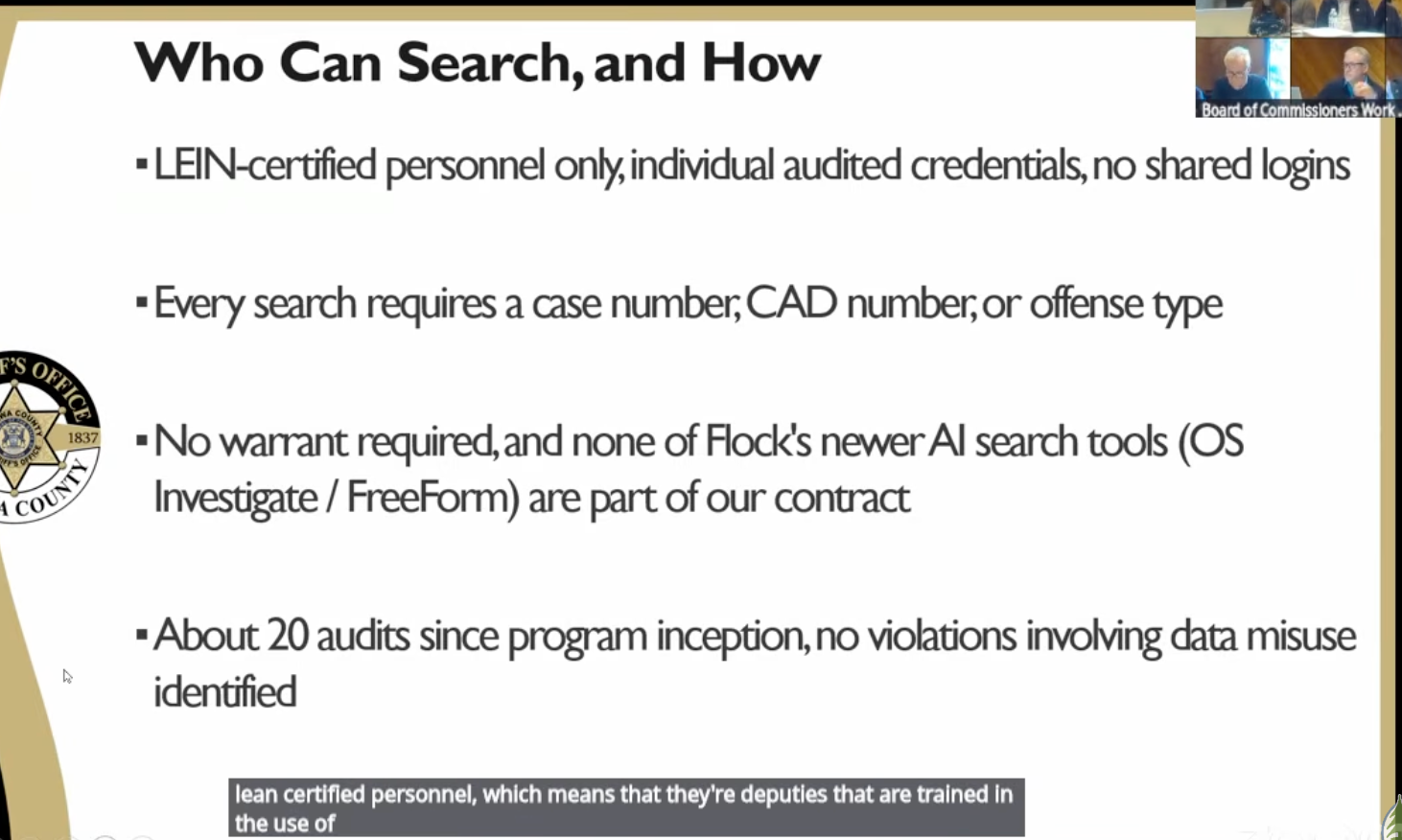
"Only LEIN-certified personnel ... are allowed to use this system. We have individual audited credentials. That means there's not a general login, so that if you do misuse it, we know exactly who you are," he said. "Every search requires a case number. ... Our policy says right there that we must independently verify all information, so when your Flock alert goes off, you don't just throw on your overheads and start taking action. You look at what you've got."
DeBoer pointed to the sheer volume of untouched data as proof that the system isn't being used to monitor ordinary citizens.
"I find that comfort in saying we're not keeping an eye on you. We're not watching you. We're not keeping track of you," he said. "It's just someone on the side road saying, 'Yeah, that car was here at that time, and then moving on.'"
Data sharing, platform controls
DeBoer outlined recent operational adjustments made to limit external access, specifically regarding out-of-state agencies, federal databases and civil inquiries.
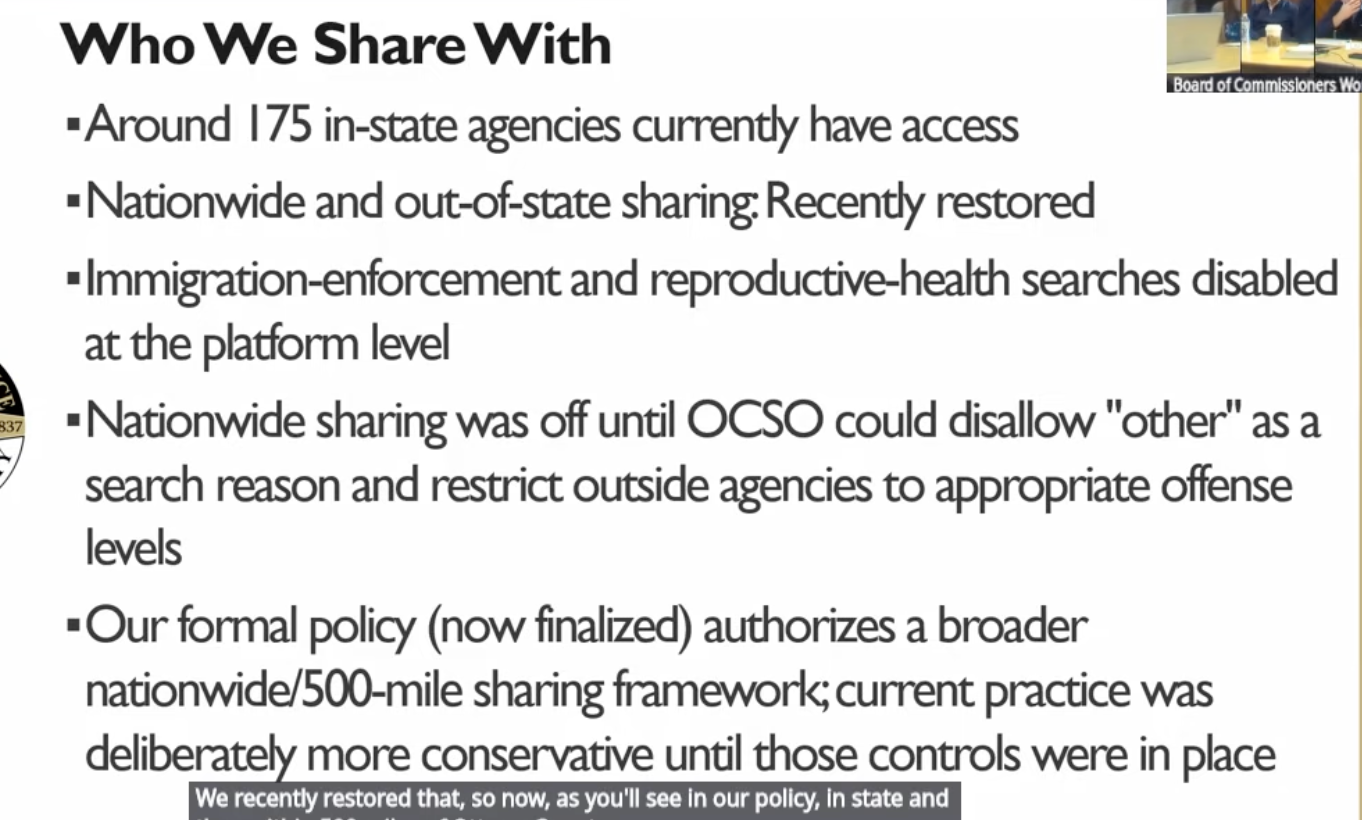
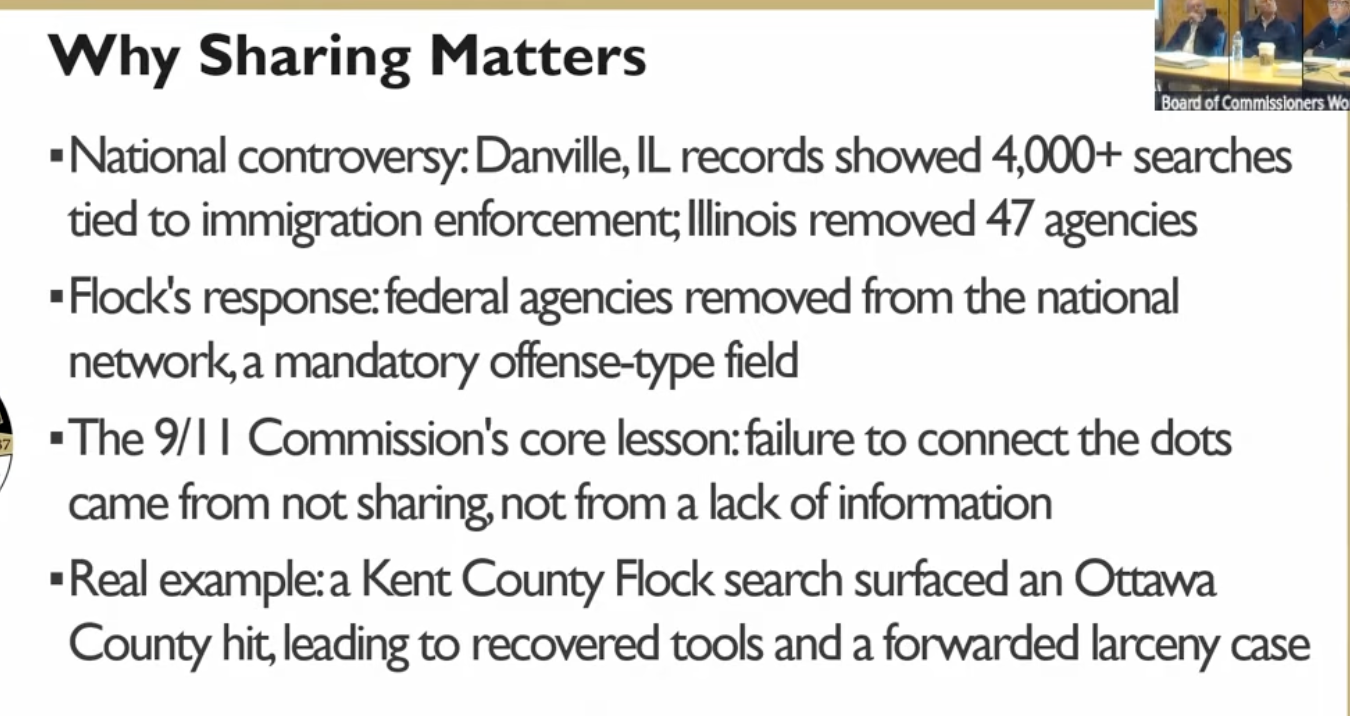
"Currently [we share with] approximately 175 in-state agencies. ... We had cut it down to in-state sharing only when we realized that our data was being shared in a way that I didn't want our data shared," DeBoer said. "We recently restored that, so now as you see in our policy, in-state and then within 500 miles of Ottawa County are given sharing rights. ... Outside of that, we're going to do it on a case-by-case basis."
Sheriff's report screenshots
DeBoer emphasized that the department activated strict policy toggles within the software to prevent local data from being drawn into politically sensitive or non-criminal inquiries.
"There are two platform-level settings to get to say we can't use our data for immigration enforcement and reproductive health. ... Civil warrants are turned off in our settings. ... ICE has no contract with Flock. Flock has settled all ties with ICE, so if ICE is getting information from a Flock data reader, it's because a user is granting them access inappropriately," DeBoer said.
Investigation case studies, outcomes
Since program implementation in late 2024, the department reported 131 arrests, the recovery of 73 stolen vehicles, over $917,000 in recovered property, and 15 missing persons located.
DeBoer highlighted several prominent investigations where the technology yielded critical leads.
In the case of Simon Van Dyke, ALPR data successfully identified multiple suspect vehicles across county lines, providing supporting evidence for convictions related to computer crimes, burglary, assault, and child sexually abusive material (CSAM). In a multi-state investigation involving interstate boat thefts, the system tracked suspect vehicles transporting stolen marine vessels from Indiana and Kentucky, ultimately leading to the recovery of over $400,000 in marine property.

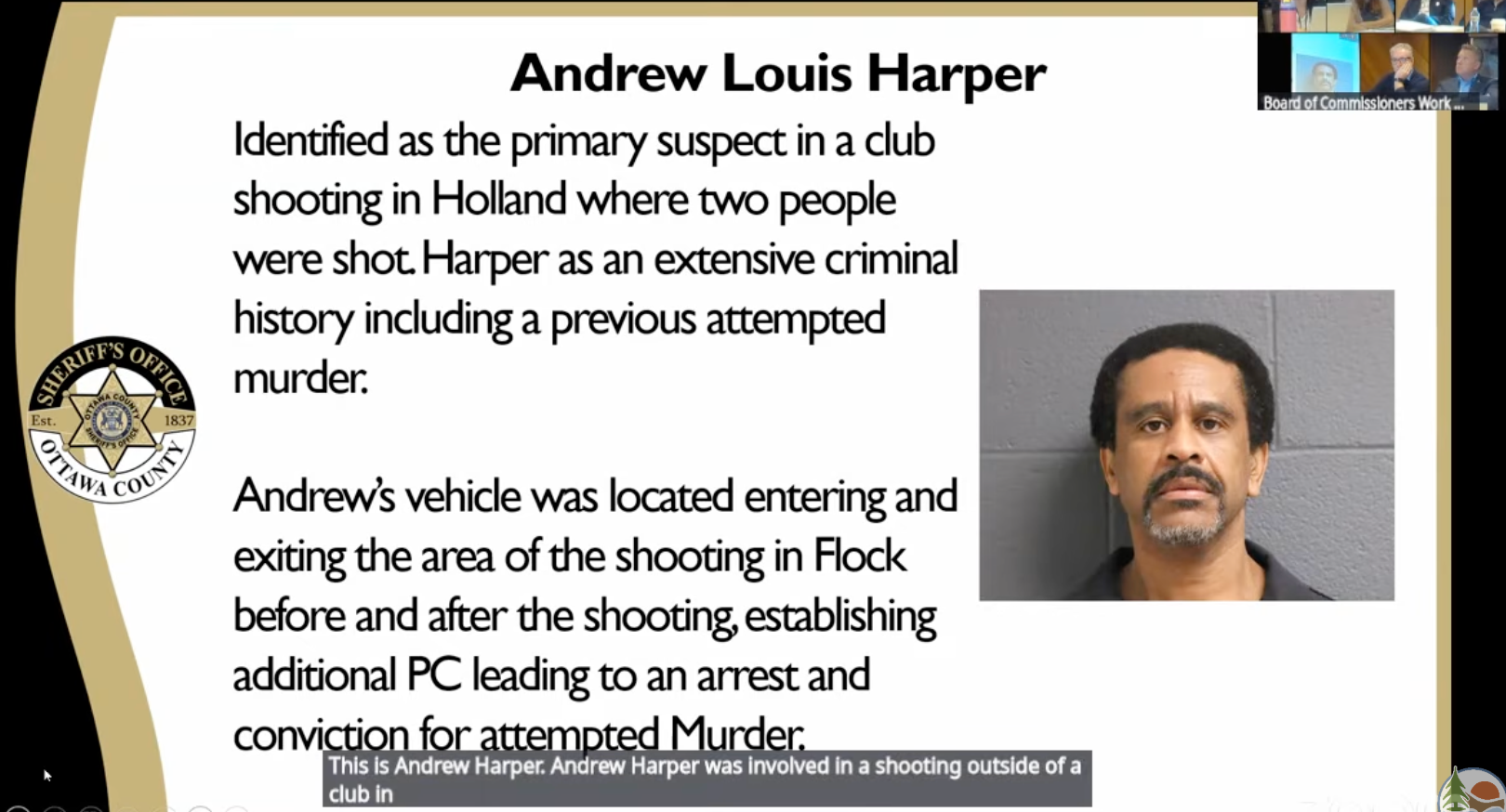
The technology also proved pivotal in the Andrew Harper case by recording a suspect vehicle entering and exiting a Holland Township location during a shooting, aiding in an arrest and conviction for attempted murder. Most recently, ALPR leads identified a suspect tied to a long-running series of night home invasions and peeping tom incidents in Allendale Township, resulting in an arrest the night prior to the work session.
DeBoer also noted a prominent "Peeping Tom" case with numerous incidents reported since last fall that finally resulted in an arrest this month.
"Since September 2025, there's been numerous instances here in the Allendale area of a Peeping Tom. Not only a Peeping Tom, but then also using recording devices against people in some of their most intimate moments ... involving him entering homes and the victims waking up to finding a man in their bedroom," DeBoer said. "Last night, he was taken into custody because of a lead from Flock that allowed us to identify him."
Read More: Grandville man arraigned in Allendale off-campus peeping, break-in investigation
Board deliberations, contract oversight
Commissioners pressed DeBoer on vendor contracting, automated renewals and internal disciplinary measures for potential system misuse.
When asked how policy violations are handled, DeBoer noted that database misuse carries administrative termination and advocated for stronger state-level criminal penalties.
"We would treat that the same as accessing any of our other databases for personal use, and that would be up to and including termination. We have fired — both in my part of administration — five people for misuse of systems. ... If I were to go in and, say, search a friend of mine's significant other in Secretary of State or LEIN, I would not only be fired, I would also be charged for misuse of LEIN," DeBoer said.
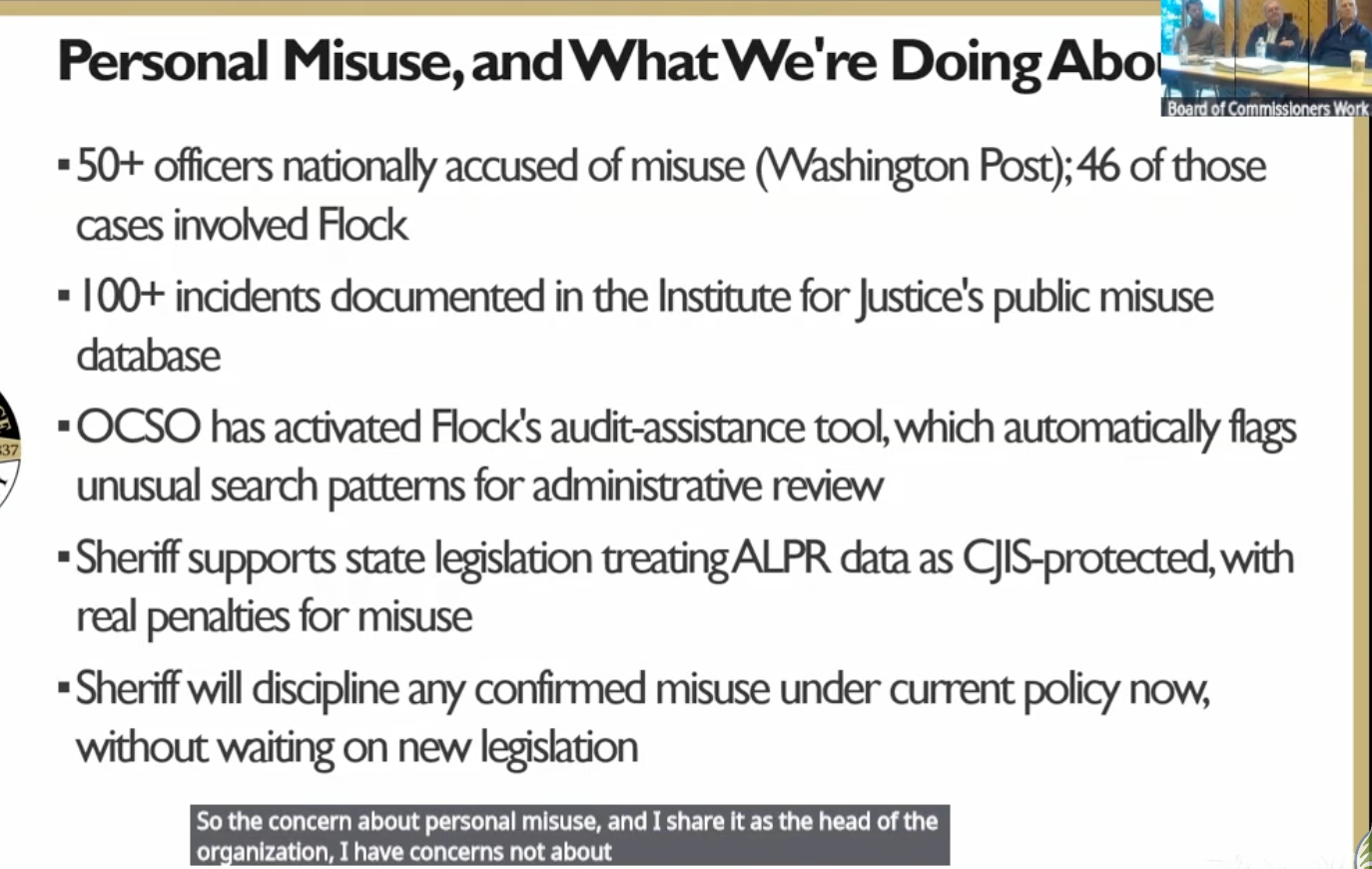
He noted shortcomings of the ALPR data, saying a law for inappropriately searching through such data doesn't currently exist.
"What I would ask as a group is to advocate through our state contacts and our lobbyists to just go and find the LEIN law violation law and add ALPR or make it broader to be all criminal justice information databases," he told commissioners.
Board members raised questions regarding auto-renewing vendor contracts, noting that while the initial agreement was approved in early 2024, automatic two-year extensions bypassed explicit legislative re-votes.
Commissioners indicated that contract renewals, funding mechanisms and policy frameworks for surveillance tools should return to the full board to maintain public transparency.
DeBoer confirmed there are no plans to budget for additional standalone Flock cameras through fiscal year 2027, though upcoming records management system software options will be brought before the board for evaluation.
The department also announced plans to launch a public transparency portal through Flock to allow residents to view active sharing agreements, system policies and usage metrics online.
— Sarah Leach is the executive editor of the Ottawa News Network. Contact her at sleach@ottawanewsnetwork.org. Follow her on Twitter @ONNLeach.


