

County commissioners poised to split parks millage renewal, increase into 2 separate votes
Ottawa County voters likely will face a pair of ballot questions — split up between two elections — that will decide how the parks department will be funded over the next 10 years.

UPDATE: At its Thursday, April 30, meeting, the Ottawa County Board of Commissioners approved the following ballot language:
- A renewal and restoration of the existing 0.33-mill Parks and Open Space millage for 10 years on the Aug. 4 ballot.
- A proposed additional 0.20-mill increase for 10 years on the Nov. 3 ballot.
OTTAWA COUNTY — Ottawa County voters likely will face a pair of ballot questions — split up between two elections — that will decide how the parks department will be funded over the next 10 years.
The current 0.33 mills that county residents pay will expire at the end of 2026. The Ottawa County Parks and Recreation Commission in February is seeking a renewal of the millage as well as raising it to 0.53 mills — a nearly 60% increase.
If approved by voters, the 0.2-mill increase would generate an estimated $102.5 million over 10 years beginning in 2027.
But first, the ballot language must be approved by the board of commissioners at its regular meeting slated for 9 a.m. Thursday, April 30.
How we got here
The Parks and Recreation Commission was created in 1987, when the county only had a few trails and parks open to the public.
Since then, the county has become one of the fastest-growing counties in the state for the past 30 years. The commission, wanting to expand to keep up with the demand of the growing population, asked voters in 1996 to help support its initiatives to create, expand and maintain county greenspace.
Read More: Parks department hopes voters will renew parks millage in 2026 to continue development
The 10-year millage was first approved in 1996 with 53% of voter approval. When it came up for renewal in 2006, 67% of voters approved it and, in 2016, 72% of voters approved it.
The dedicated park millage, combined with grant funds, user fees and gifts, and donations, has allowed the commission to provide an award-winning park system to serve residents and visitors.
Key projects that the millage money funded include:
- Ottawa Sands: a land acquisition that was formerly a sand mine, which was converted into a new park. The project included ecological restoration and other amenities. A documentary film released earlier this year, called “The Ottawa Sands Project,” won a national Savvy Award from the City-County Communications and Marketing Association in 2025. It tells the story of the park's acquisition, conservation efforts and community collaboration.
- Crockery Creek Natural Area: Another project that uses millage money to buy land, more land has been acquired by the Parks system since 1996. Part of a few parks in the county that allow hunting on the land, this area allows hunters to enter a lottery to hunt there.
- Rosy Mound Natural Area: A project that has been a work in progress for over 30 years. The department bought 291 acres over the past 30 years. Most of the 127 acres added recently will be restored as a nature area, and other sections used as an area for hiking and a boardwalk through the sand dunes for the public.
The system currently attracts more than two million visitors annually. Officials say that for every $1 invested through the millage, the parks generate approximately $6 in local economic impact.
However, with continued park expansion, a higher percentage of millage funds is now devoted to operations and maintenance, creating greater reliance on other funding for new initiatives.
Asking for more
Parks officials argue that the millage increase is a matter of necessity rather than luxury.
They contend that rising operational and maintenance costs are now fully consuming the revenue generated by the existing millage, leaving the department with little capital to expand trails, acquire new land or maintain aging infrastructure at its more than 40 sites.
"Public feedback has been clear. Residents value our parks and want more access, better trail connections, and continued conservation,” said Jason Shamblin, director of Ottawa County Parks and Recreation. “This recommendation reflects what we heard, and what it will take to deliver."
The initiative would involve what is known as a “Headlee rollback,” referring to Michigan’s constitutional requirement for local governments to reduce their property tax millage rate when the total taxable value of existing property increases faster than the rate of inflation. It ensures tax revenue growth does not exceed inflation, protecting taxpayers from high tax increases.
If the parks millage rate were to rise to 0.53, a resident with a home taxable value of $100,000 would see a tax bill increase from $33 to $53 per year.
Read More: Ottawa County Parks looks to voters to secure more funding
High-priority projects include major improvements at Rosy Mound Natural Area, the expansion of the Idema Explorers Trail, and the renovation of a historic barn at Eastmanville Farm to serve as a new park headquarters.
On Jan. 27, Shamblin presented the parks commission’s 2026 Open Space Plan, saying: “Our national polling forum who did this had never seen such high positive results. I think that's a testament to the park system we have here in Ottawa County.”
He also presented the commission’s annual report at the March 24 meeting of the board of commissioners, where county officials also discussed the parks commission’s request for a single ballot question to increase the millage on either the Aug. 4 primary ballot or the Nov. 3 general election ballot.
That report noted that there are more than 7,700 acres, including 29 parks, 13 open spaces, and more than 150 miles of trail within the county parks system, which drew more than 2 million visitors in 2025.
How would the money be spent?
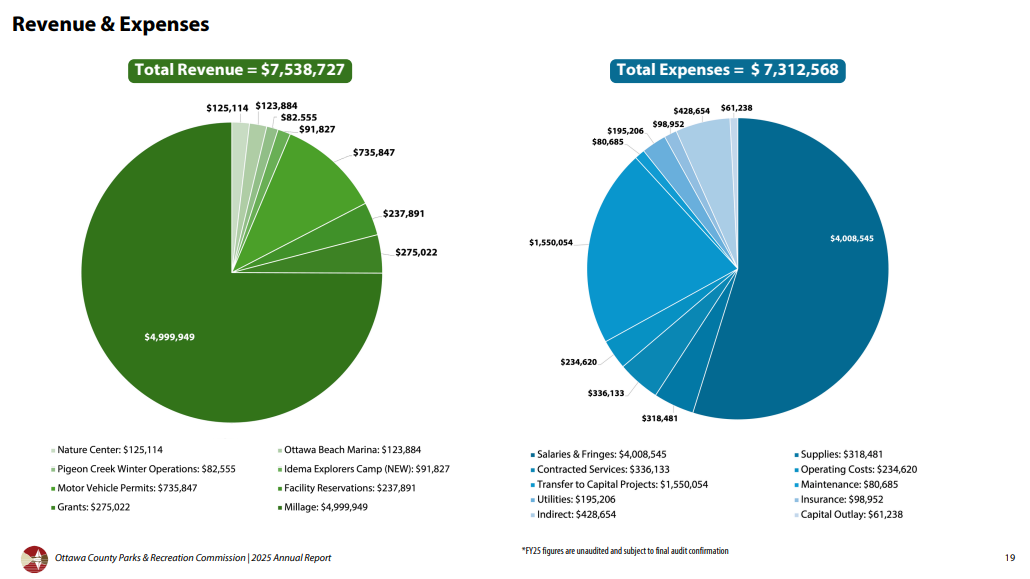
Of the department’s $7.54 million in revenue, $5 million (66%) comes from the millage, according to the 2025 report. Of the department’s expenses of $7.31 million in 2025, just over $4 million (55%) was to help cover “salaries and fringes,” according to the report.
■ Adding acreage
The parks commission said it was able to identify “specific needs” of the county if the millage increase were ultimately to be approved by the board to be on the ballot and ratified by voters, which includes adding more land to the county’s portfolio and adding additional staff.
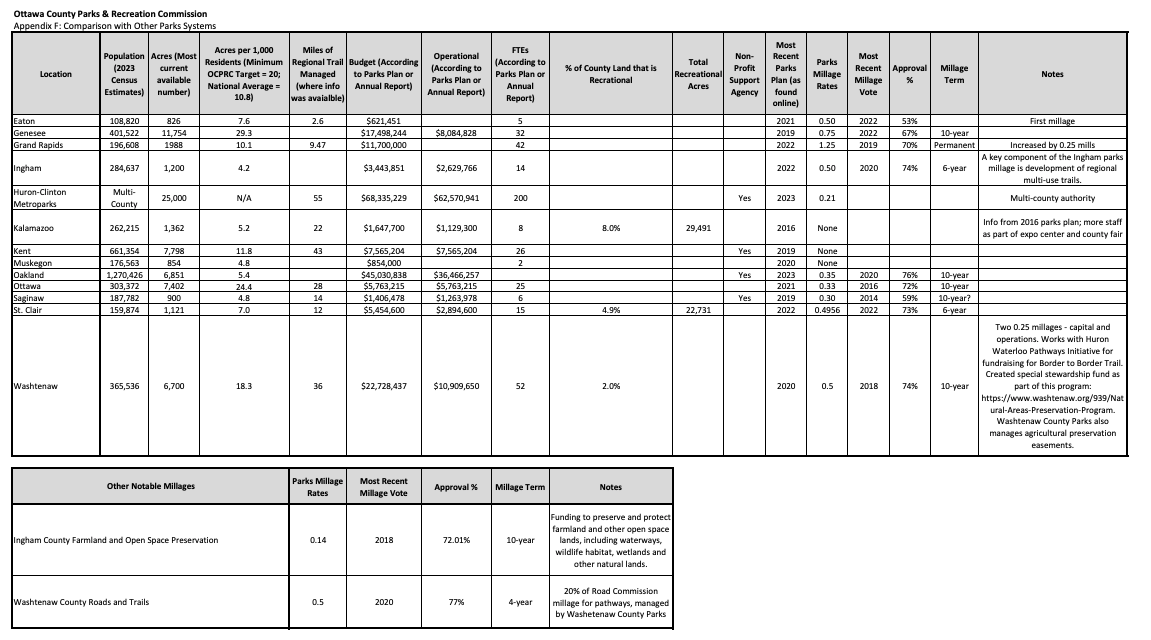
In 2021, the commission adopted a guideline of a minimum of 20 acres per 1,000 population for county park and open space lands.
Based on 2019 Census estimates, there were about 291,830 residents in Ottawa County, meaning the county should have 5,837 acres of park and open space land to meet those guidelines. At the time, the county parks system had 7,205 acres, exceeding the 1,368-acre goal to stay within the guidelines.
In that 2021 plan, the parks commission said it would need 6,760 acres by 2030 to serve an expected population estimate of 338,233, which it exceeded five years ago as well.
Ottawa is in the top tier of park acreage per capita when compared to its peers. As the seventh-most populous county in Michigan, it surpasses second-most populous Oakland County in acreage — 6,851 acres for 1,270,426 residents — and nearly equals neighbor Kent County, the fourth-most populous county, which has 7,798 acres for its 661,354 residents, according to the parks commission’s 2024 report.
In the Open Space plan that was released in January, the commission said that, although the parks system “meets the general guidelines” that were set in 2021, more land acquisition would be required to complete greenways.
In its “action plan,” the commission said it would continue to prioritize “high-quality maintenance and operations with projections of long-term capital renovation needs,” with a large majority of discretionary millage funds from the current millage level dedicated to renovations of current park facilities.
However, the commission also indicated its desire to grow with “key property acquisitions” identified.
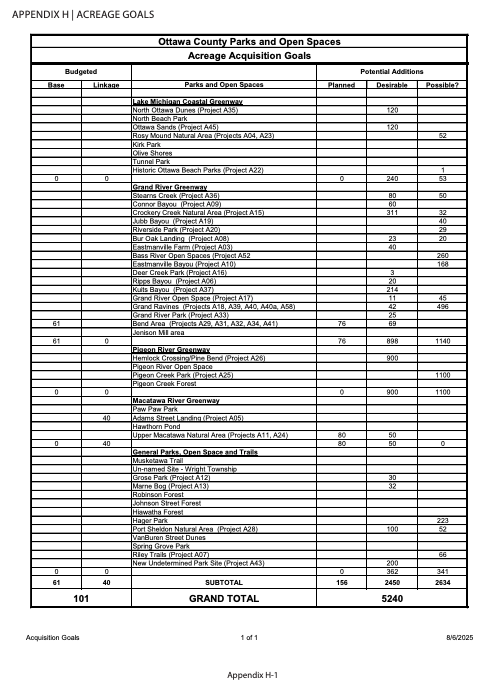
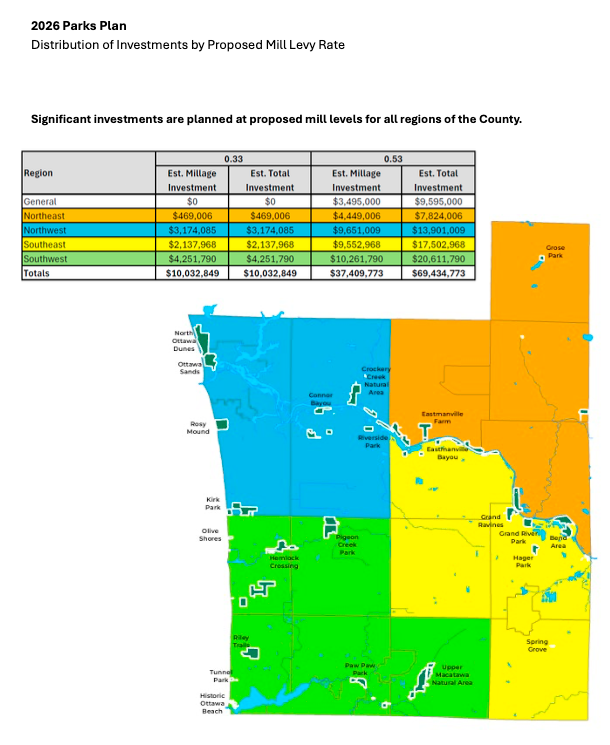
In the 2026 plan, $10 million is earmarked for more acquisitions over the next 10 years if the millage increase is approved, with a goal of adding another 5,240 acres to the parks system (156 marked “planned,” 2,450 marked “desired,” and 2,634 marked “possible?”).
“The goal really isn't ‘buy a lot of new land and expand lots of new properties,’” Shamblin told commissioners in April. “We have a small amount of funding set aside [for] properties that are adjacent to existing parks. … We want to be able to have some funding set aside if and when those opportunities present themselves.”
The majority of those acquisitions would be to expand and connect long-term projects like the Lake Michigan Coastal Greenway, the Grand River Greenway, the Pigeon River Greenway, and the Macatawa River Greenway — although more than 340 acres were labeled under “general parks, open spaces and trails,” according to the 2026 plan.
In January, Shamblin also said that, at the current 0.33 millage rate, there would be 31 major repairs and reinvestment projects. At the increased 0.53 millage rate, however, “we would have 22 projects that focused on conservation, 17 projects for additional connectivity, major trail connections, improved trail connections, and then 15 projects for community engagement.”
Shamblin cautioned board members, however, that not all of the proposed projects would be funded, “but we try to capture those and then that way if we have funding opportunities come about or a grant opportunity that allows us to apply for those …”
■ Other additions
The funds would also likely add additional staff to the parks department.
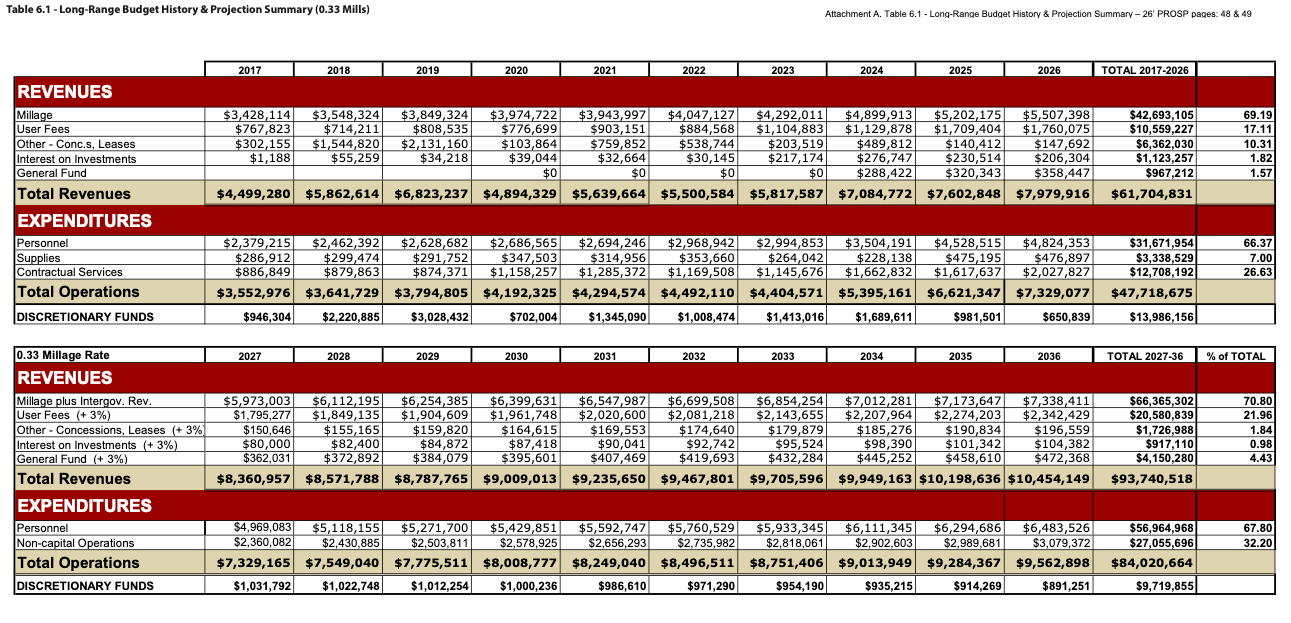
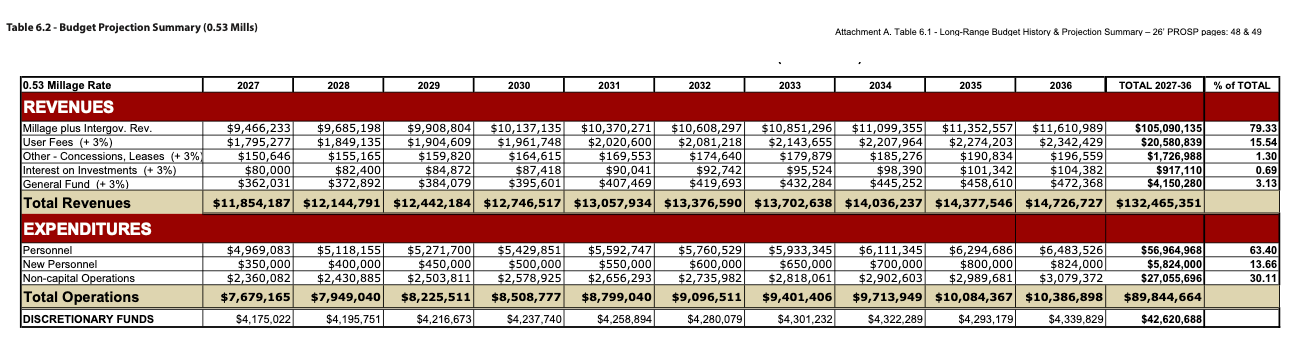
If the millage rate is renewed at its current rate, $56,964.968 of that funding would be dedicated to covering personnel-related costs; the increase to 0.53 mills would cover $5,824,000 in “new personnel.”
The commission’s discretionary funds are also notable if the increase is enacted.
Discretionary funds, which are pools of money available for non-essential spending, have grown from $1.03 million in 2017 to $9.72 million for the next 10 years, if the current millage rate were to be renewed.
That would grow to $42.62 million if the millage increase is enacted.
Pushback from commissioners
Despite mostly positive praise from commissioners, several had concerns about the increase.
“I am appreciative that you guys are taking into account where we're at now on upkeep and just maintaining what we have. I think that's really important,” Commissioner Sylvia Rhodea, a member of the board’s far-right minority faction known as Ottawa Impact, said at an April 14 work session.
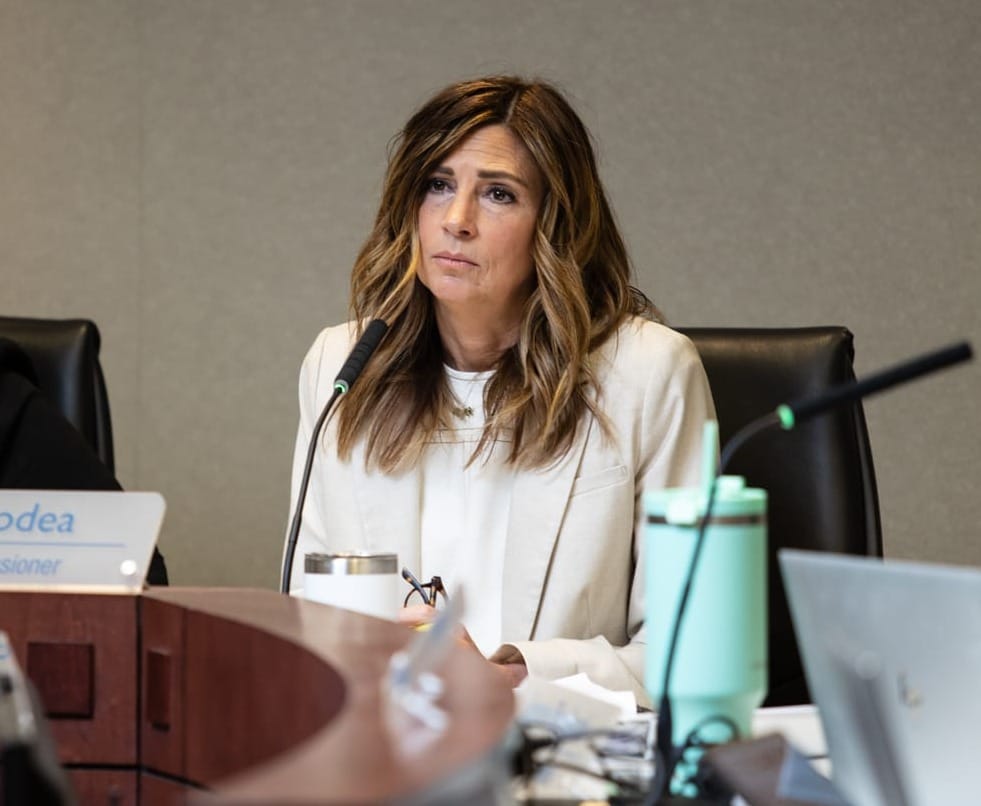
“I think it's also important to think about, as we continue to increase our parks, what's that going to look like long-term? Because then we might be looking at a higher cost ongoing and keeping up even more,” she said.
The special April work session also focused on the renewal of the county’s 0.30-mill rate of the Community Mental Health millage, which is also on the same 10-year cycle as the parks millage.
Commissioner Doug Zylstra, the board’s lone Democrat, asked for contingency options if the board were not to approve the original increase request.
“What are we actually talking about?” he asked Shamblin at the April meeting. “I'll be talking about option 0.53, but I would just like to see what our two, three, four, five options are.”
“Having conversations about taxes, let alone a tax increase, is not easy,” Shamblin said at the April work session.
Board Chair Josh Brugger asked about the possibility of breaking the increase into two separate millage requests between the August and November ballots, which Shamblin called “a reasonable compromise.”
Corporation counsel Doug Van Essen told the county officials that they could “split these votes up any way you want.”
“You could have three questions in August. You could have two questions in August, and the third in November,” he said.
He cautioned, however, against confusing voters by having the renewal and the increase as separate questions on the same ballot.
“That's so confusing to the voters,” Van Essen said. “What are these questions? ‘Do I just renew at 0.33? Do I roll back to 0.33, and then do I separately vote on the increase?”
Shamblin acknowledged that the timing of the increase, along with the simultaneous CMH ask — in addition to the volatility of the U.S. economy — were definitely factors to consider.
“If parks and CMH would do a renewal and restore in August — really for CMH, that's pretty critical timing for them — it allows us to focus on collaborating together, working on the renewal,” he said.
“If the board's comfortable with an increase, moving that question to November, then we're able to look at ensuring the operating and maintaining what we have in August, with a ‘renew and restore’ in November with the increase and having those separated,” Shamblin said.
Commissioner Joe Moss, the president of Ottawa Impact and 2023-24 board chair, said he saw the issue as two separate asks of voters.
“There's two very different mindsets that people will be in,” he said. “If you're asking people to just increase, that's a very different question than in November saying, ‘Well, we've already renewed what we had. Will you invest a little … point two more?”
Rhodea also appeared critical of the project list that the parks commission provided as to priorities for the next decade, regardless of whether the millage is renewed or increased.
“I also wonder if we really need to continue to invest quite so heavily along the lakeshore. … I'd be more comfortable with a 0.1 millage and then being careful that we're spreading our efforts out more across the county,” said Rhodea, who represents Allendale Township.
Shamblin pointed to the Grand River Greenway and Bend Area Open Space project in Georgetown Township as initiatives that underscore efforts on the east side of the county.
“We're building regional parks and 300-plus acres. So, although it's not your constituents’ direct neighborhood, we try to make sure that we're looking at where people are coming from,” Shamblin said.
Shamblin said he didn’t “want to be Chicken Little,” but that he was advocating for what the parks system would look like 15-20 down the road.
“We want to do some planning and bring the county and the board together and the other departments as we talk about managing growth, and what does that look like?” he said.
What happens now
At the board’s full meeting on March 24, OI Commissioner Allison Miedema pointed to a letter written by Parks Commissioner Field Reichardt that offered the alternative of splitting the options for voters into two asks: one to renew at the current rate and a subsequent request to increase the millage rate.
“I'm guessing that most of you received the letter from one of our parks commissioners,” Miedema said. “I thought that Field had a really good thought process and it was along the lines of some things that I had already been considering.”
In the letter, Reichardt, who joined the parks commission in January 2025, said he was an adamant supporter of the parks system and the millage; however, he recognized the impact that the increase could pose to residents.
“I … believe you support our parks, but may have some hesitation to ask the voters to support a nearly 60% increase in taxes for them in this time of economic uncertainty,” Reichardt wrote in the letter dated March 19. “Rather than oppose this increase and simply support the restoration and renewal to 0.33, I strongly suggest you consider an alternative to give the voters two ballot proposals:
- The restore and renew to .33 mills
- A second .10 mill ballot proposal with a list of specific projects to be completed in the coming decade.
“Voters would likely prefer to know detail(s) of what they would be supporting in the extra .10 mill vote and that the extra funds clearly pay for meaningful projects,” Reichardt wrote.
Reichardt told ONN on Tuesday, April 28, that he was “sensitive to the fact that we live in interesting economic times, and I'm concerned about voters looking at a 60% increase in their taxes for parks.”
He said the letter was intended to give county commissioners options, so the millage renewal and increase could get across the goal line.
“I basically just said: “If you vote to do the 0.53 mills, I will support it and I'll do whatever I can to help get it passed.’ But I also basically say, ‘Hey, I'm concerned that the voters are fiscally conservative, so I proposed an alternative, which was to renew and restore, and then have a separate item on the ballot for a 10th of a mill that basically, very specifically, says what that 10th of a mill is going to pay for,” Reichardt said.
Brugger said he had a good sense of where individual commissioners were landing on the millage question to inform the board for Thursday’s meeting.
At 9 a.m. April 30, commissioners will consider the following language:
- CMH: “To adopt the resolution approving the ballot language to place the renewal and restoration of the ten (10) year 0.30 mill dedicated millage for Community Mental Health on the August 4, 2026, ballot.
- Parks: The renewal and restoration of the ten (10) year 0.33 mill dedicated millage for the Parks and Open Space on the August 4, 2026, ballot; and placing the ten (10) year 0.20 mill increase dedicated millage for the Parks and the Open Space on the November 3, 2026, ballot.
For more information on the Parks and Recreation Commission, as well as millage request information, visit miottawa.org/parks/parks-millage.
— Sarah Leach is the executive editor of the Ottawa News Network. Contact her at sleach@ottawanewsnetwork.org. Follow her on Twitter @ONNLeach.


