

Great Lakes show signs of declining PFAS pollution
Rising levels of per- and polyfluoroalkyl substances contamination are prompting scientists to question whether these waters can safely sustain surrounding communities.

By Riley Wilson
Capital News Service
LANSING — For generations, the Great Lakes have been viewed as a symbol of abundance and food security.
However, rising levels of per- and polyfluoroalkyl substances contamination are prompting scientists to question whether these waters can safely sustain surrounding communities.
PFAS are a group of human-made chemicals that have been used in industrial products and processes since the 1940s. They are often referred to as “forever chemicals” because they do not break down naturally and require specialized technology to be destroyed.

PFAS contamination is a significant concern in Ottawa County, with multiple identified sites, including a newly declared contamination site at the Citgo terminal in Ferrysburg this year.
Key areas of concern include the 120th Avenue area near Robinson Elementary, the Southwest Ottawa County Landfill, and the Tallmadge Township area, where residential wells have been sampled.
When these chemicals enter the human body, they accumulate faster than they can be eliminated. Studies have linked PFAS to a range of adverse health effects.
According to the U.S. Environmental Protection Agency, PFAS ingestion may increase the risk of certain cancers, including prostate and kidney cancers.
Research estimates that PFAS are detectable in approximately 98% of the U.S. population.
Over time, products containing PFAS can release the chemicals into the environment, contaminating food sources and drinking water. When people consume contaminated food or water, the chemicals enter and accumulate in their bodies.
That’s particularly concerning for communities surrounding the Great Lakes, which serve as a source of food and water for millions of residents.
A recent study in the Journal of Great Lakes Research analyzed four decades of archived fish from the Great Lakes to assess historical PFAS trends.
The researchers found a decline in PFAS levels in the Great Lakes’ top predator fish species, lake trout and walleye, suggesting lower levels of long-lasting contaminants in the resources these fish consume.
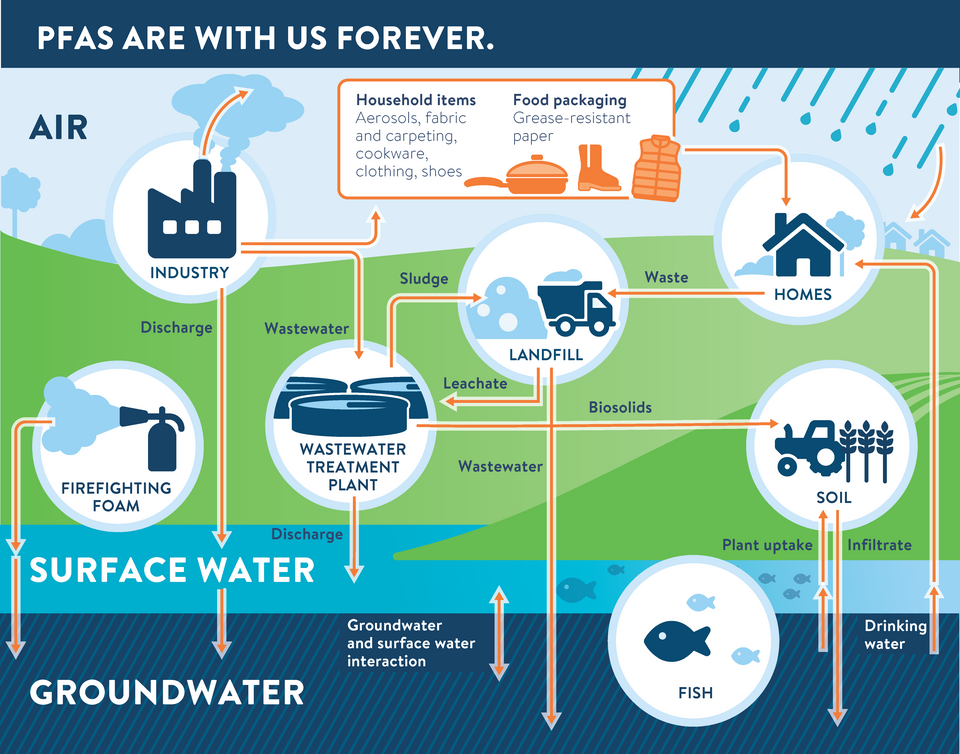
Study lead author Sarah Balgooyen of the Colorado School of Mines Department of Civil and Environmental Engineering said that diet is the primary PFAS pathway for most people. This can include consuming contaminated fish, processed foods or food that was in contact with PFAS- containing packaging.
As a result of the study, Balgooyen said people can be reassured that fish from the Great Lakes contain lower levels of bioaccumulative PFAS than they did a decade ago. This is largely because manufacturers stopped using long-chain PFAS chemicals in the production of products, making them harder to enter and contaminate Great Lakes ecosystems.
“It’s a great sign that we are seeing such quick declines and that the ecosystem is readily reacting to the industrial changes that have been made. It can be assumed that the water, therefore, contains less of these compounds as well,” Balgooyen said.
Fish are an important indicator for studying PFAS contamination because they occupy the top of the freshwater food chain and often accumulate higher concentrations of these chemicals than other freshwater organisms.
Balgooyen emphasized that limited federal regulation of PFAS has made state-level policies imperative for continuing to reduce contamination levels.
“Since the strategy of each of the states has differed, it also provides the federal government with information about the feasibility and effectiveness of these various strategies, in the event that they regulate in some of the same ways in the future,” Balgooyen said.
When considering regulations, ethical principles are essential, according to Kevin Elliott, a Michigan State University professor affiliated with the university’s Center for PFAS Research.
Certain core principles may be key, he said.
“I was involved in producing a report for the U.S. National Academy of Sciences titled ‘Guidance on PFAS Exposure, Testing and Clinical Follow-Up’ and like the principles proposed in that report: proportionality, justice, autonomy, feasibility and adaptability.”
“We proposed these principles for a clinical setting in which patients are making decisions with their doctors, but I think the principles can be helpful in many different contexts,” Elliott said.
Some communities are disproportionately affected by PFAS contamination due to higher levels of pollution and other environmental stressors, Elliot said, and policymakers must consider these cumulative impacts rather than addressing each stressor in isolation.
“An important first step is to provide more opportunities for these communities to provide their feedback and express their needs and concerns directly to policymakers,” Elliot said.

As awareness of PFAS risks continues to grow, ongoing scientific research and regulation at both the state and federal levels will be crucial to protecting communities surrounding the Great Lakes, according to Balgooyen.
Millions rely on the resources these lakes provide, making the reduction of contamination a top priority.
The EPA stresses that continued monitoring of fish and other key indicators of contamination will help track progress and sustain declines in bioaccumulative chemicals in the Great Lakes.
The National Institute of Environmental Health Sciences said that despite advances in research, PFAS contamination remains an ongoing problem, and its full impacts have yet to be realized.
— Riley Wilson writes for Great Lakes Echo.


