


State high court ruling reshapes solar battle as Zeeland Twp. lawsuit returns to lower bench
A Michigan Supreme Court ruling affirming state regulators' authority over large-scale renewable energy projects has reshaped the escalating land-use battle in Ottawa County over the proposed $330 million, 200-megawatt Silver Maple Solar facility.

ZEELAND — A Michigan Supreme Court ruling affirming state regulators' authority over large-scale renewable energy projects has reshaped the escalating land-use battle in Ottawa County over the proposed $330 million, 200-megawatt Silver Maple Solar facility.
In Almer Charter Township et al. v. Michigan Public Service Commission, the high court upheld the commission’s power to enforce Public Act 233, the 2023 law allowing utility-scale solar, wind, and battery developers to bypass local zoning boards for state permits.
The court also preserved the commission’s strict definition of a "compatible renewable energy ordinance," preventing townships from requiring special land-use permits or imposing stricter local rules than state baseline standards.
For Zeeland Charter Township — one of 72 townships and seven counties that challenged the rules — the ruling narrows its administrative options to block German-based developer RWE’s proposed 1,900-acre project across Zeeland and Jamestown townships.
Zeeland Township lawsuit returns to state court
While the Supreme Court settled how state regulators enforce Public Act 233, Zeeland Township is still challenging whether the law itself is constitutional, arguing it overrides local control over regulating wind, solar, and energy storage facilities.
The township sued Silver Maple and RWE in Ottawa County Circuit Court on July 7 before developers moved the case to federal court in August. The lawsuit centers on whether RWE attempted to bypass township oversight by improperly invoking state-level permitting rules.
In November, U.S. District Judge Paul L. Maloney sent the lawsuit back to Circuit Judge Jon H. Hulsing’s court, leaving the constitutional challenge active.
Ottawa County secures a seat as an intervenor
The same Almer litigation that curtailed township zoning power also gave counties formal standing to weigh in on state permitting decisions.
During an October work session with the Ottawa County Board of Commissioners, Corporation Counsel Doug Van Essen told commissioners that intervening before the commission does not grant veto power to stop the project.
Read More: County commissioners poised to intervene in $330M solar dispute
However, it allows the county to push for binding permit conditions on stormwater, drainage, and environmental standards. He also warned that the county could be forced to repay statutory intervenor funds, depending on ongoing court appeals.
Following heated debate, the Ottawa County Board of Commissioners voted 10-1 on Oct. 27 — with Holland Democrat Doug Zylstra dissenting — to intervene ahead of a Nov. 19 prehearing conference before Administrative Law Judge James Varchetti.
At the board's Nov. 17 meeting, Van Essen confirmed the intervening filing was complete. In the Oct. 29 filing, the county — currently represented by Van Essen until an attorney with more specialized experience is hired — stated it will define its specific positions and potential requests for permit conditions after meeting with the applicant and reviewing full case testimony.
The filing also signals the county's willingness to engage directly with the developer.
Referencing application testimony from Joseph Brochu indicating the developer's interest in meeting with local officials, the petition states Ottawa County is open to discussing a potential host community agreement that would take effect if the project is approved.
If built, state grant programs tied to large-scale renewable projects would provide host municipalities $4,000 to $5,000 per megawatt — up to $1 million in unrestricted local funds for infrastructure and upgrades.
What is the Silver Maple project?
RWE has pitched the Silver Maple Solar facility as a cornerstone of West Michigan's transition toward domestic energy independence.
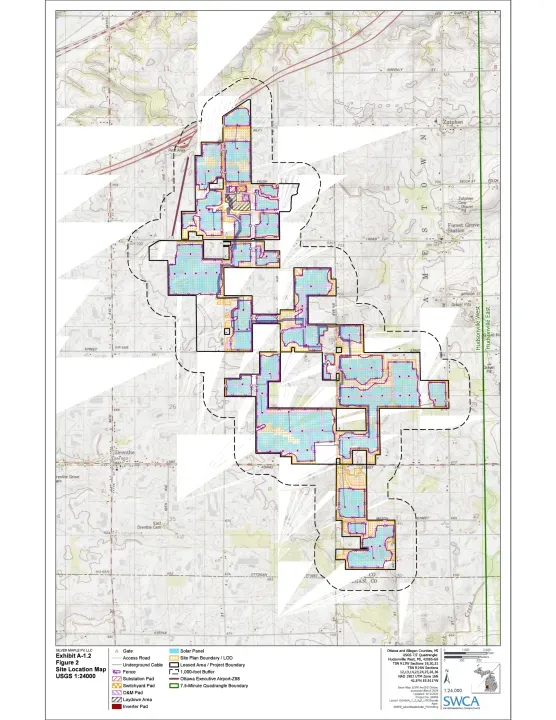
According to project specifications published by the developer, the 200-megawatt solar and energy storage array across Zeeland and Jamestown townships is designed to deliver several economic and environmental impacts:
- Power generation: Enough electricity to power roughly 34,000 homes.
- Tax revenue: Over $19 million in local property taxes over its operational lifetime, including more than $14.5 million allocated directly to area school districts.
- Environmental and health savings: Roughly 219 million gallons of water conserved annually compared to fossil-fuel generation, plus $7.3 million in annual regional public health savings due to reduced air pollution.
Local residents and neighboring farmers, however, view the proposal as an industrial intrusion on fertile soil that will harm local agriculture and the environment. Some described feeling deceived by early land solicitations and expressed alarm over declining rural property values, loss of open space, and the sheer scale of the 1,900-acre development.
RWE initially applied for approval in April, but suspended the application after a Michigan Court of Appeals ruling allowed Ottawa County to join the two townships as an affected local unit opposing the project.
The company resubmitted its application under the entity name Silver Maple PV LLC on Sept. 18 with the MPSC, giving MPSC staff 60 calendar days (until Nov. 17) to determine completeness or file an incompleteness determination notice to the case docket.
If approved, RWE expects to break ground in late 2027 and have the facility fully online in the second quarter of 2029.
What is PA 233?
The passage of Public Act 233 was the culmination of a coordinated legislative drive to realize Michigan’s ambitious climate goals by dismantling local zoning barriers to renewable energy expansion.
The momentum began in 2022 when Gov. Gretchen Whitmer introduced the MI Healthy Climate Plan, outlining a vision for the state to achieve complete carbon neutrality and transition entirely to clean energy by 2040.
As utilities and private developers moved to secure rural property for solar arrays, wind turbines, and battery storage systems, dozens of townships and counties responded with moratoriums, stringent setback distances, or total bans. State officials and industry advocates warned this patchwork of local rules created a bottleneck capable of stalling the state’s clean energy timeline indefinitely.
To overcome the gridlock, Democratic lawmakers in the 102nd Legislature introduced House Bill 5120 in the fall of 2023 to remove municipalities' traditional veto power and grant regulatory preemption authority to the Michigan Public Service Commission (a three-member body appointed by the governor that regulates utilities and telecommunications).
The bill ignited a fierce political debate:
- Proponents — spanning clean energy organizations, environmental groups, labor unions and major electric utilities — insisted a standardized statewide permitting process was essential to speed up decarbonization and drive economic growth.
- Opponents — led by the Michigan Townships Association, local officials, agricultural advocacy groups and legislative Republicans — argued the bill trampled on local self-determination and forced unwanted industrial installations onto working farmland.
Despite intense pushback from municipal leaders, the Democratic-controlled Legislature approved House Bill 5120 along narrow, largely party-line votes in November 2023. Whitmer signed the measure into law as Public Act 233, which took full effect on Nov. 29, 2024, following a one-year transition period.

What comes next
RWE’s permit application (Case No. U-22071) now moves forward before Administrative Law Judge James Varchetti, with formal county testimony due in early 2027.
While the Supreme Court will hear two remaining technical cross-appeals in the Almer case in January, the immediate fight over Silver Maple Solar hinges on Ottawa County’s push for permit conditions and Zeeland Township’s constitutional lawsuit.
How to submit public comment: Anyone wishing to express their opinions on the project can fill out an online form through the MPSC’s renewable energy and storage facility siting webpage under project case number U-22071.
— Sarah Leach is the executive editor of the Ottawa News Network. Contact her at sleach@ottawanewsnetwork.org. Follow her on Twitter @ONNLeach.


