

County commissioners poised to intervene in $330M solar dispute
Caught between clean energy goals and preserving farm land, Ottawa County commissioners met Oct. 16 to decide whether to formally oppose or intervene in state proceedings over the $330 million Silver Maple Solar Project.

OTTAWA COUNTY — Caught between the shift toward clean energy and the defense of local agricultural land, the Ottawa County Board of Commissioners met during an Oct. 16 work session to grapple with a high-stakes decision: whether to formally intervene in state-level regulatory proceedings over the controversial $330 million Silver Maple Solar Project.
The proposed 200-megawatt development by German-based developer RWE Solar spans roughly 1,900 acres across Zeeland and Jamestown townships.
However, local control over the project’s future was dramatically altered by Michigan’s Public Act 233, which shifts the primary permitting and siting authority for large-scale, utility-grade renewable energy projects from local municipal zoning boards to the state level.
A constitutional challenge to the law is now making its way through the courts, placing Ottawa County municipalities at the heart of the high-stakes dispute that could alter the course of green energy projects in the state.

What is PA 233?
The passage of Public Act 233 was the culmination of a coordinated legislative drive to realize Michigan’s ambitious climate goals by dismantling a persistent barrier to renewable energy expansion.
The momentum began in 2022 when Gov. Gretchen Whitmer introduced the MI Healthy Climate Plan, outlining a vision for the state to achieve complete carbon neutrality and transition entirely to clean energy by 2040. Meeting those aggressive targets required utilities and private developers to rapidly construct vast networks of solar arrays, wind turbines, and battery storage systems across rural landscapes.
However, as developers moved to secure property and build large installations, they ran into strong community opposition.
Across the state, dozens of townships and counties responded by passing moratoriums, enacting stringent setback distances, or implementing total bans on utility-scale clean energy projects. State officials and industry advocates warned that this patchwork of local zoning barriers was creating a bottleneck capable of stalling the state’s clean energy timeline indefinitely.
To overcome the gridlock, Democratic lawmakers in the 102nd Legislature introduced a broad package of reform legislation in the fall of 2023. At the center of the initiative was House Bill 5120, which sought to remove local municipalities' traditional veto power over major energy developments and grant regulatory preemption authority to the Michigan Public Service Commission, a three-member commission appointed by the governor that regulates utilities and telecommunications companies in the state.
The bill ignited a fierce political debate across the state.
Proponents — a coalition spanning clean energy organizations, environmental groups, labor unions and major electric utilities — insisted that a standardized, statewide permitting process was essential to speed up decarbonization and drive economic growth.
Conversely, opponents led by the Michigan Townships Association, local officials, agricultural advocacy groups and legislative Republicans argued that the bill trampled on local self-determination and forced unwanted industrial installations onto working farmland.
Despite intense pushback from municipal leaders, the Democratic-controlled Legislature approved House Bill 5120 along narrow, largely party-line votes in November 2023, and Whitmer formally signed the measure into law as Public Act 233.
Built with a one-year transition period, the statute took full effect on Nov. 29, 2024, providing state regulators time to build out the administrative framework for reviewing future energy applications.

What is the Silver Maple project?
RWE has pitched the Silver Maple Solar facility as a cornerstone of West Michigan's transition toward domestic energy independence.
According to project specifications published by the developer, the 200-megawatt solar and energy storage array across Zeeland and Jamestown townships is designed to generate enough electricity to power roughly 34,000 homes.
The company estimates the development will generate over $19 million in local property taxes over its operational lifetime, including more than $14.5 million allocated directly to area school districts.
RWE also said the water-free facility will conserve roughly 219 million gallons of water annually compared to fossil-fuel generation and yield $7.3 million in annual regional public health savings due to reduced air pollution.
Local residents and neighboring farmers, however, view the proposal as an industrial intrusion on fertile soil.
Some described feeling deceived by early land solicitations and expressed alarm over declining rural property values, loss of open space and the sheer scale of the 1,900-acre development.
RWE resubmitted its application under the entity name Silver Maple PV LLC on Sept. 18 with the MPSC. The company initially applied for approval in April, but then suspended the application after a Michigan Court of Appeals ruling allowed Ottawa County to join the two townships as an affected local unit opposing the project.
If approved, RWE would break ground in late 2027 and have it fully online in the second quarter of 2029.
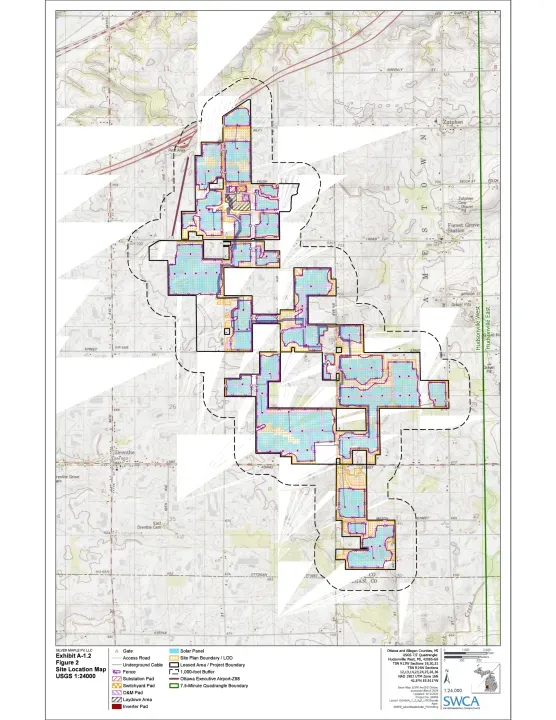
Zeeland Township filed suit claiming PA 233 is unconstitutional, arguing the law overrides local control over regulating wind, solar and energy storage facilities. The project has generated heated opposition from many township residents, who believe its construction will harm local agriculture as well as the environment.
MPSC staff has until Nov. 17 — 60 calendar days from the date the application was filed to determine its completeness. If the application is considered incomplete, staff will file an incompleteness determination notice to the case docket, according to the MPSC website.
Comments continue to be accepted online for Silver Maple. Anyone wishing to express their opinions will need to fill out an online form through MPSC. To look for information on the project, go to the MPSC’s renewable energy and storage facility siting webpage and then click on the link for the project case number U-22071.
Recent court ruling
One Zeeland Township family tried to break its contract with RWE, prompting the company to sue.
In a ruling last week, an Ottawa County judge granted RWE full legal control over 562 acres of local farmland, ordering the Smallegan family off their property and ending generations of agricultural work.
Read More: Ottawa County judge rules for solar developer in $330M land dispute with local family
The dispute stemmed from a 2020 option agreement signed by the late family patriarch, James Smallegan. RWE sued earlier this year after the family refused to honor the terms, claiming they never received formal activation notices and believed the initial paperwork covered only preliminary land studies.
Hulsing, however, rejected those defense arguments as unambiguous, noting the family patriarch’s widow had cashed over $282,000 in checks from RWE.
Hulsing ruled RWE properly exercised its option, triggering a 35-year lease that gives the developer immediate authority to clear crops and fence off the land. The judge barred the Smallegans from participating in any future legal or legislative proceedings opposing the development and ordered them to cover RWE's legal fees. The family has until Oct. 29 to file an appeal.
Despite winning physical possession of the land, RWE still faces regulatory hurdles.
In addition to the Zeeland Township legal challenge, state reviews are expected to stretch into 2027, meaning actual construction remains stalled, leaving the land and surrounding community in legal limbo.
County discusses options
In the Oct. 16 special work session, commissioners considered voting to file as an intervener in the Zeeland Township case.
Corporation Counsel Doug Van Essen explained the legal mechanics that brought the dispute to this juncture, noting how the state statute alters traditional municipal planning.
"233 is one of those instances where the state has pulled that local zoning control," he said, noting previous cases when the state leveraged that authority to site landfills. "They've now also done it in these energy projects where they pull that out of the local zoning and [have] thrown into the other state agency, in this case, the MPSC."
Following a recent Michigan Court of Appeals ruling establishing that Ottawa County qualifies as an affected local unit, or ALU, commissioners face tight statutory deadlines. The county must notify the MPSC of its intent to intervene by Nov. 12, ahead of a mandatory pre-trial hearing in Lansing scheduled for Nov. 19.
Van Essen emphasized that entering the state administrative process offers the county a seat at the table to protect key local interests — including farmland preservation, regional housing capacity and long-term infrastructure growth — rather than simply lodging a protest.
"Serving as intervener does not mean that we support one party's position or another," he said. "I think there's a sense that the county will come in and and fight this or stop this for us. ... We don't necessarily want to take a position that we're anti- solar.
"[We] want to make it clear ... that the board believes that their voice could play an effective role. We want to be effective in this process."
Van Essen further clarified that the MPSC’s ultimate decision might not be an all-or-nothing verdict, but rather a conditional permit that incorporates local standards.
"It's not necessarily the thumbs up or thumbs down. It could set conditions," he said. "It could say, 'We've listened to the county stormwater concerns ... and we'll approve the project, but only if this or that occurs.'"
In addition to procedural considerations, commissioners discussed the long-term value of participating in state-level reviews as Michigan’s renewable energy mandates take effect across rural communities.
"One of the reasons you may want to intervene is to learn more in detail about how a 233 project winds its way through the system," Van Essen said.
During discussion, ideological arguments were raised by Commissioner Sylvia Rhodea, a member of the far-right faction on the board known as Ottawa Impact, who wanted the board to consider a resolution saying the county will file as an intervenor "in every case that comes up."
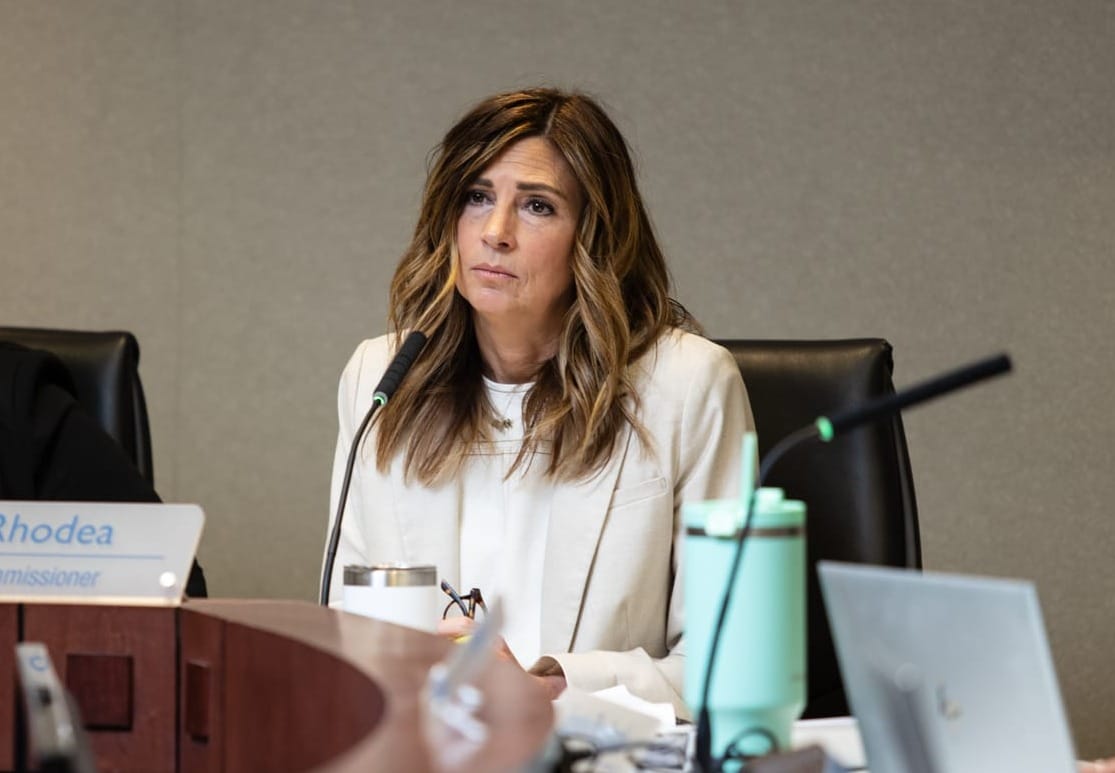
"These companies are looking for communities that they think are weak ... they're looking for where they're going to do projects ... where they don't think they're going to find resistance," Rhodea said. "I wonder if doing a resolution of some sort, where we say ... we will be an intervenor in every case that comes up in this regard — just something to signal that we're going to stand together as a community when these things come to us — to signal to these corporations we're not easy pickings."
Van Essen advised a more cautious approach to preserve the county's legal interests.
"A general resolution saying "we're going to be difficult" ... you want to be careful that you're not telling the MPSC that it doesn't matter what the project is, we're going to be opposed to it. And I say that because that hurts your ability in the MPSC to be an effective voice," he said.
Building a meaningful defense before state regulators requires a more strategic approach, he argued, one focused on substance over automatic pushback.
"If the MPSC thinks every time Ottawa comes into one of these cases, they have something meaningful to add, suddenly you're a credible player on the playing field — you're not just an obstructionist," Van Essen said.
Instead, he urged that the board craft a policy that would allow the board flexibility on what criteria would be necessary for the county to intervene in future cases.
"You need to consider, especially if the [Michigan] Supreme Court doesn't take the case, and we're going to be an automatic intervenor in all of these cases, if we choose, when we get involved and why we get involved and how we structure our analysis through a policy," he said.
Board Chair Josh Brugger said he anticipated a vote in favor of the county filing as an intervenor — if nothing more than to "keep our options open."
"I would hope that it would be a unanimous vote for the county to be an intervener in the matter," he told ONN.
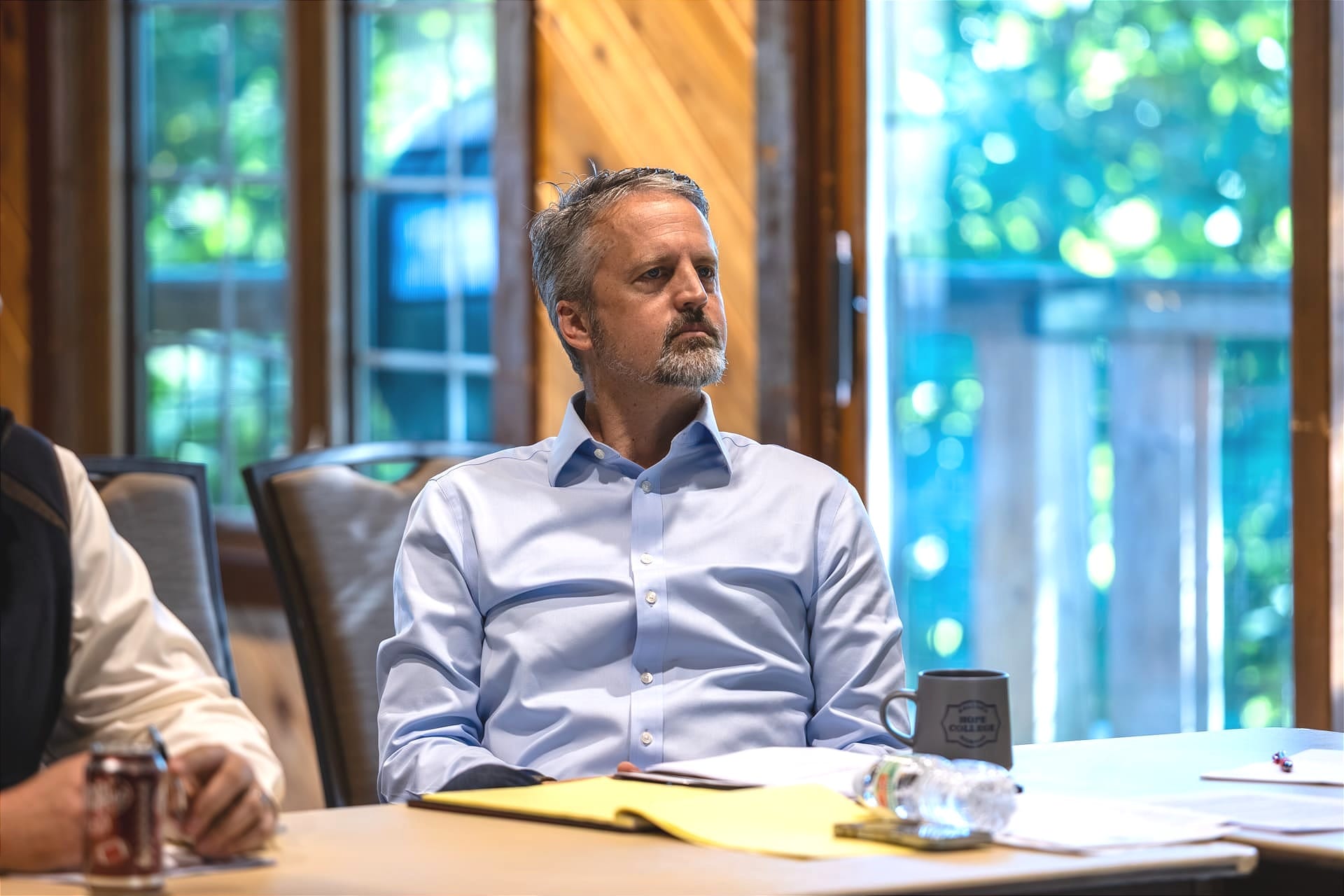
He likened the scenario to when the board voted to urge the state's Department of Environment, Great Lakes and Energy to hold public hearings earlier this year when Consumer's Energy requested permission to install two deep-injection wells to funnel ash leachate near the J.H. Campbell coal plant in Port Sheldon Township.
"While the issue at hand is different, the principle is the same. We voted unanimously to request that EGLE hold a public hearing regarding the Consumer’s Energy discharge wells. At their request, we give voice to their concerns and our residents were given the opportunity to speak to the issue," he said.
"So, too, should we add weight to the voice of our citizens regarding the RWE solar project. The vote to have a voice, to be an intervener, should be unanimous."
However, he noted that reaching a consensus on the county's official stance might prove much more difficult.
"What will likely not be unanimous is the message we send to Lansing and the MPSC. That, the second part, is where I envision the main challenge will be. Fortunately, we’ll have a little time to sort that part out."
How the money works
A key point of deliberation during the session focused on a $50,000 check sent to Ottawa County by RWE under PA 233’s intervener-funding provision.
Under PA 233, renewable energy developers seeking a siting certificate from the state must pay for a local intervenor compensation fund to assist local governments in contesting or reviewing their applications.
The idea behind the funding is that smaller units of government are entitled to launch decisions at the state level that affect them and that they typically wouldn't have the funding to launch such efforts against large conglomerates.
The developer must issue a one-time grant determined by the commission, capped at not more than $75,000 per affected local unit and not more than $150,000 in total per project.
In the Silver Maple case, RWE has already sent three checks of $50,000 each to the county and the two townships — although they have not yet been cashed as the government units sort out their respective legal strategies.
While the funds are intended to offset local legal expenses, commissioners expressed caution regarding public perception and the ethics of accepting developer funding.
There is also the possibility that the Michigan Supreme Court could reverse the Court of Appeals ruling that allows counties to be intervenors in such cases, meaning Ottawa would have to return the funds.
"Depending on the outcome of the Supreme Court case, we might be required to pay those back," Van Essen said.
What happens next
The Board of Commissioners is scheduled to cast its formal vote on whether to intervene in the MPSC proceedings, retain specialized outside counsel, and accept the intervener funding at its upcoming meeting at 9 a.m. Tuesday, Oct. 27.
If the board votes to intervene, the next step would be hiring legal counsel, which Van Essen advised should be someone who specializes in working with and presenting before the MPSC.
"They know the intricacies of it and they also have a standing with the justices," he explained about finding specialized counsel. "[The MPSC] knows that that person's credible and they can trust when that person is arguing — they're not going to come in and throw a bunch of things at the wall and mislead the commission."
Van Essen also said the commission and its procedures are unique.
"The oddities of this proceeding is you don't call a witness and present them. You present an affidavit and then you present your witness for cross-examination," he said. "So there's different skills involved procedurally in this unique setting and we should find someone that can help the local team and be an experienced player in that setting."
A pre-hearing date has been set for later this fall on the resubmitted application for the Silver Maple solar project in Zeeland and Jamestown townships.
The pre-hearing on RWE’s application with the Michigan Public Service Commission has been scheduled for 9 a.m. Thursday, Nov. 19, before Administrative Law Judge James Varchetti. The hearing will be via video/teleconference, according to application documents.
— Sarah Leach is the executive editor of the Ottawa News Network. Contact her at sleach@ottawanewsnetwork.org. Follow her on Twitter @ONNLeach.


