

Cost of the Campbell: How a West Michigan coal plant became the epicenter for a U.S. energy war
What was supposed to be a straightforward retirement for one of Michigan’s largest coal-fired power plants has devolved into a multi-hundred-million-dollar tug-of-war between federal energy officials, state regulators and community advocates.

Story Summary
- Ahead of the scheduled closure, the conservative-led Ottawa County Board of Commissioners passed a symbolic 9-1 resolution urging a halt to the shutdown, with far-right Ottawa Impact officials framing the retirement as a threat to grid stability driven by a "green energy agenda."
- Just eight days before decommissioning, U.S. Energy Secretary Chris Wright invoked emergency powers under Section 202(c) of the Federal Power Act to keep the plant online. The 90-day order echoed local conservative arguments regarding regional grid reliability. Over the course of 16 months, the Department of Energy continuously renewed the order.
- Michigan Attorney General Dana Nessel, alongside state leaders and environmental groups, mounted federal court appeals challenging the DOE's executive overreach, accusing federal officials of manufacturing an emergency at the expense of state authority and ratepayers. Meanwhile, the forced operation costs roughly $1 million per day (with Consumers Energy reporting over $135 million in excess operational costs), burdening regional ratepayers to keep the unprofitable plant online.
EDITOR'S NOTE: The following is the first installment of “The Cost of the Campbell,” a series produced in partnership with the Pulitzer Center, which provides financial and editorial support, training, and collaboration networks for journalists to pursue in-depth, high-impact reporting projects nationwide.
PORT SHELDON TWP., Mich. — What was supposed to be a straightforward retirement for one of Michigan’s largest coal-fired power plants has devolved into a multi-hundred-million-dollar tug-of-war between federal energy officials, state regulators and community advocates.
On Sept. 11, the U.S. Court of Appeals struck down the Department of Energy's emergency orders that forced Consumers Energy to keep the J.H. Campbell plant running, clearing the way for its immediate decommissioning.
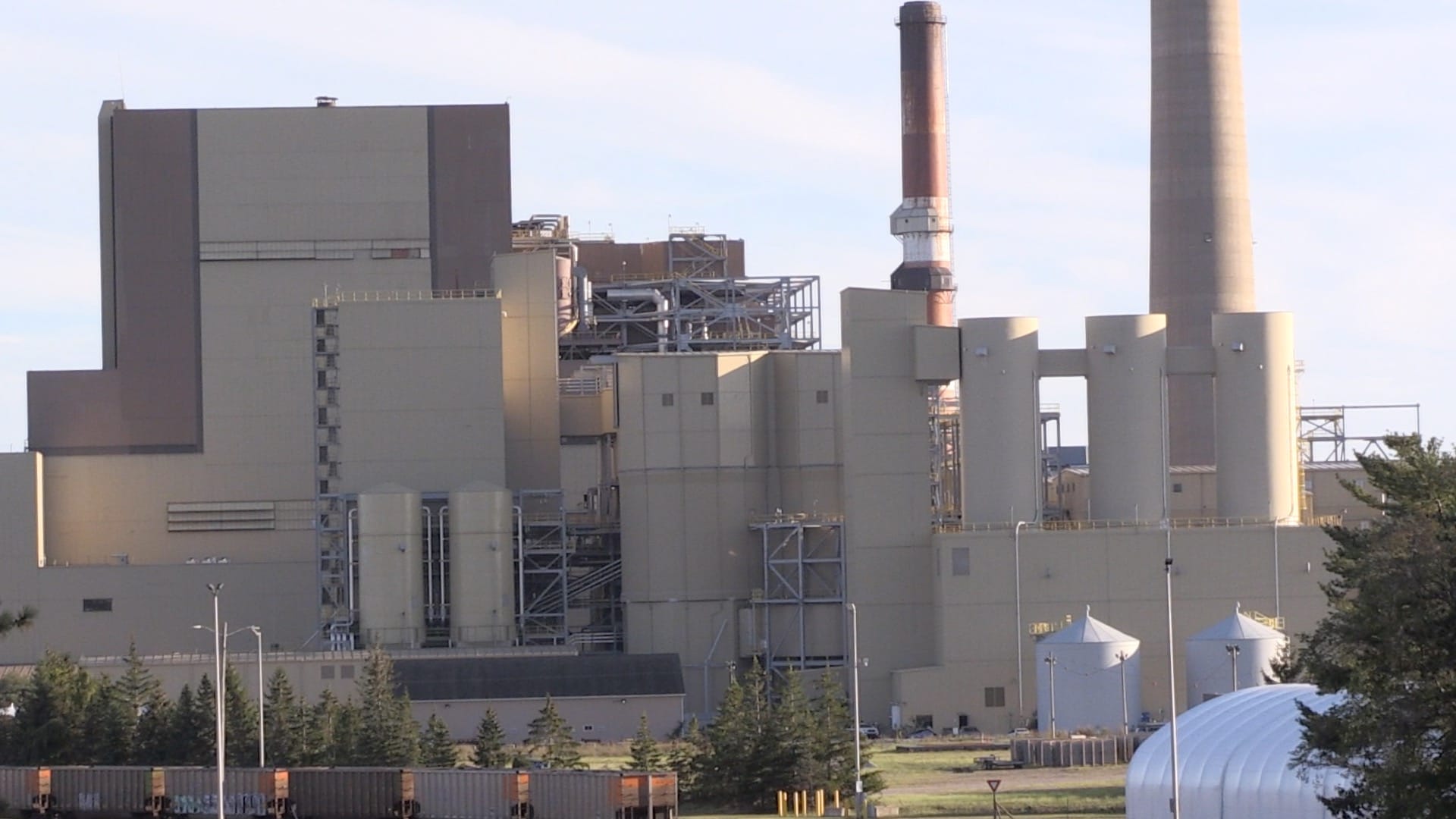
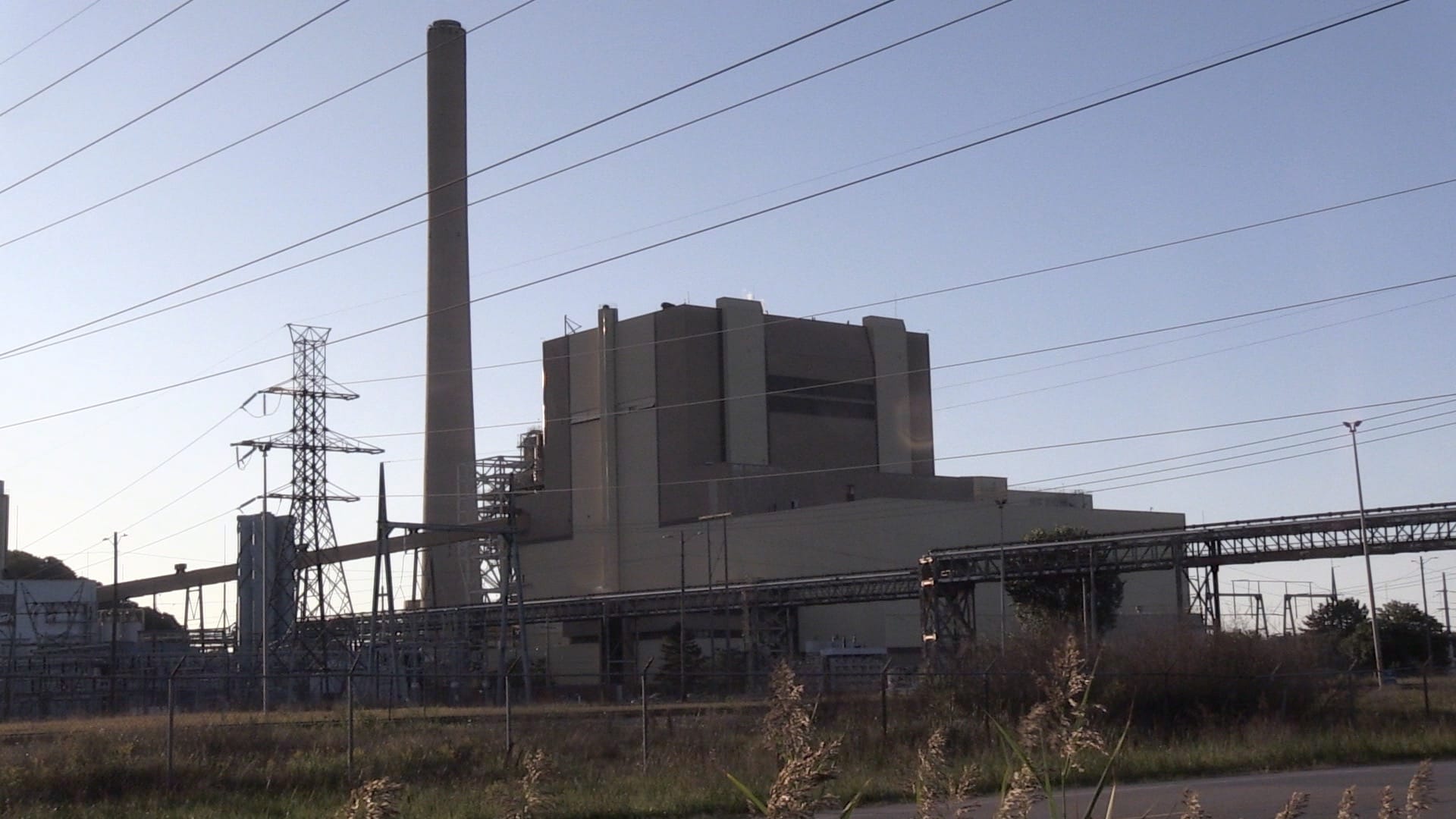
Owned by Consumers Energy, the 1,420-megawatt J.H. Campbell plant has operated along the shores of Lake Michigan since 1962. Under a state-approved clean energy transition expected to save ratepayers roughly $600 million by 2040, the aging facility was slated to burn its final ton of coal on May 31, 2025.
Read More: Consumers Energy reaches agreement to close Campbell plant, end utility's coal use by 2025
Read More: County poised to urge delay in closing Campbell as officials say plan likely won't change
Series Summary: Cost of the Campbell
The Trump Administration’s Department of Energy has repeatedly invoked emergency authority under the 1920 Federal Power Act to force Consumers Energy to keep its coal-fired J.H. Campbell power plant in Port Sheldon Township running since May 2025.
The utility and state regulators had established a long-settled timeline to retire the 63-year-old facility, substituting its output with renewable generation, storage, and natural gas. Pointing to regional grid reliability concerns, federal officials bypassed the local approval process and issued back-to-back 90-day emergency orders ordering the facility to remain operational.
The intervention reflects a broader national conflict between federal mandates to preserve fossil fuels and state-level directives prioritizing green transitions.
Locally, the decision highlighted political fractures within Ottawa County. Members of the Trump-aligned political group Ottawa Impact on the County Board of Commissioners actively campaigned against the shutdown, framing the closure as a threat by "climate crisis green energy" agendas. In early 2025, the board passed a resolution petitioning regulators and federal figures to pause the retirement, providing political momentum for the White House's executive intervention.
Overriding the planned shutdown has imposed significant economic burdens on the regional power grid. Generating power at the aging facility requires costly coal deliveries and maintenance that Consumers Energy estimates run hundreds of thousands of dollars per day, accumulating tens of millions in unanticipated compliance costs. Because the plant operates under a federal mandate rather than standard economic dispatch, these operating expenditures are passed directly to ratepayers across the Midcontinent Independent System Operator, or MISO, a regional grid that includes Michigan, 14 other states and one Canadian province.
The emergency orders have drawn fierce legal resistance. The state of Michigan — led by Michigan Attorney General Dana Nessel — along with environmental advocacy organizations and consumer watchdog groups has filed several challenges claiming that the DOE unlawfully manufactured an "energy emergency" under federal law to indefinitely override state regulatory oversight, private utility planning and statutory grid transition rules.
Beyond financial and legal friction, the forced operation of the Campbell plant prolongs its toxic environmental footprint. Continued coal combustion releases air particulates, sulfur dioxide, and nitrous oxides while generating vast volumes of toxic coal ash.
Local residents and environmental advocacy groups continue to express concern regarding wastewater discharges and coal ash ponds that threaten Lake Michigan and demand extensive long-term remediation to prevent heavy metals from leaching into Ottawa County’s groundwater supply.
The following is the first installment of “The Cost of the Campbell,” a series produced in partnership with the Pulitzer Center, which provides financial and editorial support, training, and collaboration networks for journalists to pursue in-depth, high-impact reporting projects nationwide.
Instead, the plant remains tied to the energy grid — kept alive by repeated federal mandates at a cost of roughly $1 million per day.
Just eight days before the plant’s scheduled decommissioning in May 2025, U.S. Energy Secretary Chris Wright invoked Section 202(c) of the Federal Power Act, issuing a 90-day emergency order that required Consumers Energy to keep the Campbell online, citing regional grid reliability concerns and warning that retiring the facility could risk blackouts or brownouts across the Midwest.
Read More: Campbell coal plant's closure delayed 90 days with Energy Secretary's emergency order
What was initially framed as a temporary 90-day pause soon turned into a long-term mandate. Over the past 16 months, the Department of Energy has repeatedly renewed the order — five times since the initial May 31, 2025, order — forcing the facility to run well past its planned end date.
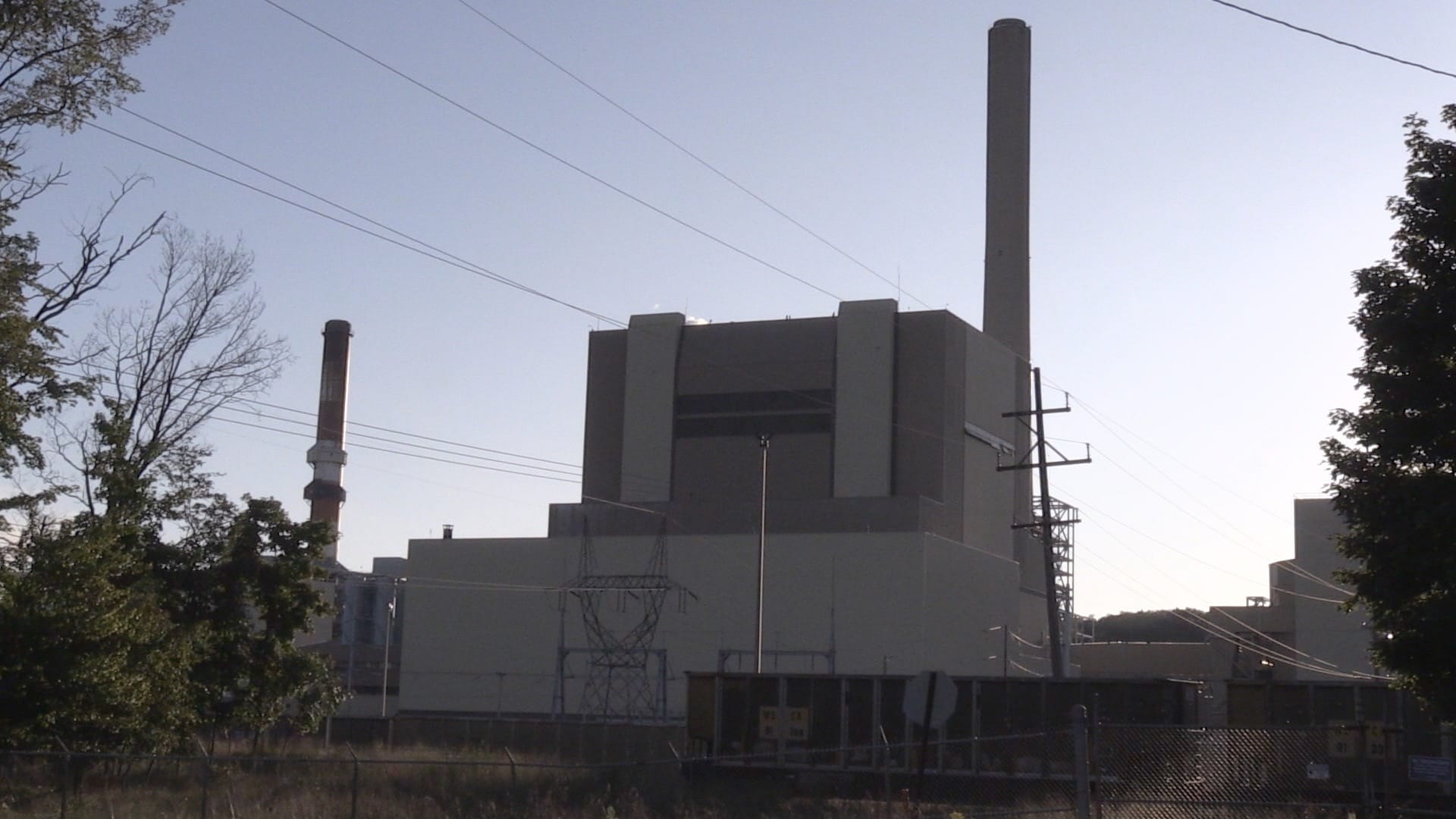
Power and politics
Before the feds intervened, the battle over the J.H. Campbell plant was waged in the crowded boardroom of the Ottawa County Board of Commissioners.
Despite Consumers assuring local-level officials that the decommissioning of the Campbell would not impact local service levels, conservative county commissioners voiced regional reliability fears.
Commissioners, however, pointed to two separate reports — from MISO as well as the North American Electric Reliability Corporation, or NERC — that gave them concerns over the energy grid’s reliability once the Campbell is taken offline.
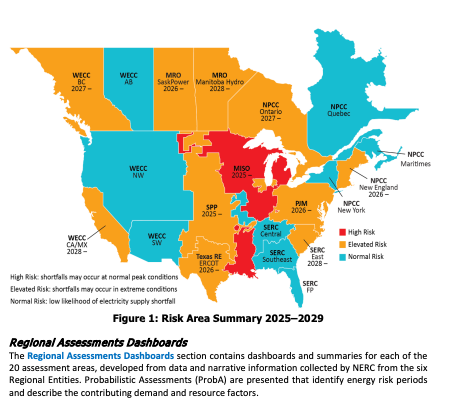
“There's an elephant in the room, and I just want to make sure that we're fully addressing this,” said Commissioner Jim Barry during a February 2025 meeting. “I still don't feel like I really have a complete thought process on how MISO works with the grid and Consumers works with MISO and the grid, but … they've voiced some concern about a hasty transition closing the coal plants … that renewables are the future, but that we're not there yet. How would you respond to that?”
Dena Isabell, stakeholder engagement manager at Consumers, outlined assets within the company’s portfolio, including generating stations elsewhere in West Michigan that added 1,200 megawatts to help offset the planned closure of the Campbell.
The decommissioning process for the plant — when it finally begins — is expected to take about five years to complete and includes remediation and restoration, Isabell said.
“We take our responsibility for reliability seriously. And so when we hear concerns and the like, we want to address them. We want to explain them, and where there are concerns that are legitimate, we try to address them,” Srikanth “Sri” Maddipati, vice president of electric supply with Consumers, told ONN in February 2025.
“We care. I don't want the power going out any more than you do. So we're all in this together.”
Despite the reassurance, the county board was not convinced.
The far-right faction on the board of commissioners known as Ottawa Impact framed the shutdown as a threat to regional grid reliability and a symptom of a rushed "green energy agenda."
Those commissioners, which numbered four of the 11-member board, forced a vote authorizing the county to sue Consumers to prevent the closure, which was voted down 7-4.
The remaining conservatives on the board said they didn’t see the harm in asking Consumers and state regulators to take a second look and, in February 2025, the conservative-led board approved a non-binding resolution urging that the decommissioning be delayed.
Commissioner Josh Brugger, who was the vice chair of the board in 2025 and now chairs the body, said he the issue was brewing as he and a slate of moderate conservatives were running in 2024 to challenge Ottawa Impact’s far-right policies — some of which endorsed the idea to take the Campbell plant over as a county-run public utility.
“Leading up to taking office at the beginning of 2025, there was a large push by certain members of the community to keep the Campbell plant operational, keep it running, and potentially even take it over as a county to make the Campbell plant a part of the Ottawa County business infrastructure,” Brugger said.
“There was a concern by some constituents that the plant was going to close and they wanted it to stay open. There were also concerns by other members of the community who were concerned that it might stay open, and they wanted it to be closed for environmental issues among other things, so that came to the fore very quickly in 2025,” he said.
After researching the issue and discussion with other commissioners, Brugger said he authored a resolution for the board to consider that urged Consumers to delay the plant’s closure — enough time for state regulators to take another look after approving the decommissioning plan in 2022.

“Three years had passed, so our concern as a board was: Do the conditions on the ground still support closing the Campbell plant?” Brugger said. “One of the questions we were asking ourselves is what responsibility do we even have as Ottawa County officials to weigh in on a state and federal energy-level issue?
“We felt, in the end, that we were kind of closest to the area of concern and so perhaps we had a different perspective,” Brugger said. “In hindsight, I'm not sure that we did, but that's what we felt, and we felt we had an obligation to do that.”
The measure passed 9-1 — the lone Democrat on the board opposed the move — but not without sharp public pushback.
Local residents, environmental advocates, and health professionals packed public comment periods to oppose the resolution, pointing out that the aging coal facility was a major local source of toxic pollution.
Utility representatives from Consumers Energy also pushed back, clarifying that the retirement was part of an approved, long-term transition to cheaper solar and battery storage designed to save ratepayers money without compromising power supplies.
The board forwarded its resolution to the Michigan Public Service Commission, which approved Consumers’ plan years earlier.
State regulators quickly dismissed the county’s non-binding request.
“This issue was decided in Consumers Energy’s most recent integrated resource planning case (Case No. U-21090), conducted through a contested proceeding as legislatively mandated,” MSPC Public Information Officer Matt Helms told WGVU shortly after the vote. “A settlement agreement in the case details Consumers’ plans to replace the energy from the Campbell plant with energy from renewable sources and battery storage. … There are annual utility capacity reviews to ensure adequate energy supply.”
The resolution was also shared with federal officials.

Commissioner Jordan Jorritsma, who currently serves as legislative director for State Rep. Curt VanderWall (R-102), told his colleagues that the board’s resolution was forwarded to the DOE and that a political appointee from the Department of the Interior was “aware of the situation” surrounding the plant.
Just three months later, Wright invoked federal emergency powers to keep the plant running. The federal mandate directly mirrored the reliability arguments made by local commissioners — effectively elevating a contested county board vote into a sweeping federal intervention that overrode state regulators, the utility and local residents.
“This administration will not sit back and allow dangerous energy subtraction policies threaten the resiliency of our grid and raise electricity prices on American families,” Wright said in his order. “With President Trump’s leadership, the Energy Department is hard at work securing the American people access to affordable, reliable, and secure energy that powers their lives regardless of whether the wind is blowing or the sun is shining."
Conversely, Democratic state leaders, environmental groups and resident activists aligned with broader clean-energy goals framed the facility as a costly, health-threatening relic whose forced operation bypasses state authority and burdens ratepayers.
By late summer 2025, public frustration across Ottawa County spilled out of meeting rooms and into the streets through a series of rallies and demonstrations.
Activists and medical advocates gathered directly outside the gates of the Port Sheldon Township facility on Aug. 12, flanked by banners demanding a transition to clean energy.
Read More: Activists, officials call for closure of Campbell coal plant as utility looks to recover costs
State Rep. Stephen Wooden and other speakers accused the federal government of manufacturing an artificial energy crisis to prop up failing fossil fuel assets.
"We're here today because in 2024 Donald Trump made a deal with the fossil fuel industry: 'You give me a billion dollars to prop up my campaign, and I will prop up your industry,'" said state Rep. Stephen Wooden (D-81), whose district includes the northeast portion of Grand Rapids.
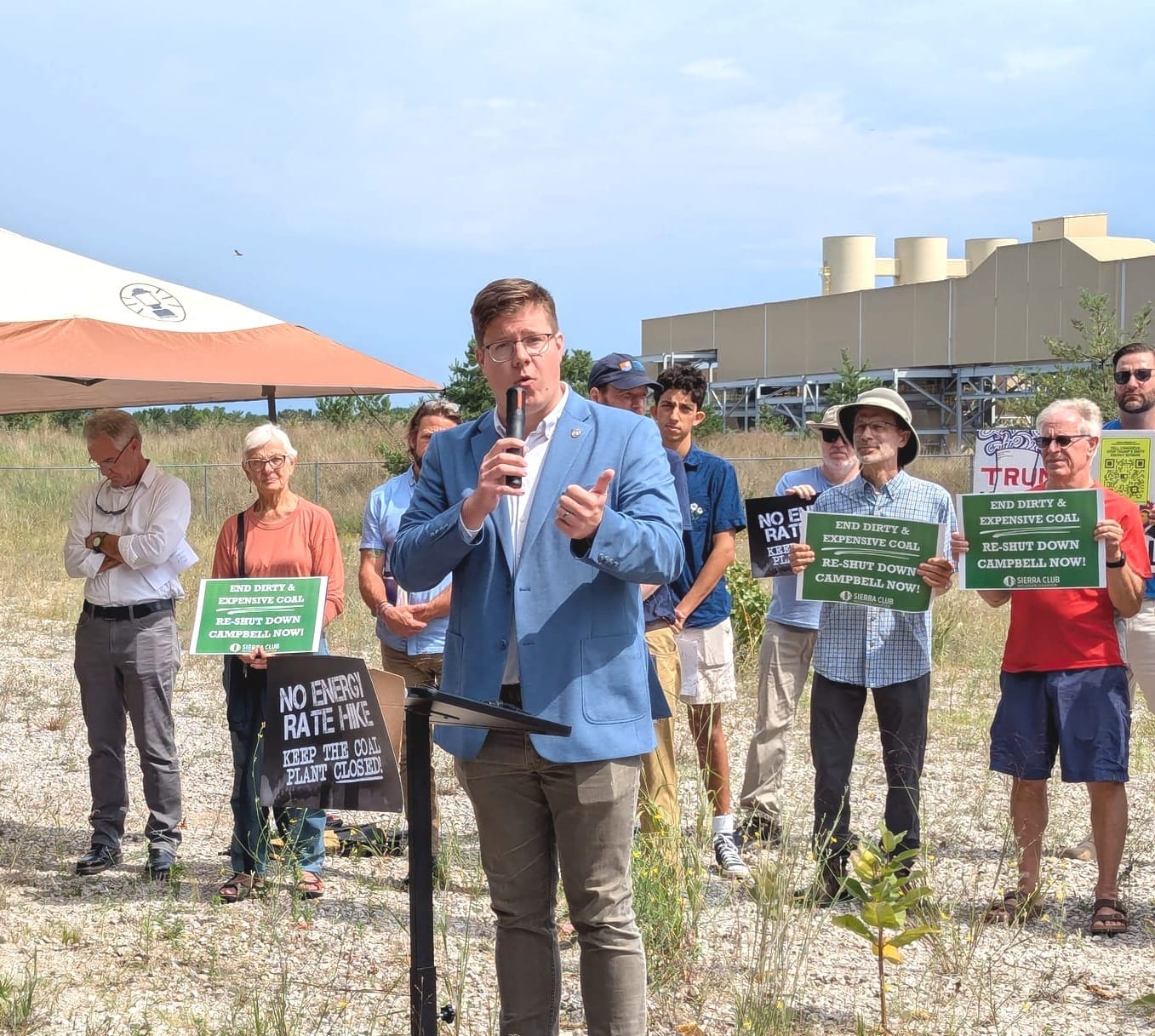
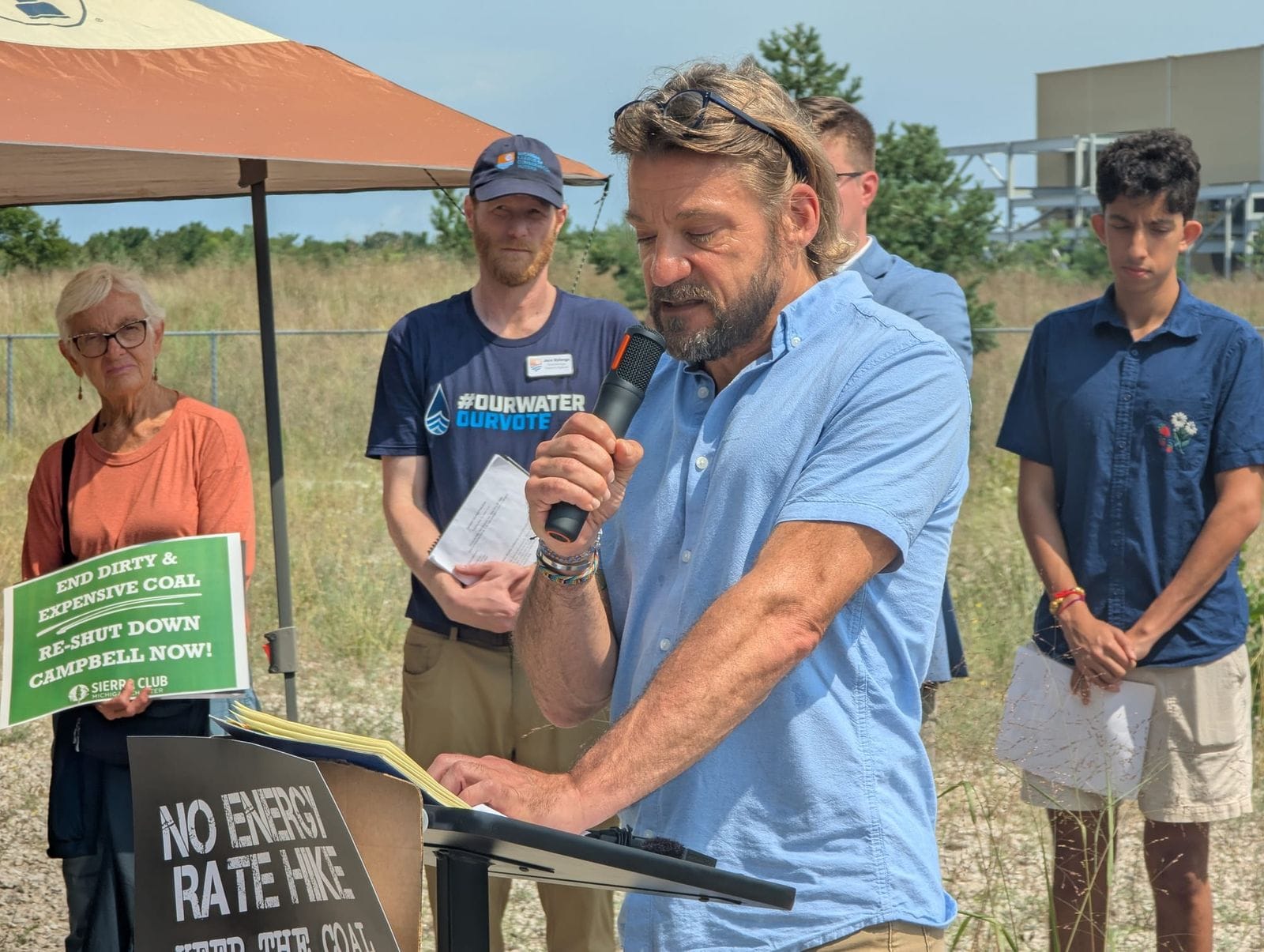
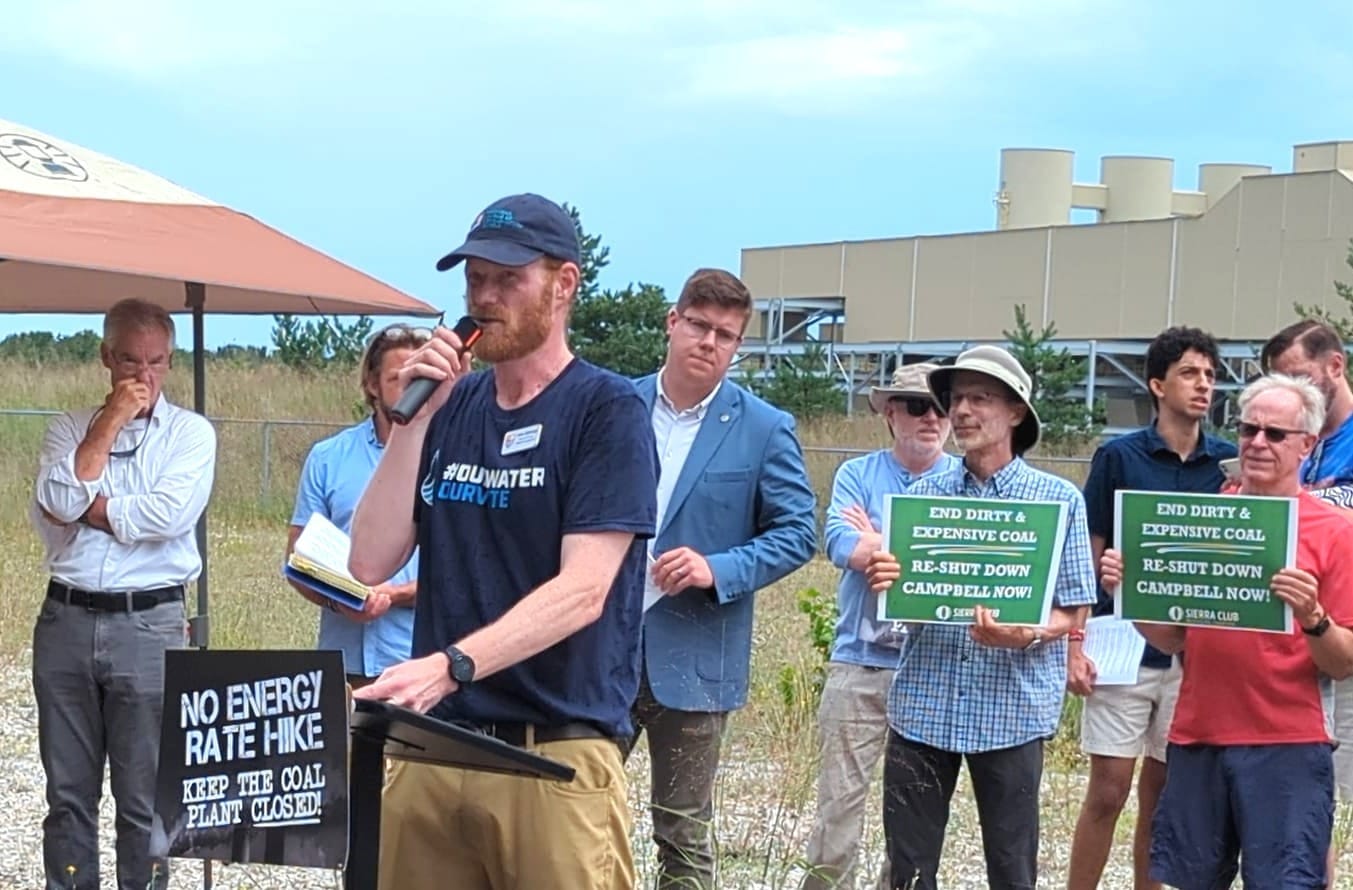
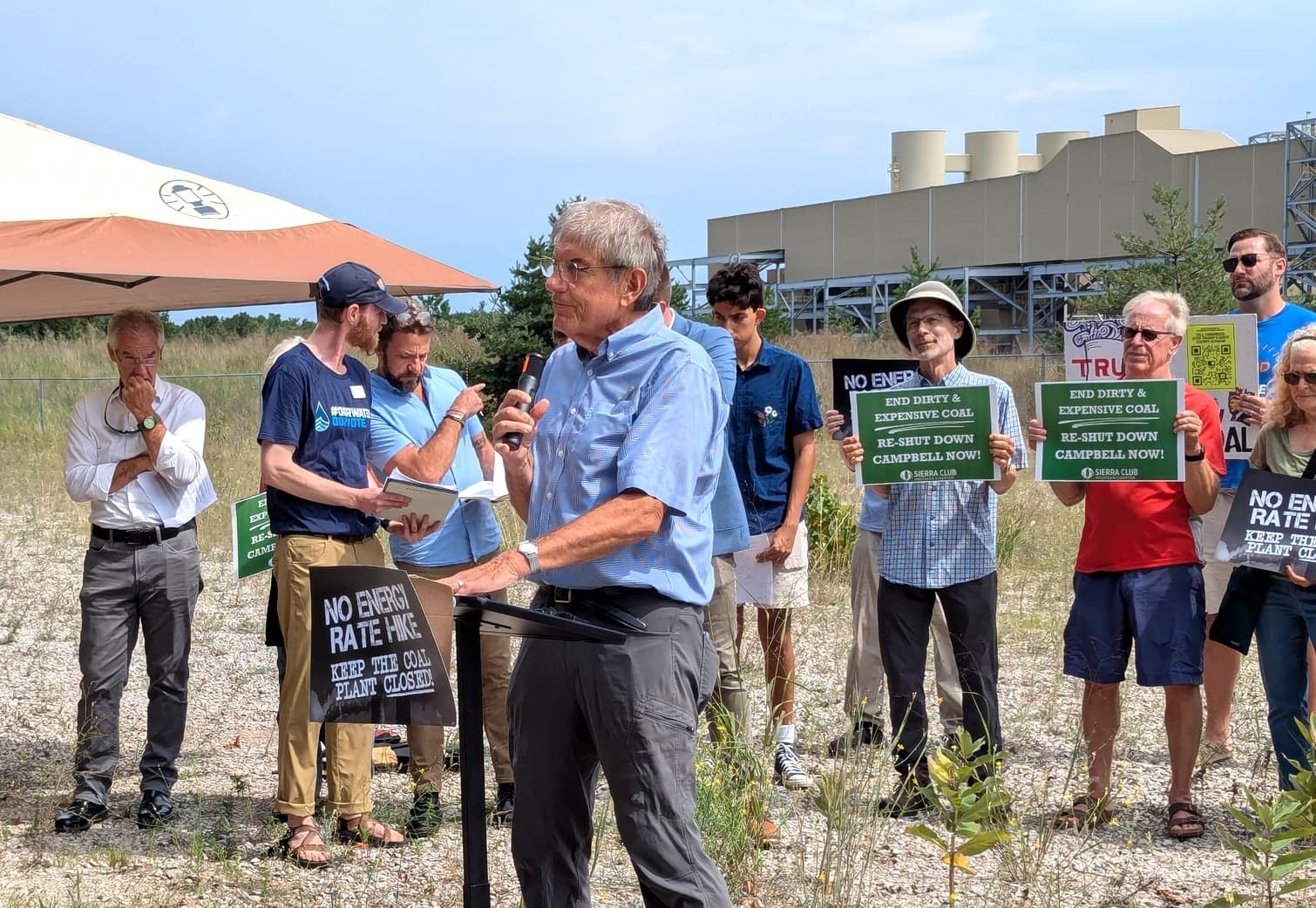
Clockwise from top left: State Rep. Stephen Wooden, D-81, speaks in front of the J.H. Campbell plant in Port Sheldon Township on Tuesday, Aug. 12, 2025. Former county commissioner Chris Kleinjans said the board bears partial responsibility for the Trump Administration's intervention, because it requested a delay of the closure for additional review by regulators. Jayce Bylenga, West Michigan regional coordinator for Michigan League of Conservation Voters, reads a prepared statement from Michigan Attorney General Dana Nessel. Dr. Steven Ashmead, a family physician and a member of the Michigan Clinicians for Climate Action, spoke. [ONN photo/Sarah Leach]
Medical professionals at the protest emphasized the ongoing health risks posed by sulfur dioxide and particulate pollution pouring from the plant's massive cooling towers.
"Medical science has had over 250 years to study the health impacts of using coal for heat and energy production. The health effects have been documented at every stage of coal production and combustion, from mining to the disposal of ash," Ashmead said.
"These pollutants directly affect our hearts, blood vessels, lungs and brains. Children, the elderly like myself, pregnant women and individuals with chronic disease and those that work outdoors are at increased risk of exposure to these deadly pollutants. ... That does not include the millions of dollars that will be spent on health problems associated with burning of coal, such as asthma, COPD, heart attacks, stroke, cancer and many other chronic diseases."
Just three days later, nearly 100 residents and youth activists assembled at Memorial Park in Holland, holding signs reading "My asthma and my wallet can't afford coal."
The crowd marched through downtown to the district office of U.S. Rep. Bill Huizenga, demanding accountability over skyrocketing operating costs that were already topping $1 million a day.
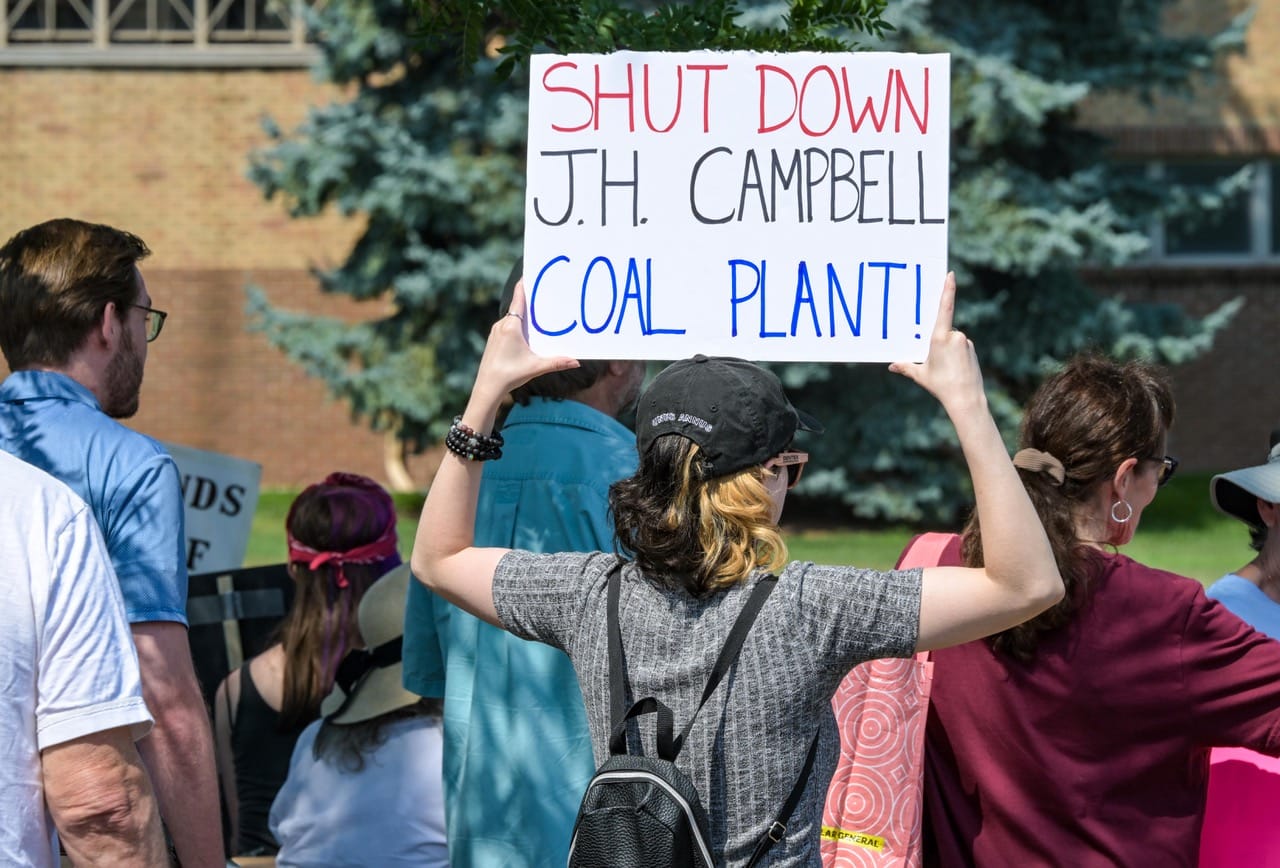

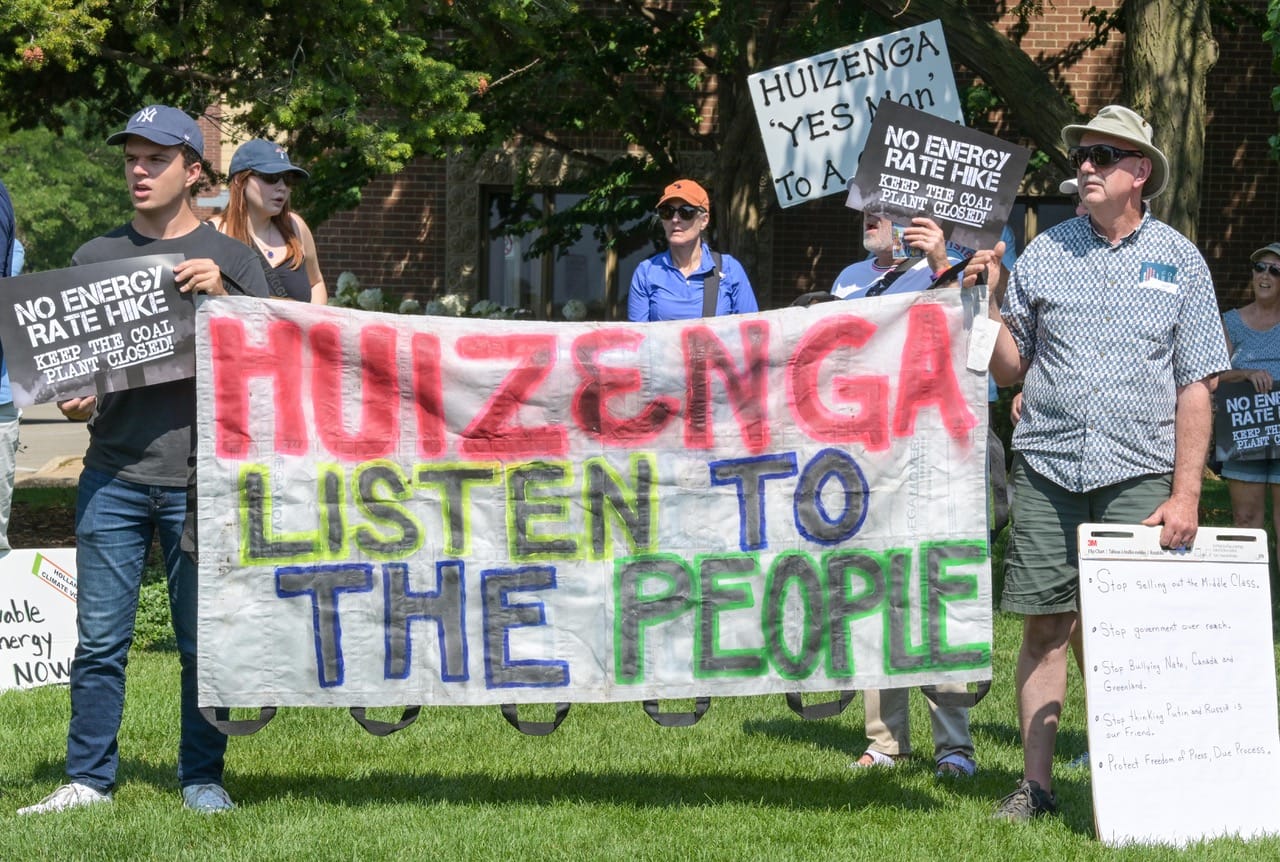


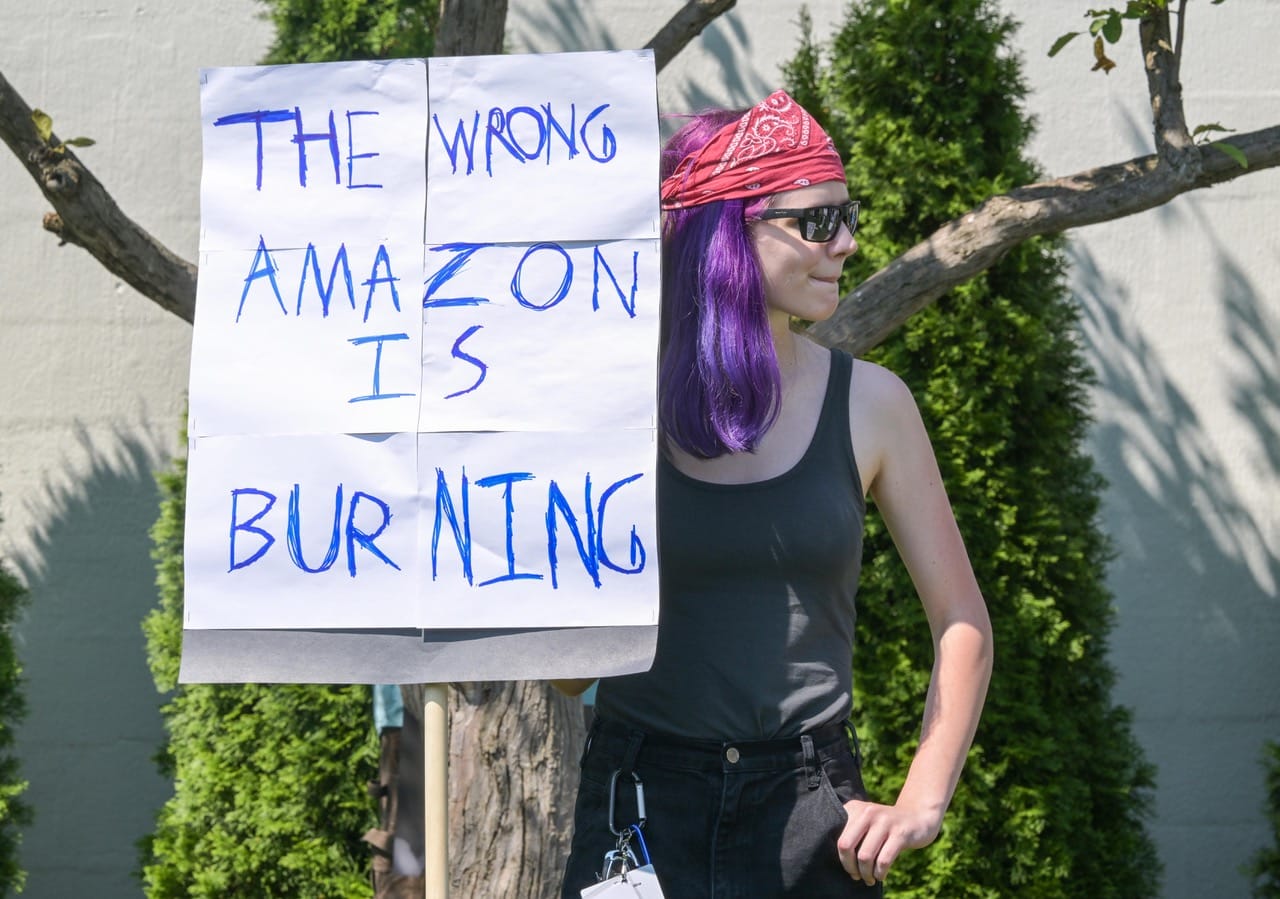
Nearly 100 residents and youth activists assembled at Memorial Park in Holland in August 2025 to protest the continued operation of the J.H. Campbell plant. [ONN photos/Dirk Wierenga]
Weaponizing or stabilizing the grid?
By using federal emergency powers to override market dynamics, state regulators, and the utility’s own decarbonization plans, the federal intervention has effectively turned a township power plant into a proxy fight over executive overreach, state sovereignty and whether the nation will accelerate a green transition or mandate the preservation of legacy coal.
For decades, Section 202(c) of the Federal Power Act of 1935 existed as a rarely used administrative safeguard — an emergency tool designed to keep the lights on during wartime crises, severe natural disasters or acute grid failures like the 2000 California energy shortage.
Historically, the law allowed federal energy secretaries to issue temporary, short-term directives, often lasting just days or weeks, to bypass environmental limits or direct fuel supplies when sudden physical outages threatened regional stability.
That narrow framework was upended when Wright transformed the 90-year-old statute into a proactive way to prevent the closure of fossil fuel-powered plants, rather than responding to unforeseen disasters.
Beyond the Campbell, Wright invoked 202(c) to halt the closure of oil and gas peaker units at Pennsylvania’s Eddystone station, delay the retirement of coal-fired units at Indiana’s R.M. Schahfer plant and Colorado’s Craig station, and force Washington state's last remaining coal plant in Centralia to stay online.
In each case, the administration cited surging power demand from data centers and manufacturing as an overarching national security crisis, claiming that retiring dispatchable fossil fuel-powered plants posed an unacceptable risk to grid reliability.
The administration’s broad interpretation of emergency powers has drawn severe pushback from legal scholars, state attorneys general and utility regulators.
Opponents argue that the DOE is distorting the text of the Federal Power Act by treating predictable, state-vetted utility plans as sudden emergencies. Critics point out that, although Section 202(c) explicitly caps emergency orders at 90 days, the administration has exploited a loophole by stacking continuous 90-day extensions indefinitely.
As multi-state lawsuits wind through federal appeals courts, the dispute has elevated from a series of local plant closures into a historic constitutional showdown over whether the executive branch can override state sovereignty and utility markets to force legacy coal plants to keep burning.
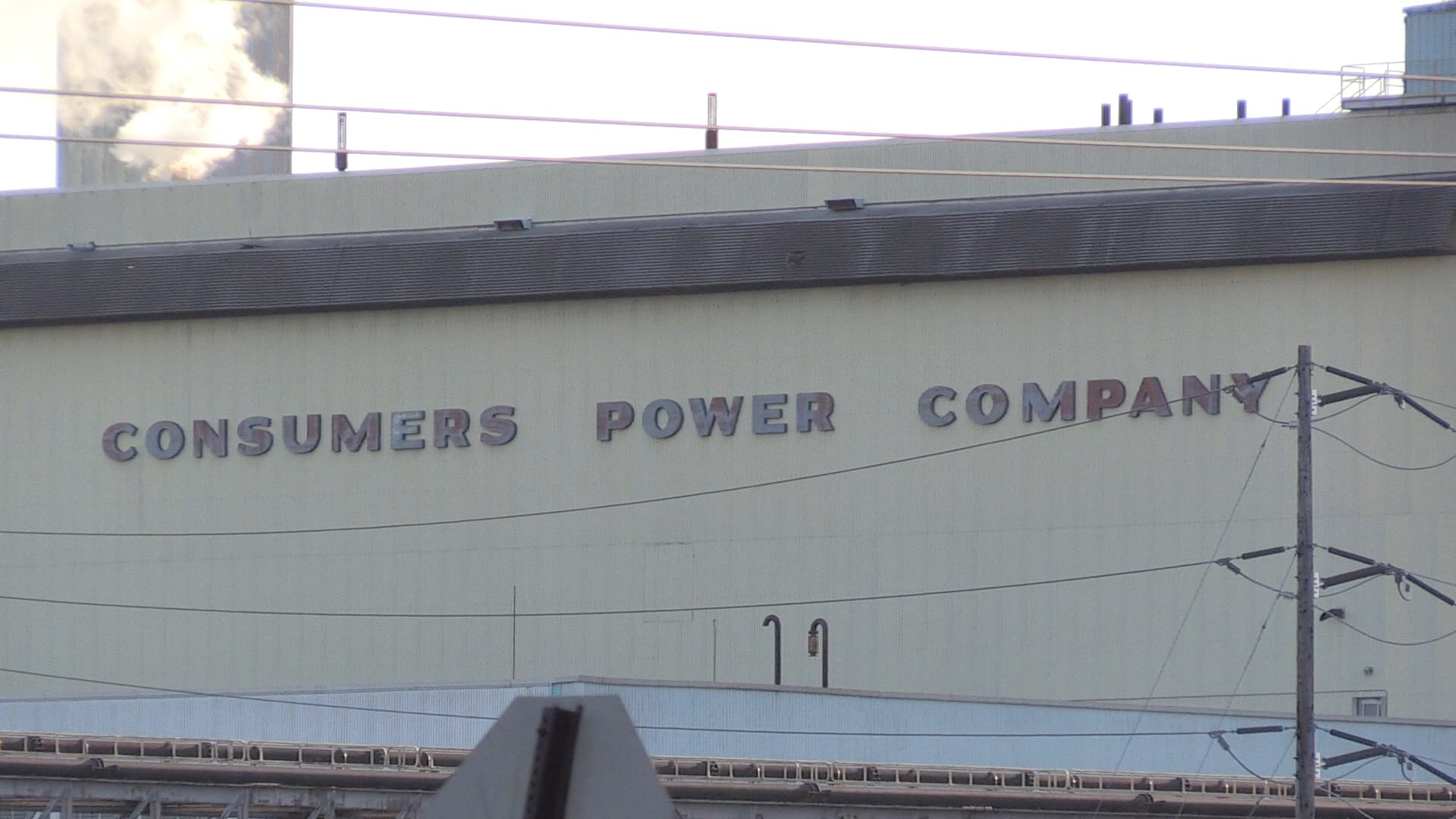
“This is very unusual. The Federal Power Act and other emergency authorities have previously only been used in very targeted, short-duration responses to specific time-bound problems,” said Zealan Hoover, who worked on the White House Energy and Climate team during the Obama Administration, and was a senior advisor to the EPA administrator during the Biden Administration.
“It's always been done in collaboration with local resource planning authorities, so it's also incredibly unusual for the federal government to be coming in and dictating that a specific power plant be kept online over the objection of local resource planning authorities,” Hoover said.
Those previous examples, Hoover said, would typically involve a utility asking permission of the government to exceed planned closures.
“This is not the case here. The federal government is coming in over the top of the utilities, the regional transmission authorities and others and dictating individual plant-level decisions, which is quite unprecedented and also wreaks havoc on resource planning processes at all levels, because the entire process of planning — grid investments and utility rates and investments — is a long, thoughtful process,” Hoover said.
“And when you have the federal government coming in and joy-sticking decisions like this, it throws things into disarray,” he said.
“I think when they make decisions like this, they might believe they are helping the local communities because it confirms their prior conceptions of what is good or bad. But the reality is … it doesn't. If you divide the cost that local taxpayers are going to have to pay to keep this plant operational above the cost of buying electricity on the open market … and you divide it by the number of jobs at this coal plant, I mean, it's going to be an astronomical figure. …
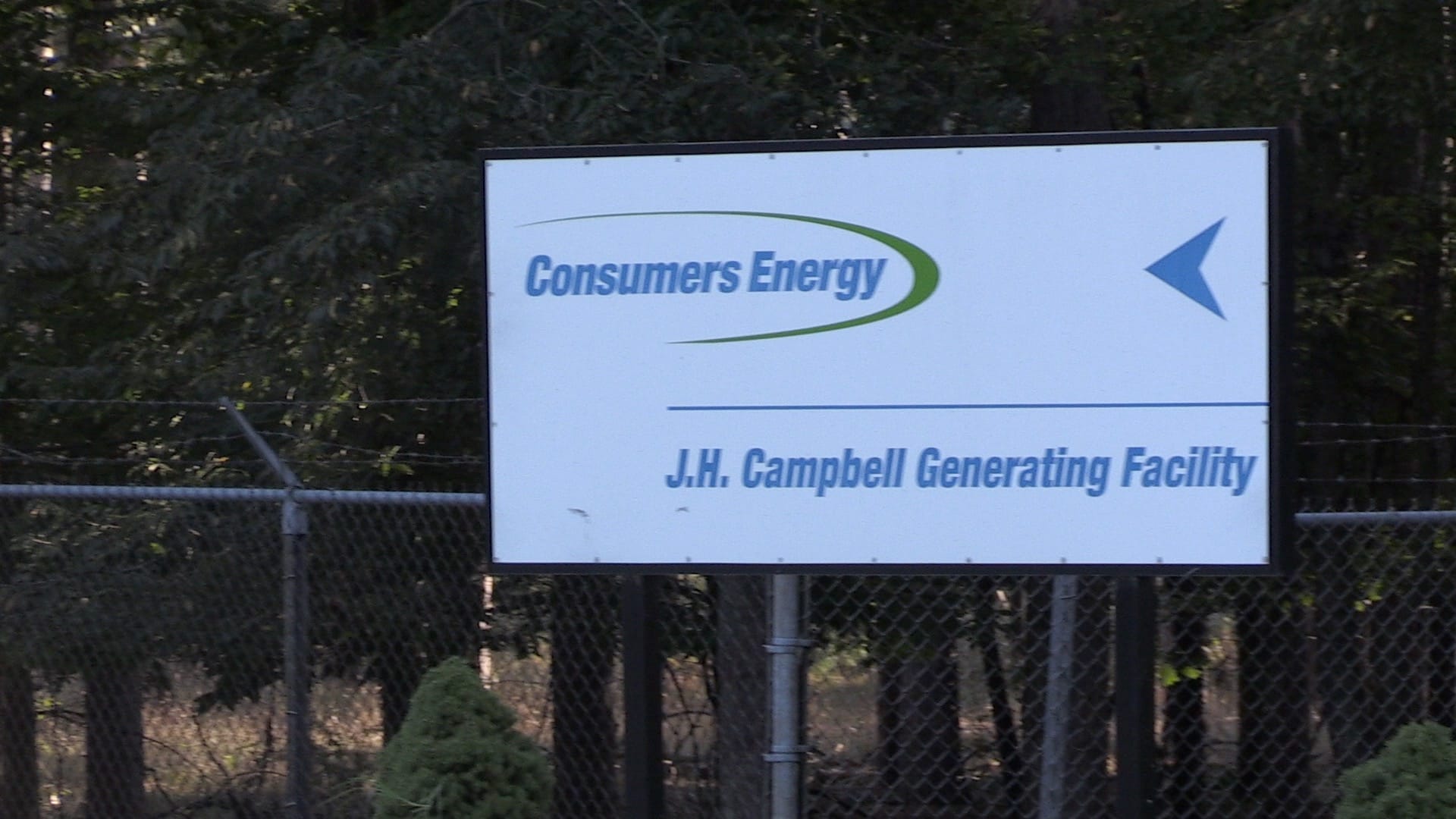
"The question is whether that is a worthwhile investment to advance longer-term strategies and goals. ... In this case, they are forcing local ratepayers to pay out the nose on their electricity bills to keep a plant operational that is inevitably going to close in the next few years — it's just a question of when it closes, and the only people keeping it open right now are the taxpayers of the local community.”
Consumers confirmed that the plant will close once the Trump Administration’s orders are lifted.
“When these orders end, we will close the plant, and we do have plans to continue to meet the clean energy and renewable energy standards in the state,” said Shaun Johnson, executive vice president of business transformation and the company’s chief legal and administrative officer.
Legal battles, soaring costs
The fate of the Campbell plant has transformed Ottawa County into a high-stakes arena for the broader ideological war over the nation's energy future.
A year after the initial order, the grassroots resistance aligned directly with top state leadership. On May 21, Nessel stood alongside local community members in the shadow of the plant’s smokestacks to mark 12 full months of forced operations.
Read More: 'Crying wolf': Nessel says feds created energy 'emergency' to keep Campbell coal plant open
Nessel blasted federal officials for "crying wolf" over grid reliability at the direct expense of Michigan utility customers.
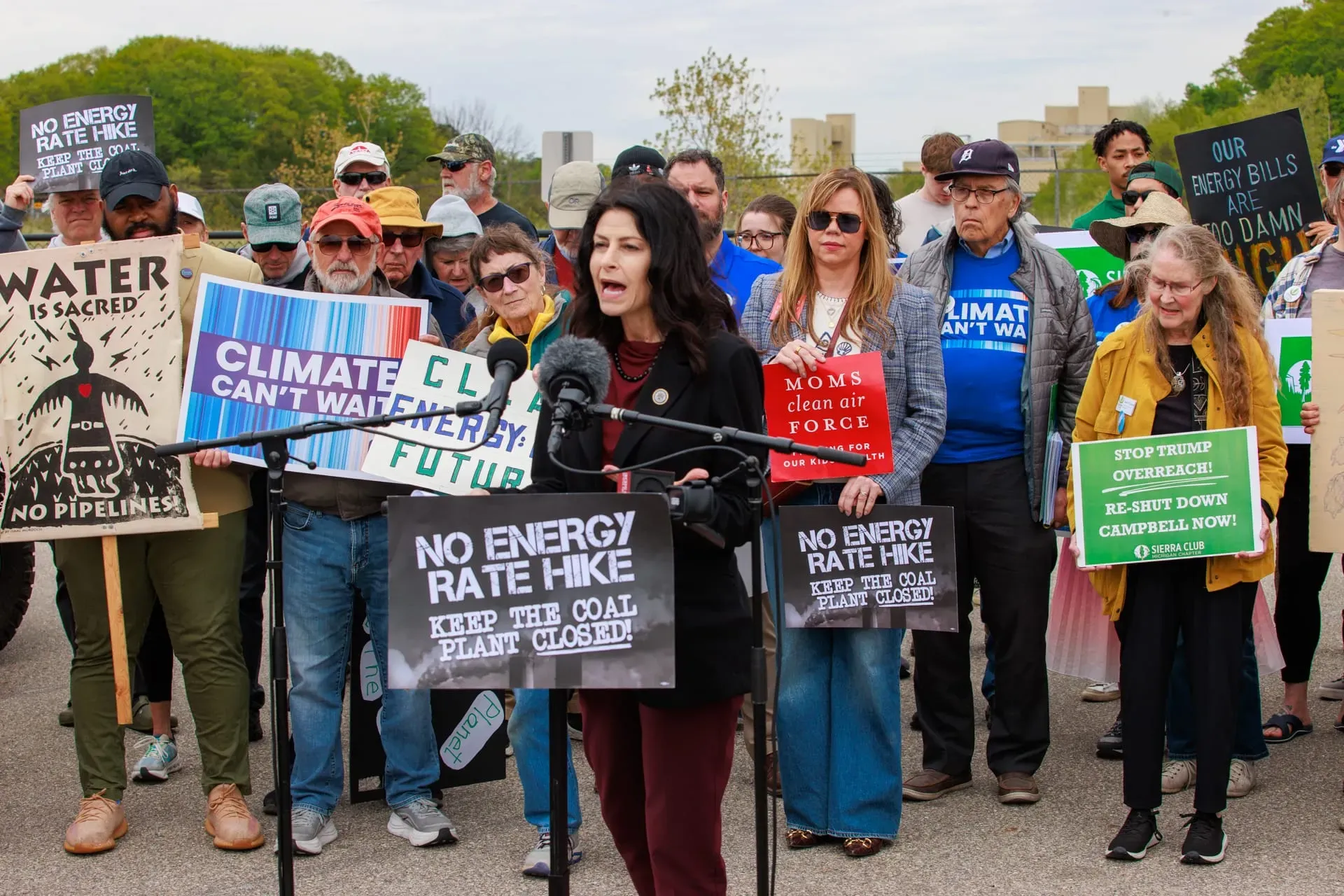
The rally served as a high-profile backdrop for the state's ongoing litigation before the federal appeals court, underscoring how a localized environmental and financial burden had escalated into a high-stakes constitutional showdown.
Read More: Appeals court considers: Did a real 'energy emergency' justify DOE order to keep the Campbell open?
Because those home states share interconnected power grids with surrounding jurisdictions, the ultimate impact of these federal interventions extends to another dozen states nationwide.
During oral arguments before a three-judge appellate panel in mid-May, the central dispute focused on what constitutes a genuine "energy emergency."
State attorneys argued that the federal government overreached by manufacturing an emergency where none existed, pointing out that state regulators, regional grid manager MISO and utility Consumers Energy had already arranged for sufficient replacement power.
"The department's claim of authority here is unprecedented and unchecked, which transformed the structure of power for regulating resource planning as it has been commonly understood for decades," Michigan Assistant Attorney General Lucas Wollenzien told the U.S. Court of Appeals on May 15.
Federal attorneys countered that Wright does not need to wait for rolling blackouts to occur before intervening to preserve grid capacity.
Robert Stander, who represented Wright and the Department of Energy, argued that the energy secretary had "sole discretion" delegated by Congress "to determine how much risk is too much risk, how much of a shortage is too short," and that Wright's orders should be affirmed, "so long as it's supported by substantial evidence."
Appellate Judge Robert L. Wilkins said the arguments from both sides seem to hinge on how to define an emergency and what warrants invoking the federal statute's powers.
"It seems that there's a lot of ink spilled in the briefs about definitions of emergency in various dictionaries and statutory contexts, and one of the arguments ... seems to be on whether an emergency is something that has to be kind of unforeseen or unforeseeable," Wilkins said.
While Friday's ruling invalidates the original May 2025 order, the fate of the Campbell plant remains tied up in subsequent legal battles. The DOE has issued five successive extensions since the original directive, with its sixth and current order mandating operations through November 14 — nearly 18 months past the plant's intended shutdown.
Nessel's office has filed multiple administrative rehearings and appeals challenging the subsequent extensions, which remain pending before the court. The U.S. government also could appeal to the U.S. Supreme Court.
A representative from Consumers Energy said Friday afternoon that the company is reviewing the court ruling.
"While that happens, we are continuing to comply with the current 90-day Department of Energy order that keeps the Campbell plant operating," said Brian Wheeler, media relations specialist for the utility. "Ultimately, we will follow the law and work to ensure that everyone who benefits from power from the Campbell plant across the Midwest pays their fair share."
The outcome of the case is likely to have broader consequences beyond the Campbell, as Wright has issued similar emergency orders that prevented the closure of coal, natural gas or oil plants in four other states: Washington, Indiana, Colorado and Pennsylvania (although the impact of those orders affects another dozen states that share energy grids with the affected home states).
The legal offensive has also expanded into a financial dispute before the Federal Energy Regulatory Commission, or FERC.
Running an outdated coal facility out-of-market carries a steep price tag.
According to regulatory filings by parent company CMS Energy, maintaining operations at the facility costs roughly $615,000 every single day.
The cost to continue running the plant varies, according to Johnson, but the first 90 days alone was a net cost of $45 million.
“Fuel costs for that first 90 days were $55 million that includes both the coal and the reagents, which are the chemicals that we have to put in for environmental compliance,” Johnson said.
That, coupled with the cost of staffing the plant and materials for repairs and maintenance over those 90 days added up to another $11 million.
“Then, if you think of all the fixed costs associated with it — property taxes, depreciation, all of that — for the first 90 days was another $52 million,” he said. “If you add all of that up, then you subtract from it that we made $73 million by selling the energy when MISO dispatched the units.”
That left the company with unreimbursed costs of $45 million for those 90 days.
Financial records filed through the first quarter of 2026 reveal that the cumulative cost to keep the plant running has now surpassed $400 million. Even after factoring in $221 million generated from power sales, the utility faces $180 million in unrecovered operating losses.
Consumers is currently petitioning federal regulators to distribute those net operating losses across ratepayers throughout the multi-state MISO grid, leaving the final price tag — and who will ultimately pay it — at the center of an ongoing regulatory debate.
Meanwhile, Nessel is actively contesting the utility's attempts to pass those unbudgeted operational costs on to local ratepayers, arguing that Michigan families should not shoulder the bill for a federal mandate.
Port Sheldon effect
As political pushes and resolutions swept through Ottawa County urging Consumers Energy to stall the decommissioning of the Campbell plant, Port Sheldon Township Supervisor Michael Sabatino offered a practical perspective on the reality facing his community.
While the county board of commissioners and a handful of neighboring municipalities — including Blendon, Chester, Georgetown, Grand Haven, Jamestown, Polkton and Zeeland townships — passed resolutions urging a delay, Port Sheldon Township notably abstained from joining the symbolic push.
Sabatino said local resolutions carry little to no practical weight over broader utility decisions, state energy plans and grid regulations.
"A local resolution doesn't change the retirement plan," Sabatino pointed out in February 2025, noting that even with formal requests from local government units, "the plan likely won't change."
Now a year after the plant’s forced continued operation, Sabatino emphasized that federal delays and ongoing grid interventions have not derailed local planning efforts.
He noted that the township's long-term framework remains steady despite the fluid situation surrounding the plant's operational status.
"There has been no significant immediate impact on our master plan," Sabatino said in a recent email to ONN. "It is intended to be a long-range guidance document, and even under the Campbell plant's original retirement timeline, demolition and site restoration were projected to take approximately three to five years before the property would be prepared for its next use."
With utility officials signaling that federal interventions are likely to persist, Sabatino noted that the prolonged timeline aligns cleanly with municipal planning requirements:
"Consumers’ representatives have indicated that they expect to see the continuation of 90-day extensions for the foreseeable future. With that in mind, the timing actually aligns fairly well with the township's normal planning cycle.
“Our next five-year statutory review of the master plan will occur in 2030, at which time we will evaluate whether amendments or a broader update are appropriate. By then, we should also have a much clearer picture of the site's condition and potential future uses (hopefully)."

Addressing concerns over the loss of industrial tax revenue once the plant eventually goes dark, Sabatino said detailed fiscal analyses show the township is well-positioned to weather the transition.
"We also did a deep dive into the potential financial impacts through our Economic Resiliency Response Plan, and the data largely confirmed what we anticipated,” he said. “The closure is not expected to have a marked impact on township revenue."
The supervisor credited ongoing community expansion and residential development with cushioning the fiscal blow as the plant's value depreciates over time.
"Our steady residential growth has been keeping pace with, and increasingly offsetting, the depreciation in taxable value of the Campbell plant,” he said.
He said the plant only accounts for approximately 9.45% of the township’s general fund revenue — the primary operating fund that a government uses to track its routine activities and basic public services.
“While the immediate fiscal and master plan impacts are relatively limited, the long-term future of the Campbell property is certainly significant to Port Sheldon Township," he said
By focusing on long-term stewardship, economic resilience and strategic planning rather than symbolic political maneuvers, Sabatino underscored that Port Sheldon Township is steadily preparing for the eventual post-coal era.
— Sarah Leach is the executive editor of the Ottawa News Network. Contact her at sleach@ottawanewsnetwork.org. Follow her on Twitter @ONNLeach.


