


The Business Next Door: Fred Bauer and Gentex: How a Holland entrepreneur turned a problem into a multi-billion-dollar business
When I dug into the history of Gentex, I learned that today it is a $2.6 billion international automotive supplier that began as a maker of smoke detectors for the manufactured and mobile home industry.


In the early 2010s, I accidentally met Fred Bauer at Frank’s Restaurant, a 100-year-old classic diner in downtown Zeeland.
It was midmorning, and Fred sat at a large table toward the back of the restaurant with a group of locals, drinking coffee and sharing stories. When the person I was looking for casually introduced me to Fred, I was dumbfounded. I’m glad I don’t remember how I responded, because a small-town hamburger joint on a midweek morning was the last place I expected to find the CEO of a $1 billion company.
But that chance meeting and Fred’s unpretentious character weren’t my only surprises. When I dug into the history of Gentex, I learned that today it is a $2.6 billion international automotive supplier that began as a maker of smoke detectors for the manufactured and mobile home industry.
And Fred was an integral part of it then.
Here is his story.
Son of an engineer
Fred Bauer was born in North Carolina on January 10, 1943, while his father was on the move teaching pilots during World War II. The family relocated 15 times before they settled in Fenton, Michigan, a town 60 miles east of Lansing and 16 miles south of Flint, where Fred spent his high school years.
During that formative time, Fred lived in the heart of Michigan’s mobile and manufactured home industry. In those days, the players were Vagabond Coach Manufacturing Company, founded in 1931 and known for elegant travel trailers and mobile homes with birch interiors, and Champion Homes, founded in 1953.
Also during that time, Fred’s father, Lee Bauer, did engineering work for that industry. He developed, with Jim Miller of Michigan State University (MSU), the “Miller Mobile Gun,” a squirt-gun-like machine that turned liquid oil into a fine mist which was ignited with a spark to create a continuous flame. This invention, sold through the Home Furnace Co. of Holland, Michigan, not only saved millions of gallons of oil, but also put the Home Furnace Co. on the map.
Watching his father work taught Fred an appreciation for both the technical challenges of manufacturing and the commercial opportunities that came from solving practical problems. And it motivated him to attend MSU.
It also taught Fred other lessons. According to Fred, Lee’s favorite boast was that he was the best father a boy could have, on the theory that a man with that many vices was a living, breathing lesson in everything not to do!
After graduating from MSU in 1965 with a degree in electrical engineering and a minor in business, Fred went to work for Whirlpool Corp. in Benton Harbor.
Soon thereafter, in 1966, the Home Furnace Co.’s plant on East Sixth Street at Fairbanks Avenue burned to the ground. In the aftermath, Lear Siegler Inc. (LSI) purchased the company and built a new factory for it on Brooks Avenue near 32nd Street and the U.S. 31 bypass. Home Furnace Co. became LSI’s Home Division, and it continued to manufacture the Miller Mobile Gun.
But Lee Bauer, now working at LSI, was having difficulty with certain furnace controls.
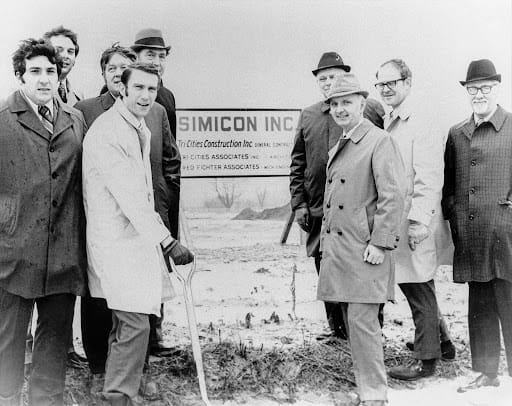
Simicon
So, in 1966, at the age of 23, Fred Bauer founded Simicon to manufacture electronic controls to monitor combustion in residential furnaces. His father was a shareholder.
Operating from an old truck garage at 1601 Washington Avenue (on the campus of the present-day West Michigan Regional Airport), Fred helped develop solid-state controls using photoelectric sensors; in other words, an electronic brain with no moving parts that used a tiny digital eye that scans for a flame.
The garage was as much a home as a workplace. It ran to 5,000 square feet, with two three-bedroom apartments above that had sat empty for years.

Fred married Lois around the same time, and they moved into one of the apartments; the other apartment became Fred’s office. There was no honeymoon and no vacation. “She did 22 loads of laundry the second day we moved in,” Fred recalls. “A lesser woman would have run like hell.”
In Simicon’s first three years, no one knew if it would survive. Money was so tight that Lois’s oven doubled as part of the furnace-control manufacturing process, causing a smell which “stank to high heaven,” she would say.
Then emerged a problem: Fred set aside whatever cash the business made and entrusted it to his father-in-law to keep in a dresser drawer for a rainy day, a phrase he would use at company meetings decades afterward. But the bookkeeper they hired turned out to be a swindler. So, Lois took over the books herself, and six decades later she is still keeping Fred’s personal books.
In that instance and others, Fred learned not to ride the business’s highs and lows. One night, certain he had cracked a design problem, he ran outside and shouted for joy, only to find by morning that the breakthrough was nothing of the sort. “Hero today, goat tomorrow,” he would say.
As Simicon grew, Fred reinvested its profits back into the business. This meant he continued to drive an old car with chains on the tires during Michigan’s winters. Yet Fred still cared about his team. Once, when an employee, a single mother, was snowed in, he drove the beater out himself to bring her to work so she would not lose a day’s pay.
Within five years, Simicon’s payroll had grown to approximately 100 employees.
In 1972, Fred sold Simicon to Robertshaw Controls. But it wasn’t the first time someone tried to sell the company: By Fred’s account, his father twice tried to sell the company out from under him, even rallying the stockholders against Fred. Fortunately, they refused, convinced that Fred was the only one who knew how to run Simicon.
Fred sold Simicon himself, for an offer three times larger than the one his father had tried to accept. Furthermore, his father learned of the sale to Robertshaw and the sale price only when he signed the papers.
From furnace controls to smoke detectors
With the sale of Simicon, Fred had the financial resources to launch another venture.
In 1974, Fred helped launch Gentex with his younger brothers Dan and Larry and their friend Arlyn Lanting in a rented space at 343 E. 16th St. in Holland (present-day site of the Langeland-Sterenberg Funeral Home).
Fred launched Gentex in part to give his youngest brother, Dan, a chance to show what he could do, much as Fred’s own father had once put him to the test with Simicon. Fred himself was deeply involved from the very beginning, as the company’s founder and the hand behind it. The 16th Street storefront sat across from a cemetery. “I’ll be darned if we didn’t end up almost in that cemetery multiple times,” Fred would later say of the early years.
Initially, the new company focused on fire protection for manufactured and mobile homes, producing a battery-powered smoke detector that used light-emitting diodes and photoelectric sensors to detect smoke, an industry and technology Fred was familiar with.
At first, Dan served as Gentex’s first full-time officer, while Fred served as a vice president of Robertshaw. Larry Bauer and his friend Arlyn Lanting, who was then president at Donnelly Corporation, were silent partners.
But the numbers became punishing: Dan, as Fred remembers, “borrowed more money and lost more money,” until Fred stepped in with some hard truths: The company needed more than one customer; it could not survive on negative-12-percent gross margins, and it had to pay the bank. But Dan didn’t give up. “He never did run away,” Fred said, “and that was a good thing.”
Meanwhile, Robertshaw tried to move Fred up. First, the company offered to make him vice president of operations in California, which Fred turned down rather than uproot the family and raise his children there. Then, its leadership asked him to come to corporate headquarters in Virginia and, they told him, become the next president of the entire conglomerate. Fred refused that too. Fred was more concerned about Gentex. It was losing money. Fred decided he would not let it go under.
So, in 1979, Fred left Robertshaw and joined Gentex, a tiny company in severe financial distress. Remarkably, his associates joined him. Then they went to work.
First, they developed new products. The result was that Amway gave Gentex a major contract for smoke detectors.
Second, they entered a joint venture with Donnelly Corporation. Fred, engineer Jon Bechtel, and computer programmer Dave Schmidt, with funds from Donnelly, began work on a new idea: self-dimming mirrors.
But the brutal 1979 recession — so bad that it caused Donnelly’s sales to plummet 40 percent, resulting in layoffs of 33 percent of its employees — almost killed the project. While Donnelly considered pausing the research, Fred charged ahead.
Arlyn Lanting joined Gentex in 1980. In 1981, Fred and Arlyn Lanting took Gentex public, raising $4.3 million by selling 30 percent of Gentex’s stock at $3 per share to investors in Denver, Colorado. The money enabled Gentex not only to acquire a building at 10985 Chicago Drive (between Holland and Zeeland) but also to continue the work on a self-dimming mirror.
That innovation would drastically change Gentex’s future.
Electronic sensors in rearview mirror
For years, automobile manufacturers had struggled with a familiar problem: headlights from vehicles approaching from behind would temporarily impair a driver’s vision. Automakers wanted a rearview mirror that would automatically reduce glare without requiring drivers to adjust it manually.
The challenge was finding a practical and affordable way to make one.
Fred approached it the way he approached most hard problems. The industry had worked 20 or 30 years to build a non-glare mirror and never managed it; there were 30 patents on the problem but still no product that worked. “I read all the other patents,” Fred says, “and learned how not to do it.” The patents, however, didn’t discourage him; instead, they strengthened his resolve: “My main goal was to do some genuine good for the industry and make things that really worked.”
Bauer and his team produced a solution: Electronic sensors that detected glare and activated a small motor that adjusted the angle of the mirror.
But their solution wasn’t perfect: The motor made an audible whirring sound, and the mirror sometimes moved back and forth repeatedly in city traffic. The constant movement could be distracting.
Nevertheless, it solved a real problem, and the automakers were interested: In 1983, Ford began installing Gentex’s automatic-dimming mirrors in the Lincoln Continental. In 1985, Gentex had its first profitable year. In 1986, the “Big Three” automakers installed 300,000 Gentex mirrors in their luxury automobiles.
But Bauer believed Gentex could do better, in part because he had met Harlan Byker.
Harlan Byker
Fred Bauer knew Harlan Byker’s father, Gary Byker, a former state representative from Hudsonville and a stockholder in Gentex. Harlan Byker was an electrochemist working at Battelle Columbus Laboratories in Ohio.
During the Christmas holidays in 1982, Harlan visited Gentex. According to then-Holland Sentinel editor Mike Lozon, Harlan mused about the possibility of developing a mirror that would darken electronically rather than mechanically.
Fred took Harlan up on his idea.
Initially, Gentex supported Harlan’s research at Battelle. But in 1985, Fred hired him. Working in a makeshift laboratory in Gentex’s Chicago Drive facility, Harlan pursued solving a problem that had challenged scientists for decades. After reviewing some Russian technology, Harlan discovered how he could make the mirror darken over an infinite number of levels using a thin gelatinous film held between two pieces of glass, which he could darken with an electrical charge and lighten when removing it.
Gentex announced the invention in 1986 and then made its first acquisition: Vanguard Glass Fabricators on N. Centennial Street in Zeeland. This acquisition, spearheaded by Fred and Kenneth LaGrand, who had replaced a retiring Dan Bauer as president, not only brought more skilled craftsmen into the company, but also eventually doubled the size of Gentex’s manufacturing plant.
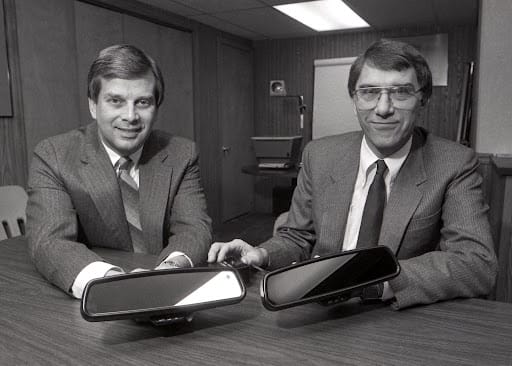
When, in 1987, Ford Motor Co. ordered a small volume of Gentex’s electrochromic mirrors for its 1988 Lincoln Continental, Gentex’s sales of mirrors surpassed sales of fire-protection devices. In 1989, GM bought mirrors for eight models; Chrysler and BMW ordered electrochromic mirrors in 1990.
In 1989, Donnelly announced it was marketing its own “polychromatic” mirror and mirror assemblies. Upon investigation, Gentex was convinced Donnelly had infringed on several of its patents and filed suit. Donnelly believed the same and countered with a suit of its own. The companies settled their dispute in 1996.
From mirrors to a technology platform
Meanwhile, Gentex’s scientists and engineers were busy developing their Night Vision Safety (NVS) mirrors into a platform that could host additional technologies.
In 1991, Gentex marketed the first continuously variable electrochromic exterior mirror, a milestone because such mirrors are subject to one thousand times more ultraviolet radiation than interior mirrors.
In 1993, Gentex’s NVS mirror was enhanced by a patented compass licensed from Holland’s Prince Corporation. Later, HomeLink garage door openers from Johnson Controls Inc. (JCI) were added as an accessory.
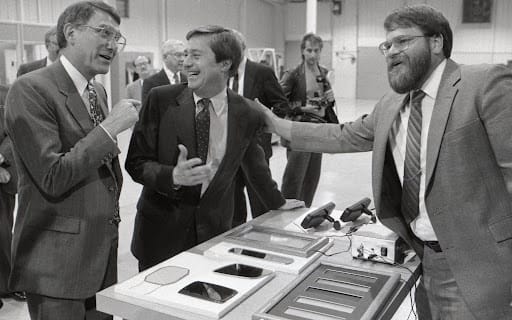
In 1996, Gentex doubled its floor space with a $12.5 million facility at 96th Avenue and Riley Street and shipped its 10 millionth mirror. Even then, the automotive market still seemed attractive because only 10 percent of the automobiles included Gentex mirrors.
By 1997, Gentex sales topped $186 million, a 200 percent increase over 1992.
In 1998, Ernst & Young, a national accounting firm, named Fred Bauer Master Entrepreneur of the Year. That year, Gentex built another plant off Riley Street. Its workforce then numbered 1,750.
In 2001, Gentex introduced LED technology into its mirrors. The mirrors then became the “gateway” for other electronic, wireless, Internet, and navigation features, such as GM’s OnStar system based on Global Positioning System (GPS) technology. Sales that year reached $310 million.
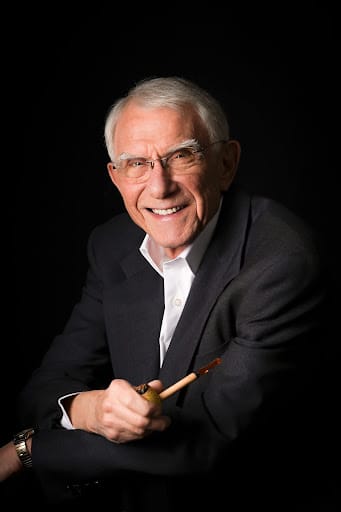
In 2004, after a $35 million expansion, Gentex introduced SmartBeam technology, which automatically switched between high and low headlight beams. The company also developed rear-camera display systems that allowed drivers to see images projected through the mirror surface.
Its electrochromic expertise even found applications outside automobiles. In 2005, Gentex secured a contract to supply electronically dimmable windows for Boeing’s 787 Dreamliner.
When Gentex’s business rebounded after the Great Recession of 2008, exports to Europe and Asia exceeded revenue in the United States!
In 2011, Gentex’s sales surpassed $1 billion. About the time I accidentally met Fred Bauer at Frank’s, Gentex employed 3,500 people locally, making it one of the region’s largest employers.
And the smoke detector division, tiny compared to Gentex’s automotive business, was still going strong.
The people 'who pulled the sled'
Despite all the advances in technology, Fred insists the company’s success belongs to its people. His philosophy of business rests on the four pillars of unpretentious management, an ownership mentality, a commitment to quality, and a commitment to innovation and lifelong learning. The fifth, which went without saying, was to treat everyone like family.
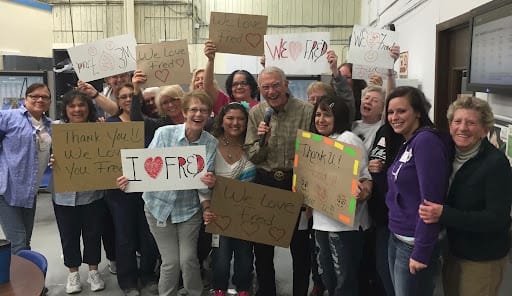
That was because Fred wanted to reward the people who, as he put it, helped “pull the sled up the hill,” a conviction reflected in how Gentex handled bonuses and in a steady discipline of saving for a rainy day.
One story captures it. At the first Gentex plant on Chicago Drive, Sharon “Shar” Beckman was like a mother to the women on the production line. She took Fred’s advice to save her bonus for a rainy day and held onto her Gentex stock, believing in the company and in Fred. Over the years, the value of Gentex stock grew so much that she was able to put all her grandchildren through college. Long afterward, one of those grandsons, working at the Detroit Athletic Club, recognized Fred’s daughter Sheila and told her that to the whole Beckman family, Shar was a hero. Fred agrees, for Shar embodied the culture and values Fred strived to create at Gentex.
Fred Bauer remained chairman and CEO of Gentex until his retirement at the end of 2017.
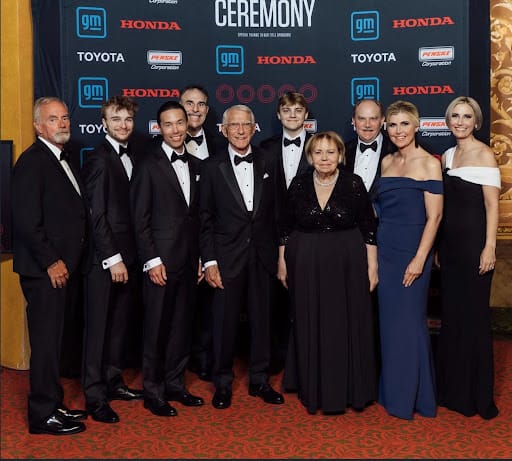
In 2023, Fred was inducted into the Automotive Hall of Fame in recognition of his contributions to automotive technology. Accepting the honor, Fred did what he had always done and gave credit to others instead of himself. He said, “I’m a simple guy,” and thanked the Automotive Hall of Fame committee for their work. He ended by saying, “I want to tell you how grateful we are, truly grateful. My family is ecstatic about it.”
If I could speak for the community, I would say we are truly grateful for Fred.
— Information for this article comes from Robert Swierenga’s "Holland, Michigan," the Fred T. Bauer Oral History Interview (digitalcommons.hope.edu) at Hope College, Bauer’s 2023 Automotive Hall of Fame acceptance remarks, and correspondence with Fred Bauer and his daughter, Sheila.


