


The Business Next Door: Surviving Against the Billion-Dollar Majors: The Trendway story: Part 2
Don Heeringa’s story and the history of Trendway is documented in the book “Surviving the Billion-Dollar Majors,” available at Reader’s World in downtown Holland.

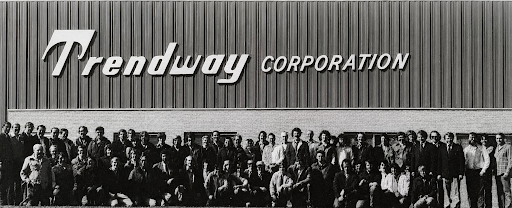
In 1973, George Heeringa purchased a struggling Trendway Corp. and recruited his sons, Jim and Don, to run the company. Jim exited the company in 1995. Don continued until 2019, when Trendway was sold to Fellowes Brands.
In the 1980s and 1990s, Trendway grew at an astonishing average annual rate of 24%, and three times, “Michigan Business Magazine” recognized it as one of the state’s “one hundred fastest growing privately held businesses.” In addition, in 1983, Don was named the Michigan Small Businessperson of the Year; and, in 2014, the Junior Achievement of the Michigan Great Lakes Business Hall of Fame.
More interesting is why these results and accolades occurred.
Don’s story and the history of Trendway is documented in the book “Surviving the Billion-Dollar Majors,” available at Reader’s World in downtown Holland. In ONN, I offer an abridged version, in three parts.
Read Part 1: The Business Next Door: Surviving Against the Billion-Dollar Majors: The Trendway story: Part 1
This week is Part 2: The Market.
Sawing wood
When Don Heeringa and his brother, Jim, returned from the West (Jim from California, Don from Arizona) to join their father, George Heeringa, at Trendway, the company had sales of $400,000 and losses for profits. After six months under its new ownership, only half of the original 13 people were left, and Trendway was still losing money.
One of George’s favorite sayings was: “Keep sawing wood.” Don took those words to heart. Eventually, according to Don, “We got an order we didn’t expect. Then someone asked to be a dealer.” The next year the company broke even. In the following year, it made a profit.
In that third year, 1976, Trendway also got a boost when Gerry Haworth (founder of Modern Partitions, later Haworth), who attended Hope Church with Don’s parents, called George with an idea.
According to Don:
Gerry said: “We’re going with the ‘open office’ with all our money. We have a floor-to-ceiling product. Would you like to buy it?” We thought: “They have accounts all over which we don’t have.”
So, Trendway bought Modern Partitions’ floor-to-ceiling panel business, and Modern Partitions remade itself into Haworth. The transaction was good for both parties: Haworth received cash to help finance the introduction and growth of its pre-wired panel system (ERA-1), panel connector (the Living Hinge), and new corporate name; Trendway received a floor-to-ceiling panel business, new customers, and a backlog of orders.
And the price was right: Haworth agreed that Trendway could pay Haworth a small percentage of its total sales (2%) every quarter for five years. This deferment of costs allowed Trendway to make the first of many additions to its Quincy Street plant.
Listen to the market
One of Don’s favorite sayings is “Listen to the market.” The ability to hear and the willingness to respond brought many profitable changes to Trendway, including a move into office furniture, buying their own trucks and putting one of them on a barge, hiring manufacturer’s reps, and drastically cutting delivery times.
Office furniture
Throughout much of the 1970s, Trendway was focused on expanding its floor-to-ceiling business, especially after the acquisition of the Modern Partitions’ product and the connections with customers that came with it.
Although Trendway was successful, as the 1970s ended, Don and his team understood why Haworth was investing heavily in the “open office” concept: this segment of the office furniture industry was experiencing unprecedented growth. “Watching it was intoxicating,” recalls Don. “So, our people began to develop Trendway's own open office system product.”
Trendway called its first-generation product the Space Management System.
By 1983, Trendway was employing nearly 200 people at its Quincy Street plant and had leased a showroom in Chicago's Merchandise Mart to launch its new product line at the National Exposition of Contract Interior Furnishings (NEOCON) trade show. But to survive against the majors — Haworth, Herman Miller, and Steelcase, which had sales in the billions — Trendway had to develop its own unique way of garnering attention.
Semi-truck on a barge
When Don first arrived at Trendway, the company was using two vehicles for deliveries: a beat-up 18-year-old Ford station wagon and an old Chevy 20-foot straight truck. As Don remembers:
The truck was on its last legs, and it worried me to have a part-time employee drive it to Chicago to the only customers we had for deliveries.
So, Don decided to replace the truck. But Trendway didn’t have the cash to buy one. Fortunately, both he and Jim knew a salesperson at the R.E. Barber Ford dealership in Holland who would lease them a truck. Then Don had a humbling experience.
Don describes what happened:
I decided we needed to have the truck lettered with the name Trendway and some additional information. I had two boyhood friends who were in the sign painting and lettering business, and they volunteered to help me by doing the work for free.
So, one Saturday they both came to Trendway. We opened a 16-foot door and backed the truck inside so they could do their lettering work more easily.
After a few hours, they finished and we had a gleaming new truck with its proper lettering. Now that it was complete, I hopped into the cab to drive it outside to where it would be parked.
When I got in the truck, the garage door was open to the outside world. It did not occur to me that the door was only open high enough to clear the cab, but not high enough to clear the box. So, when I drove out, I heard a loud clatter as I knocked the door off its tracks and into the parking lot. To fix the door, I had to make an embarrassing call to a contractor to reinstall it back onto the building.
The following week, one of Trendway’s employees knocked the door off its tracks when moving the truck out of the building. When I heard about it, I went to the location and addressed the person who caused the door to be knocked off. He was taken aback when I shook his hand and told him, "It could happen to anyone!" with a big smile on my face.
The story went around quickly.
In 1981, Don made a trip to Ohio to address an issue a dealer had with Trendway.
Here’s Don’s version of events:
When I met with the customer, he showed little interest in discussing the issue I came to address. Little did I know, this was a Steelcase dealer who used Trendway products and services only when the marketplace demanded our quick service or a special. The bulk of our conversation was about a Steelcase truck that recently made a delivery in all its beauty. The dealer wouldn’t stop talking about how it was spotless and how it made a positive impression on the end user.
So, Don went back to Holland and signed a full maintenance lease on a new tractor. Trendway then bought two trailers and had them painted. From then on, Trendway was in the trucking business, with happy consequences: Don says: “As it turned out, having our own trucks aided our rapid delivery,” a future Trendway distinctive.
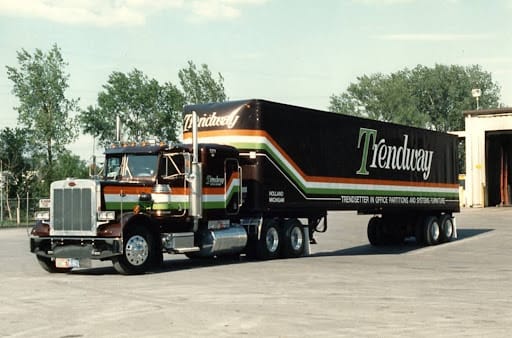
As time went on, Trendway added more trucks and drivers, then a new tractor brand, negotiated by the drivers.
According to Don, here is what happened:
The Trendway truck drivers typically would leave to make their deliveries on a Sunday and usually would return on Thursday. There were exceptions, but this was the norm.
The drivers were compensated for the miles driven, plus some compensation for time for each stop. A multi-stop truckload was also the norm. We offered the drivers a room every other night as part of their compensation package.
The truck program turned out to be an important part of Trendway’s service package. It allowed us to commit to delivering on a specific date.
Earlier in our truck life history, a leasing company had made an attractive proposal for a long-term truck lease. In the proposal, however, there was a specified lower-end but well-known tractor brand. A good brand, but in the lower-price and image category.
That’s when I learned that image matters. With no input from me, the drivers collectively made a proposal. They offered to wash and clean the tractors each week if we would get them one of the high-profile tractors, namely a Peterbilt or Kenworth.
We accepted their proposal, and we were in the high-profile trucking business.
At Trendway’s peak, it owned nine tractors and 20 semi-trailers.
Image also matters at the National Exposition of Contract Interior Furnishings (NEOCON) trade show, held every June in downtown Chicago. In 1983, Trendway opened a showroom in Chicago’s Merchandise Mart, a massive building that fronts the Chicago River, but Trendway needed to do something extra to get noticed.
In preparation for the NEOCON events, Trendway worked with an advertising agency, and Don participated in those meetings. As they were preparing for the 1991 event, Don heard an idea that he was sure would get Trendway noticed.
Here is Don’s account of what happened:
Each year in June, there is an industry trade show at the Merchandise Mart in Chicago called NEOCON. About 50,000 people attend.
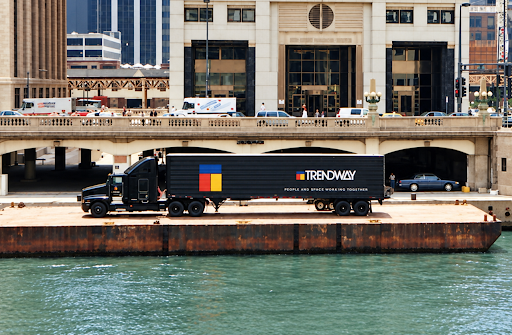
Prior to the event, we had a planning meeting for NEOCON with the advertising agency that handled our account. During our discussions, a lower-level employee suggested we consider her idea. It was to put one of our trucks on a barge and float it down the Chicago River on opening day, then park it in front of the Merchandise Mart for the show.
We fell in love with the idea.
Right before the event, a brand-new truck was loaded on a barge in Michigan City, Indiana. We put spotlights on the truck to make it easier to see at night. The barge drew a crowd. No one had ever done that before. As it turned out, it was the lowest cost promotion we had done for the show with undoubtedly the highest impact. And we had just taken delivery of a new truck the week before. It was a smash hit and the industry talked about it for years.
That stunt also got the attention of salespeople.
Manufacturers’ representatives
In the commercial office furniture industry, sales representatives call on dealers and dealers call on final customers. When Don became president of Trendway in 1983, he began hiring independent sales agents to reach dealers across the country.
According to Don, it happened this way:
I got a call from a guy in Ohio. He had set up a lot of dealers. So, we had dinner together. He suggested most of the big companies had their own salespeople, so Trendway needed to have sales representatives assigned to territories and working on commission. A few days later, the guy called back and said, “I am your first rep!” Then word got around the industry.
Eventually, Trendway had 40 manufacturers’ representatives calling on 500 dealers throughout the United States.
One of those representatives was Tim Nordquist, who explains the state of the industry this way:
Most of those manufacturers — who had sales of $50 million or less — were so small that they couldn't really afford their own sales team. … And the typical customer would order 100 workstations, which was a decent size for Trendway, but a trivial amount for Steelcase, Herman Miller, and Haworth.
Trendway needed to find a way to turn its size into a competitive advantage.

Same-day shipping
To survive against the billion-dollar giants, Trendway needed a unique strategy.
Don put it this way:
In the early 1980s, Herman Miller and Haworth had three-month lead times. So, we redesigned the factory and cut our lead time to three weeks.
That meant that if an order came at the first of the month, Trendway promised it would be delivered by the 23rd of that month. No one else in the industry made such promises.
As Trendway matured, we were always looking for ways we could improve on performance. We developed a reputation for rapid delivery. It was our niche. Most of our machinery was automated yet designed to produce a small number of units fast.
We also developed a capability for fast delivery and were willing to review any special item the customer wanted. The "big boys" would not do that.
By 1998, Trendway’s sales were $75 million, now larger than many small manufacturers, although still tiny compared to their billion-dollar neighbors. But Trendway was profitably surviving.
To meet the demand for rapid delivery, Trendway established a quick shipping facility (Xpress) with about 25 special employees in a leased building in Zeeland, Michigan, within sight of Herman Miller (now MillerKnoll). At its peak, it was shipping $2 million per month. Don would go there periodically to hold a meeting, which most of the time consisted of thanking the team for their excellent performance.
According to Don, their performance was facilitated by a special employee who came to him with a proposal:
At the time, our commitment to the field was to ship the order within five days from when we received the order. She had studied that commitment, then calmly told me the staff agreed to the following: If they received an order in the morning, they would ship that order that same day.
It would be a substantial reduction in lead time. The team said they would work all the required hours until every order was shipped however long it took, sometimes late into the night.
What she didn't tell me (but I found out later) was that on the days we received a light order load, she let the people go early and paid them for a normal day’s work. That was the tradeoff — to get them to agree to stay for the heavy days. Thus, she proved not only to be a great leader, but also a good team builder as well.
Her name was Barb Kleevs.
Not only did Trendway’s management team set up a special rapid delivery shipping arm in a separate facility, but it also created a more flexible communication process in its main plant, borrowing a Japanese concept called “Gemba,” meaning “where value is created.”
As Don explains:
We had 350 people in the organization. … We used Gemba to improve on what had become the mantra of our company "on time and complete shipments." This meant the department leaders would meet at 11 a.m. each day for a short meeting.
Dave Williams, a long-time manufacturing engineer, who later ran facilities, maintenance, and tech support, claims that “It’s on time or it’s free” was both a nightmare and a blessing.
He recalls:
You had to have everybody on board. I can remember Sue Bush. She was a hi-lo driver … and she stayed over one night because of two pieces that were going to cause us to have a late shipment. She stayed and her statement to me was, “We're not going to miss on my shift!” and that was the attitude everybody bought in, especially the purchasing people.
Not only did everyone at Trendway need to be on board, but also Trendway’s suppliers. One of Trendway’s best suppliers was Metalworks, of Ludington.
According to Dave:
Metalworks made our filing cabinets and they missed. They didn't have a three-high lateral or four-high lateral file, so they had to scramble around, and they stayed late, on their bill, to make that. …
We had till midnight to get it done … but the truck had left Trendway for Chicago and Metalworks … had their people stay till 9:30 or 10:30 at night to get that lateral file cabinet done. A young lady from the manufacturing plant had a pickup truck and drove to Trendway, accompanied by her dog, to deliver the lateral.
I met them at the back door at 11:30 at night, and we offloaded that four-high lateral and, as I'm walking by the truck, the dog thought I was an intruder: I scared the heck out of the dog and the dog scared the heck out of me!
At 11:30 at night, one of my tech guys and I put that in a truck, and we drove to Chicago. The next morning, we met the Trendway truck and delivered it.
Next week, we’ll conclude our story with more anecdotes and lessons learned.
— Steve VanderVeen ("dr v") is a biographer, educator, and learner, discovering history and developing future entrepreneurs. See start-upacademeinc.com.


