

The Business Next Door: From Main Street merchants to world-stage science: The legacy of Zeeland’s DeKruif family
Read how a recent renovation project inspired a deep dive into one of Zeeland's most well-known families.


Another Dutch immigrant family that left their mark not only in Zeeland but also around the world is the DeKruifs. This is part of their story:
Foreward
The genesis of my renewed exploration of the DeKruifs was a Facebook post from Joldersma Construction. Amid a remodeling project, the post showed an old sign on the wall of an adjacent building. That building at one time belonged to Henry DeKruif. Henry’s father was Hendrik DeKruif.
Hendrik DeKruif
Hendrik DeKruif was born in Gelderland, Netherlands, in 1817. He married Elizabeth Van Belkum in 1943. Henry and Elizabeth’s son, Geerlinus, was born in 1844. Sadly, Elizabeth died in 1846.
Hendrik, a farmhand, was also a pioneer and an entrepreneur. In 1846, leaving Geerlinus behind (presumably with relatives), amid economic hardship due to the Potato Famine and persecution from the state-controlled Dutch Reformed Church, he accompanied Albertus Van Raalte, Holland’s founder, and 58 other immigrants of the Seceder Church to America.
They sailed from Rotterdam aboard the “Southerner” on Oct. 2 and arrived in New York on Nov. 17. Then, they took a steamboat to Albany, a canal boat to Buffalo, and a steamboat to Detroit, arriving there on Nov. 27.
Initially, the immigrants thought they would settle on the west side of Lake Michigan, in Wisconsin. But with winter approaching, Van Raalte left his followers in Detroit to see if the east side of the lake could be suitable.
He, Judge John Kellogg of Allegan, and an unnamed Odawa guide arrived at the Old Wing Mission, a missionary outpost in Fillmore Township built by George Smith, Isaac Fairbanks and Joseph Wakazoo’s Odawa, on Dec. 31. Then, using the mission as his home base, Van Raalte explored West Michigan.
Although he could have chosen places near Allegan, Grand Haven, Grand Rapids, Kalamazoo, Singapore, he chose a wooded wilderness near Black Lake (later, Lake Macatawa), believing he could build a city on a hill amidst a forest which could also be harvested and turned into cash.
Van Raalte’s family and followers, including Hendrick DeKruif, arrived near the Black River and Black Lake in the spring of 1847. Many other Dutch immigrants followed.
Upon his arrival, Hendrik DeKruif bought a flatboat from Jan Rabbers, who had left the Netherlands aboard the “Isabella Bath” on Oct. 13, 1846. Because the Erie Canal was frozen, Rabbers’ group took a train from Albany to Buffalo, then apparently proceeded to Detroit through Canada on foot!
They arrived in Holland in March 1847. That spring Rabbers founded Groningen along the Wa-ma-ta-go-sha Creek (later, Frenchman’s Creek), a branch of the Black (later, Macatawa) River, where he built a sawmill.
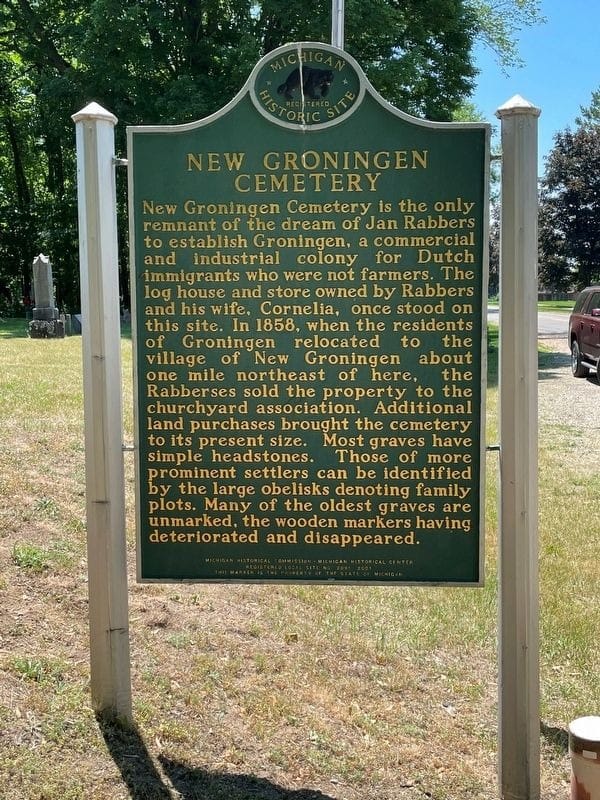
Hendrik initially made his living traversing up and down the Kalamazoo River, through Singapore and into Lake Michigan, back and forth across Black Lake, and into the Black River, to provide settlers with supplies and food.
He then worked two years for Rabbers and a man named Reeken in their mercantile business. In addition, Hendrik served as an interpreter because, aided by his job, he was one of the first to learn the English language.
Hendrik married Dina van de Luyster in March 1848.
Dina was the daughter of Jannes and Dina Naaije van de Luyster, also members of the Seceder Church. They hailed from the Province of Zeeland and had the unusual distinction of being wealthy farmers in the Netherlands. The van de Luysters led one of three groups of Dutch immigrants to West Michigan, paying the passage for many. The Rev. Cornelius Vander Meulen and Jan Steketee led the other two groups.
The van de Luysters and their followers left from Antwerp, Belgium, on the ship “Kroonprins von Hanover” on April 22, 1847. They arrived in New York City on June 6. Then, they took a steamboat to Albany, and a canal boat from Albany to Buffalo. Then, they boarded a steamer that took them through the Great Lakes and around Michigan’s Lower Peninsula to the mouth of Black Lake, where they disembarked on flatboats.
They arrived in Holland on June 27. In August, they founded the colony of Zeeland, Michigan, where van de Luyster purchased 1,600 acres of land and lent money to his fellow immigrants so they could buy it. The next few years were so difficult, however, in part because the village of Zeeland — unlike Holland — was landlocked, that many of van de Luyster’s neighbors could not pay him back.
Hendrik DeKruif purchased 80 acres of land, built a log house in Zeeland, and began farming. In 1855, his son, Geerlinus, joined him in America. In 1861, Hendrik moved to Holland, where he operated a meat market and tannery. He also put his natural math skills to work as a tax assessor and served as a constable.
In Holland, Hendrik and his wife, Dina, had eight children, among them Johannes, Anthony, Hendrik (“Henry”) and John, who were among Zeeland’s early business leaders after the arrival of the railroad in 1872.
John made his mark on Grandville Avenue on the southwest side of Grand Rapids. Geerlinus became a private in the Civil War. After the war, he also moved to Grand Rapids.
Johannes DeKruif
Johannes was born in 1850. He worked as a farmhand until 1865, whereupon he married Maria Van Leeuwen and became a blacksmith.
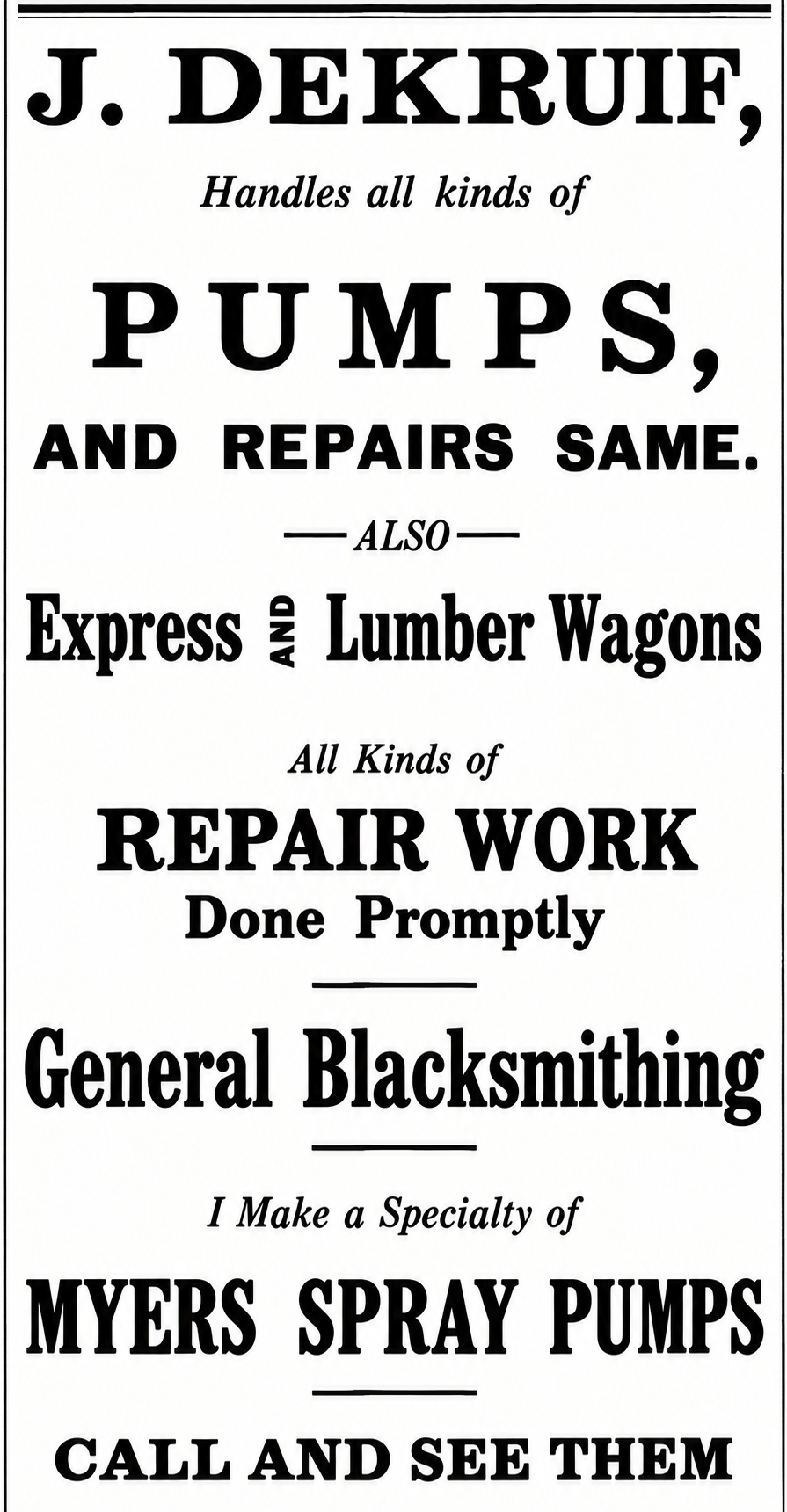
In 1879, Johannes became a business partner of Willem Wichers, who had been making wagons and sleighs since 1870 at 340 E. Main Ave.
By 1882, Wichers, DeKruif, and Co. consisted of a 54-by-40-foot main building, a 30-by-42-foot blacksmith shop, a 20-by-30-foot engine house (with a 25-horsepower steam engine), and a 20-by-50-foot lumber shed. That facility eventually became Wichers Lumber Co.
Meanwhile, Johannes moved to Bangor, Michigan. He died there in 1923.
In 1905, Willem Wichers co-founded the State Commercial and Savings Bank, called the “Red Bank” by locals because of its distinctive red brick façade, a classic presence on the southeast corner of Main Avenue and Church Street.
Years later, it became home to Van Raalte’s Restaurant.
Anthony DeKruif
Anthony was born in 1851. He became a druggist. Where he learned his trade is unclear.
In 1878, Anthony opened a store in a frame building on the north side of Main Avenue. Like many druggists in this era, DeKruif sold his own concoctions: DeKruif’s Emulsion of Cod Liver Oil and Hypophosphites, DeKruif’s White Pine Cough Balsam, DeKruif’s Laxative Cold and LaGrippe Tablets, and DeKruif’s Amsterdam Cream.
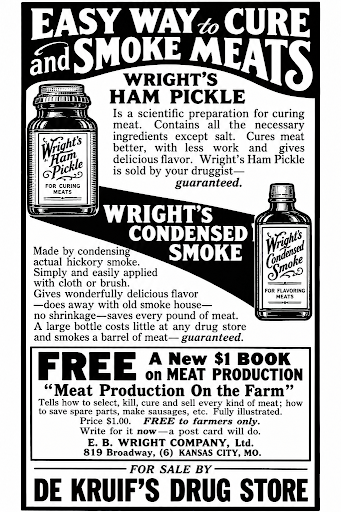
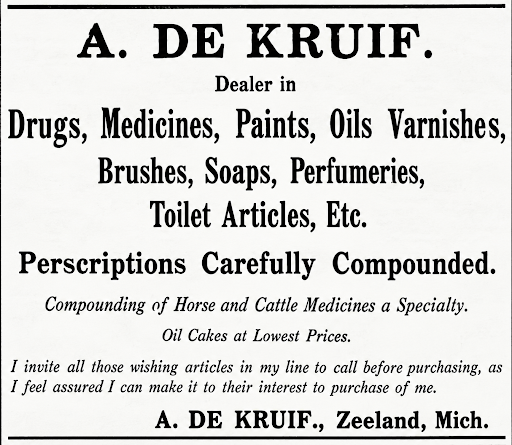
Advertisements for Anthony DeKruif’s Drug Store. [Courtesy/The Zeeland Expositor, March 3, 1879]
Sometime after 1892, Anthony built a two-story brick building at 156 Main Ave. (southwest corner of Main Avenue and Church Street) in Zeeland, next to his brother’s establishment. (See below.)
In 1900, Anthony’s direct business competitor was one block to the west: Dick Van Bree and his drug store on the southeast corner of Main Avenue and Elm Street.
But Anthony survived. In 1902, he provided a Swiss clock with any purchase of the Wanted brand of liniment and salve. In the 1920s and 1930s, Anthony added a soda fountain and, on the second floor, a basketball court, boxing ring, and miniature golf course.
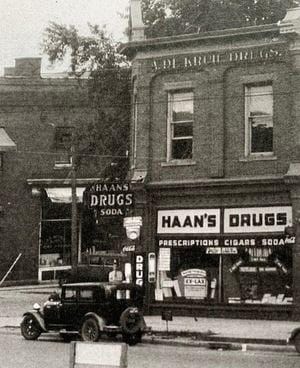
Anthony DeKruif died in 1922. His son, Angus, sold DeKruif’s Drug Store to John Poest and John Haan of Zeeland in 1935.
Henry DeKruif
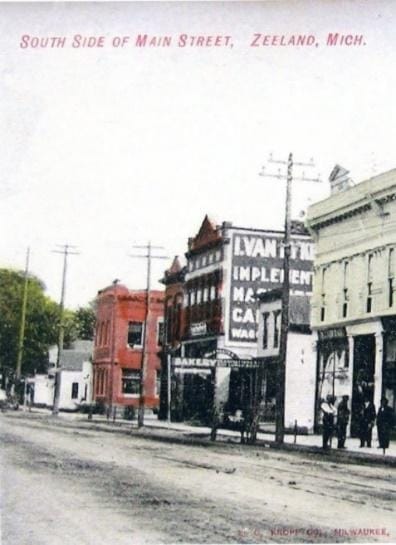
Henry was born in 1857. In 1882, he opened a farm implement business, which, of course, depended on the railroad for supplies. In 1888, Henry hired Isaac Van Dyke, a teenager, to assist him.
In 1889, Henry married Hendrika Kremers. Their first home was at the corner of Main Avenue and Maple Street. Their son, Paul, was born in that home in 1890.
Part of Henry’s success as a farm implement dealer was that he offered credit to farmers.
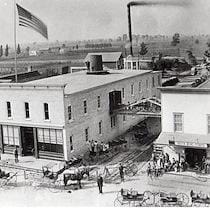
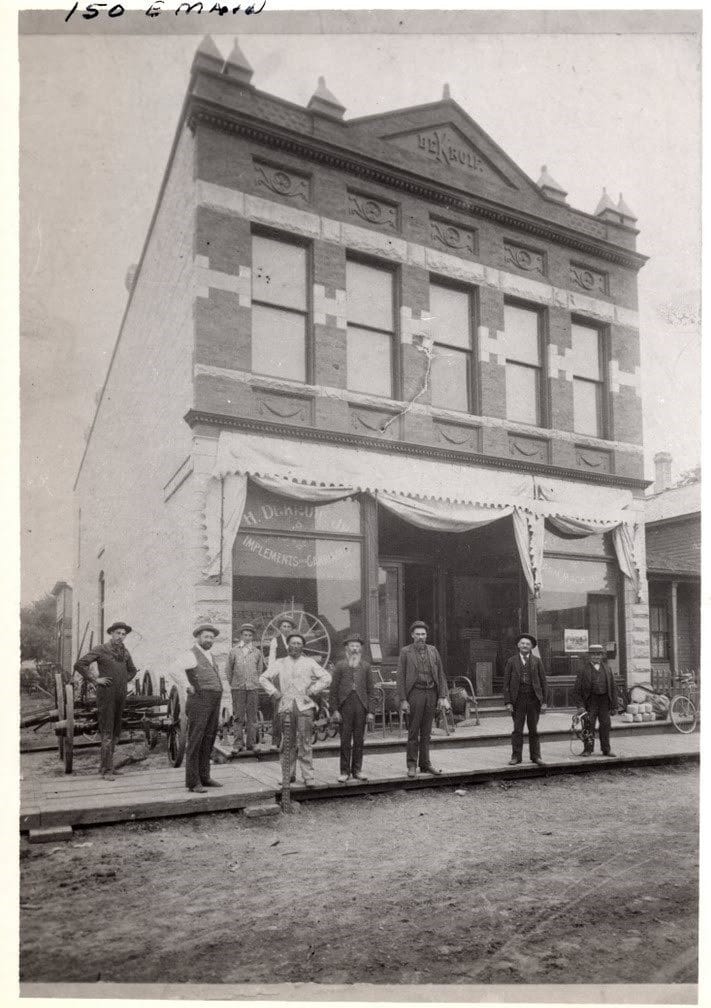
In 1892, Henry built a magnificent showroom for his business at 150 E. Main Ave. That year he also joined Berend Veneklasen (Zeeland’s brickmaker) and Albert La Huis (Zeeland’s merchant of clothes and household items) as agents of the Texas Colonization Co. of Omaha, Nebraska, to recruit Dutch farmers to relocate to a Dutch colony in southeastern Texas. But the speculative venture turned out to be a bust.
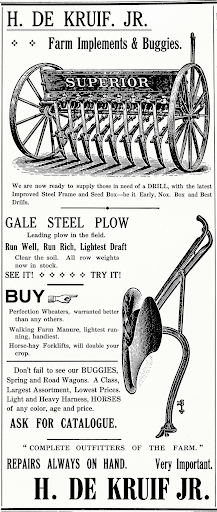
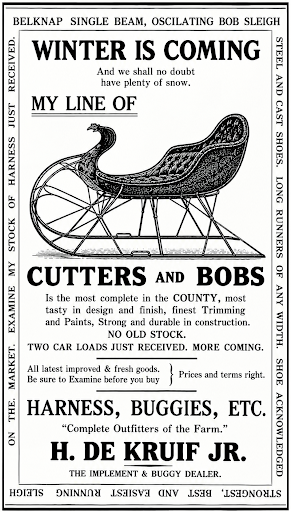
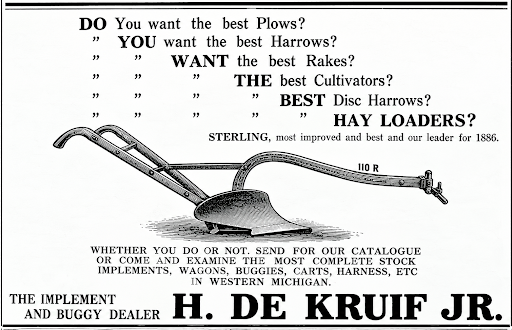
Advertisements for Henry DeKruif’s farm implement store. [Courtesy/The Zeeland Expositor, March 29, 1895]
In 1898, Henry hired John Hartgerink to work for him as a bookkeeper in his farm implement business.
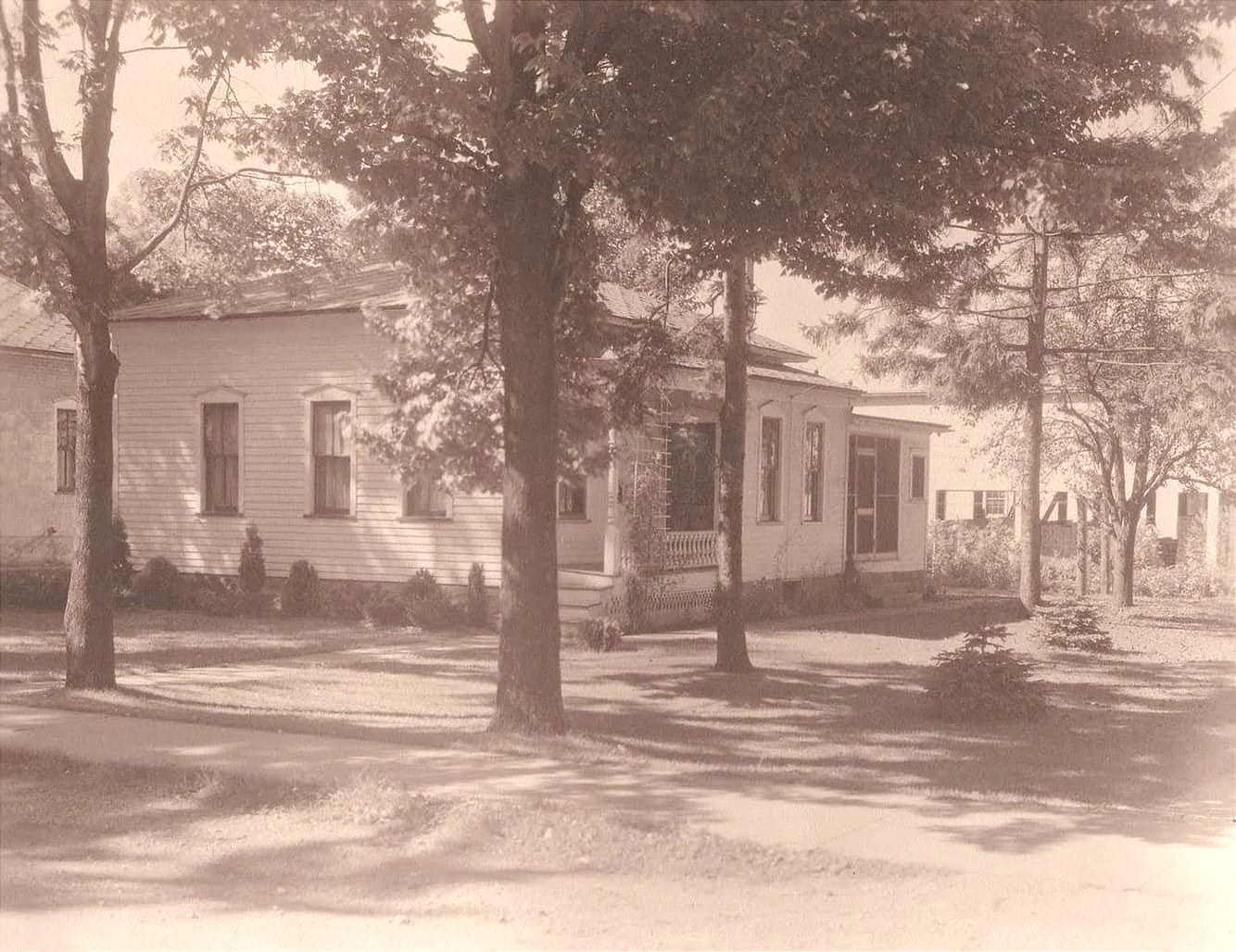
In 1899, Henry built a large home at 214 E. Central Ave. (present-day Parkview Home). He also became a founding investor in the Holland Sugar Co.
In 1901, he sold his implement business to Isaac Van Dyke, Hartgerink and other investors.
In 1906, Henry invested in John Spyker’s Colonial Clock Co. He also sold Ford cars. In 1909, he and Christian Den Herder, Dr. Thomas Huizenga, Albert LaHuis and John Veneklasen bought Spyker’s interest and hired Herman Miller as plant superintendent.
In 1913, Henry sold his home on Central Avenue to Herman Miller.
Meanwhile, Henry’s son, Paul, attended the University of Michigan, where he graduated in 1912. Although Henry wished for Paul to become a doctor or lawyer, Paul, influenced by Zeeland’s Dr. Thomas Huizenga, chose to become a doctor.
Henry DeKruif died in 1917. At the time of his death, he was a director of the Zeeland State Bank, the Holland-St. Louis Sugar Co., and the Colonial Manufacturing Co. His death was not unexpected, because he had been in poor health.
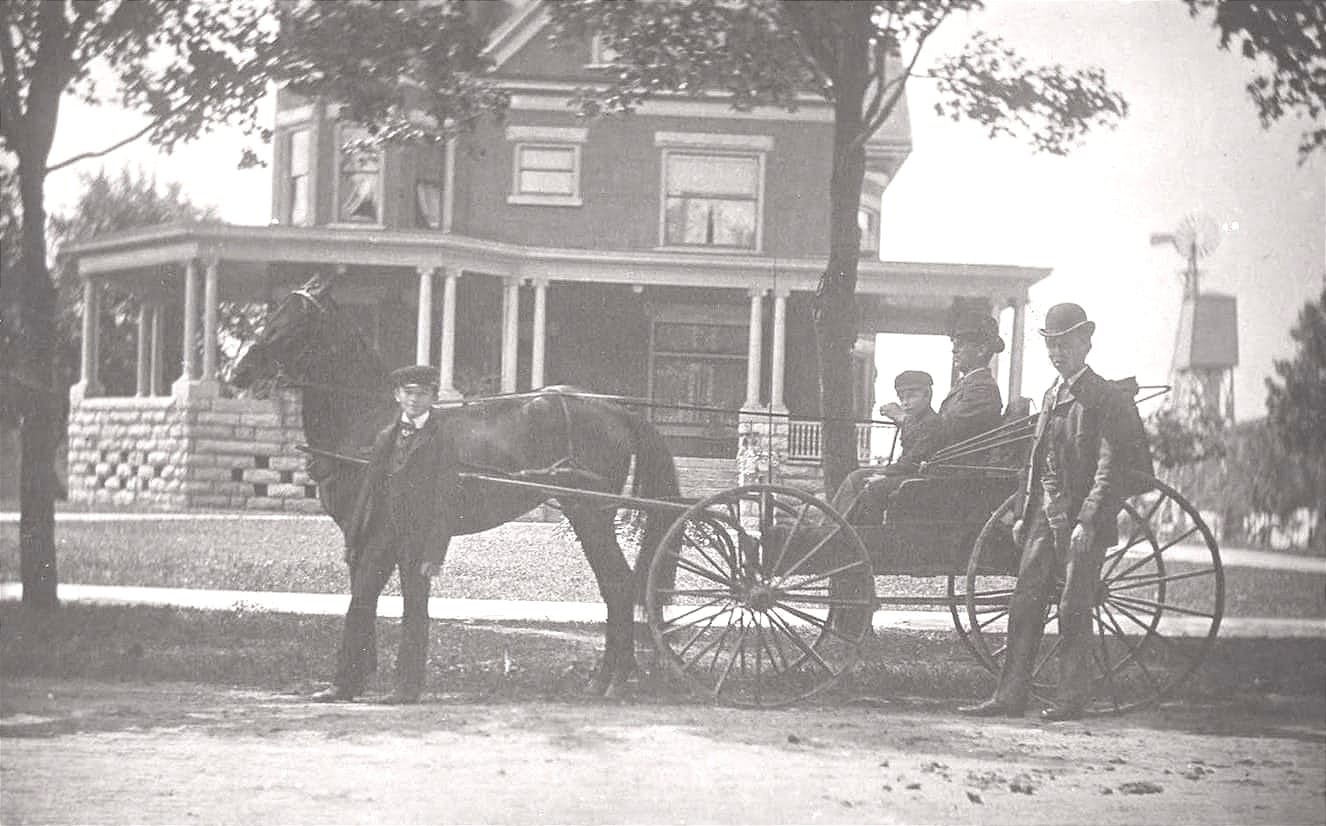
John DeKruif
John was born in 1865. He married Annette Van Leeuwen in 1888.
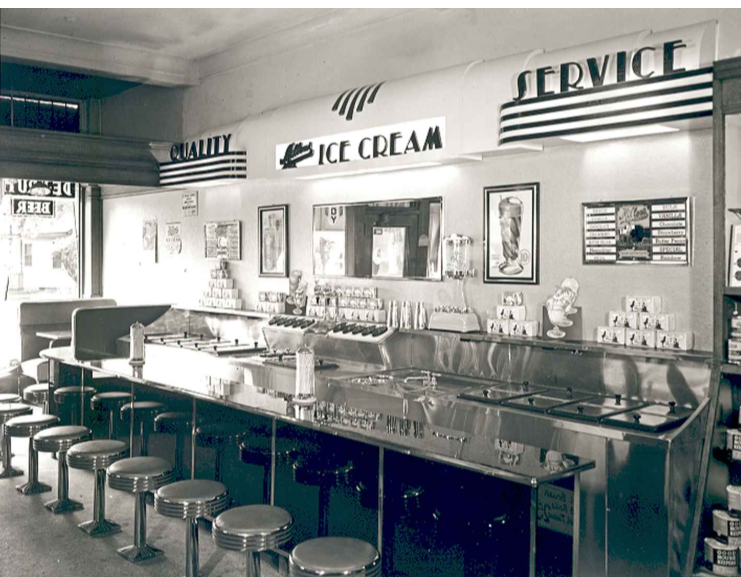
John operated two drugstores, one at 80 Grandville Ave. and one at 476 Grandville Ave., both on the west side of Grand Rapids, then a Dutch neighborhood.
John also served on the Grand Rapids Civic Auditorium Board. He lived on Caulfield Avenue in Roosevelt Park. He died in 1952.
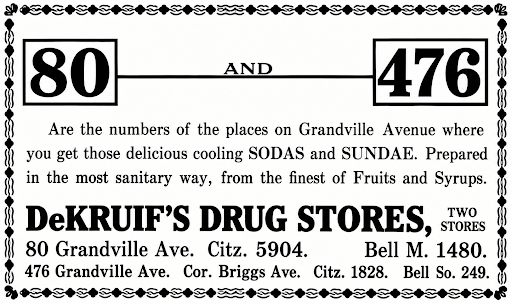
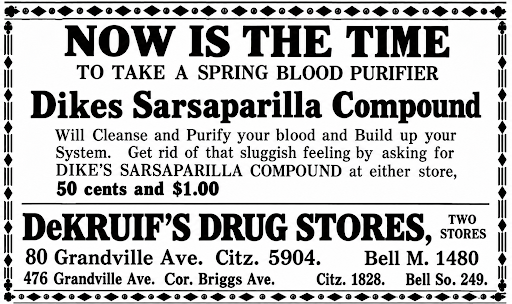
Advertisements for John DeKruif’s Drug Stores in The Grandville Avenue Record (April 7, 1911). [Courtesy/Grand Rapids Public Library (ChatGPT enhanced)]
But the most famous DeKruif was Henry and Henderika’s son, Paul.
Paul DeKruif
Paul Henry DeKruif was born in 1890.
Like many of his friends, he enjoyed playing baseball (with dreams of being a pitcher) and football. Paul also had dreams about boxing. Although his mother encouraged his learning through books, many of which weren’t available in Zeeland, such as books by Russian novelists, his father motivated Paul with fear. That may be why Paul rebelled against his father’s church and culture.
Here is what Paul wrote about his father:
In my boyhood in our family my father would be stony silent for days, gloomy, preoccupied, only opening his mouth to read the inevitable chapter of the Bible after every meal. He was a tough, totally self-made man whose formal learning had ended at the second grade. He was a natural mathematician who would offhand give me the answer to a stated problem in college algebra without so much as having heard of a quadratic equation. He solved the fiscal angles of profit and loss in his hard-driving farm-implement business at a glance. He had contempt for the economic calfishness of his farmer customers and foreclosed them without too much mercy.
My father made what was big country money in those early nineteenth century days but then often tossed a part of these profits away in bold investments, such as a yet unsuccessful paper milk bottle, and in Portland cement companies. These disasters made him furious, not at himself but at my mother, who was then reduced to tears. Outside our home he was considered a jolly man; his round face smiled and his round belly shook with hearty laughter.
He was true to my mother, who feared him and loved him. “Your father was a hard man,” my mother summed him up to me just before she died. On his black days, for minor peccadilloes, he bared my back and had at me with a horsewhip with the abandon of Captain Bligh. Afterward he seemed to feel better and might take us out for an auto ride — “for a spin” as he called it — and then would likely treat us to an ice-cream soda.
He was determined to get me away from our small town, wanting me to become an engineer or a doctor or a “rattling attorney,” though he never made it clear to me why an attorney should rattle. Yet he had no great hopes for me, considering me a coward because I couldn’t keep “a stiff upper lip” — I whimpered when he beat the hell out of me.
The streak of cowardice in me must have stemmed partly from fear of my father. I do not blame him because I now know that for many years — beneath his being outwardly robust — he was, sub-clinically, a sick man; and his irritability was that of an undiagnosed diabetic. In his last years, slowly starving to death under diabetic treatment on scant calories, he became gentler to me. He was proud of my going great guns at the [University of Michigan], microbe hunting under Professor Novy. Happily, my father told me Dr. Novy said I might turn out to be one man in a million.
A few years before that, I had been glad to announce to my father that he was relieved of all financial responsibility for my education. Though well-off, these outlays had always irked him sore. But now he would be happy to know — this was in 1912 — that I’d quit medicine for a Rockefeller research fellowship in bacteriology under Professor Novy to work for a Ph.D. and my schooling wasn’t going to cost him anything more at all. From then on out he began to respect me somewhat. Of him — in his last five years as he slowly starved toward diabetic death — this is my best memory.
~ Paul DeKruif, “The Sweeping Wind,” (pp. 64-66)
Even so, Paul did have an adventurous youth. Before attending college, he worked in his father’s Ford garage and was even given the opportunity to test his Ford Roadster: He drove from Zeeland to Detroit in nine hours — then considered a record time!
Unfortunately, Henry DeKruif missed out on Paul’s larger accomplishments. Henry died one year after Paul earned his Ph.D. in microbiology, and before Paul’s writing career took off.
After earning his doctorate in 1916, Paul served in the U.S. Army on the Pancho Villa Expedition during the Mexican border war (1916-1917) and in World War I. Then he returned to the University of Michigan in 1919, where he served as an assistant professor of bacteriology and continued to work in Dr. Novy’s lab, seeking to understand the bacteria that cause strep throat.
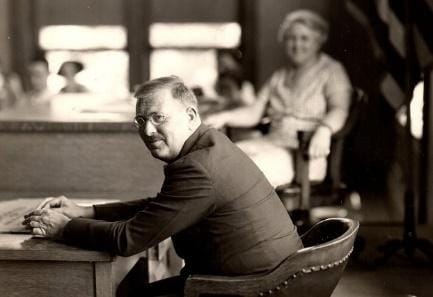
In 1920, Paul took a position in New York with the Rockefeller Institute for Medical Research.
While there, Paul became acquainted with the literary world and developed a friendship with Sinclair Lewis, who had become famous for publishing “Main Street,” a satirical account of small-town Protestant culture, in 1920, and “Babbit,” a satirical account of a church-going real estate salesman in a large Midwestern city, in 1922. Both novels must have resonated with Paul.
Meanwhile, Paul had become disillusioned with both research and medical practice and, likely motivated by Sinclair Lewis, wrote articles condemning practitioners who sold patent medicine remedies and researchers who were more focused on profits than scientific rigor.
When his supervisor learned what Paul had done, fearing that the articles would cast a dark shadow on the Rockefeller Institute, he fired Paul. Ironically, the dismissal pushed Paul out of laboratory research and into literary science journalism, where he flourished.
But his firing influenced Paul in another way: Paul’s next two projects presented readers with heroic characters of the medical field. The first was a fictional character, Martin Arrowsmith, the protagonist in Sinclair Lewis’s 1925 “Arrowsmith,” a medical researcher who struggled to maintain his integrity despite political and economic pressures to do otherwise.
Paul’s second project was the book “Microbe Hunters,” a collection of true stories of bacteriologists, including Louis Pasteur, who showed how microorganisms cause disease and how to make vaccines; Paul Ehrlich, who pioneered research on the body’s immune system; and others who were willing to sacrifice everything in the name of science. The book was published in 1926 and became an immediate success.
Paul’s third project was “Hunger Fighters,” a book published in 1928. In it, Paul tells stories of unknown farmers who thwarted grain and livestock diseases.
“Seven Iron Men,” which Paul published in 1929, was about the Merritt brothers, who, after discovering iron ore in the Mesabi region of Minnesota, lost their empire to John D. Rockefeller, the founder of Standard Oil Co. and at one time the richest man in America.
In “Men Against Death,” published in 1932, Paul highlights researchers who discovered the causes and treatments for diseases such as diabetes, syphilis and tuberculosis.
During the Great Depression, Paul wrote about wealth inequality, malnutrition, and the insufficiency of state public health services. He also campaigned to expand access to testing and preventative medicine for diseases such as tuberculosis and whooping cough.
In “Why Keep Them Alive,” published in 1936, Paul took the radical position that the poor have rights to have children and access to social services.
In “The Fight for Life,” published in 1939, Paul proposed that a disease-free future was on the horizon for people of all classes, if only all people had access to medical services.
Paul was also heavily involved in a nationwide campaign against polio, even appointed to President Franklin Roosevelt’s commission for polio prevention in 1934, and to the role of secretary of the National Foundation for Infantile Paralysis (NFIP) in 1938.
During the World War II years, Paul continued to be a prolific writer. In 1943, he wrote an article for “Reader’s Digest” entitled “Tomorrow's Health Plan — Today!,” and in 1945, “Conquest of a Killer,” about a new treatment for bacterial endocarditis.

He also wrote four books:
- “Health Is Wealth” (1940), in which Paul argued for a national public health program.
- “Kaiser Wakes the Doctors” (1943), in which Paul provided a case study of the Kaiser-Garfield pre-paid medical program for ordinary workers.
- “The Male Hormone” (1945), in which Paul described testosterone research and his hope that it would help reduce the effects of aging.
- “Life Among the Doctors” (1949), in which Paul provided stories about the positive character of physicians.
In the 1950s, Paul made contributions to “Reader’s Digest,” “Ladies’ Home Journal” and the “Country Gentleman,” encouraging readers to utilize new vitamins, antihistamines, and other commercially available products, including an article that benefitted the DePree Chemical Co. in Holland.
Unfortunately, Paul’s articles were so widely read that they helped create demand for many untested treatments, some of which were later shown to be ineffective.
His memoir, “The Sweeping Wind,” was published in 1962.
Even though Paul spent much of his adult life away from West Michigan, he returned to the Holland area, to a residence on Lake Michigan, south of Holland.
He died in 1971.
Epilogue
While writing this story, I asked my parents if they remembered reading any of Paul deKruif’s work. They did. In fact, my father told me he had read “Microbe Hunters” for a science class in the early 1950s, while he was in junior high school. He remembered doing so because, back in those days, in private Christian schools, books written by non-believers were generally not prescribed, and he remembered the controversy.
The book is that good. I recommend it to inspire future physicians, scientists, and writers.
— Information for this story comes from The Zeeland Expositor (now The Zeeland Record); Adrian Van Koevering’s “Legends of the Dutch”; Henry Lucas’ “Dutch Immigrant Memoirs and Related Writings”; Paul DeKruif’s “The Sweeping Wind”; The Science History Institute; University of Pennsylvania; Kaiser Permente; Find a Grave; Jan Peter Verhave’s “A Constant State of Emergency: Paul De Kruif: Microbe Hunter and Health Activist,” and Michigan Genealogy on the Web.


