

The Business Next Door: The rise, the transition, and fall of the Holland Furnace Company III
From 1906 to 1928, the Holland Furnace Co. grew from an idea to a manufacturing powerhouse, making 46,000 furnaces. However, the world was on the verge of experiencing an economic depression and the Kolla and Landwehr families a devastating tragedy.

EDITOR'S NOTE: This is the third in a three-part series delving into the history of the Holland Furnace Co.
Part III: The Fall of the Holland Furnace Company
John Kolla and August Landwehr co-founded the Holland Furnace Co. in 1906.
By 1928, it was manufacturing 46,000 furnaces per year, selling them through 500 branch offices throughout the United States, generating revenue of $18 million ($365 million in 2026 dollars), and earning $2 million in profits. In addition, its stock had “gone public” on the New York Stock Exchange at $47 per share.
Read More: The Business Next Door: The Rise, the transition, and fall of the Holland Furnace Company Part I
Read More: The Business Next Door: The rise, the transition, and fall of the Holland Furnace Company Part I
But that same year, on July 27, Paul Landwehr — grandson of John Kolla and first-born son of August Landwehr — and John Nystrom — grandson of John Kolla and first-born son of Katherine Kolla Nystrom — died in a boating accident on Lake Macatawa near Marigold Point.
In his grief, August Landwehr suffered a nervous breakdown from which he never recovered. His brothers, Charles and Edgar Landwehr, tried to fill his oversized leadership shoes at the Holland Furnace Co.
But they couldn’t.
Unfortunately for the Holland Furnace Co., the timing of August Landwehr’s demise coincided with the 1929 Stock Market Crash and the world’s economic depression. To make matters worse, the Holland Furnace Co. could not purchase the Payne Heating Co. or the Carrier Heating Co., whose market values were likewise depressed, because it had used its scarce resources to build a new, elaborate office building.
Because co-founder John Kolla believed the office building was a frivolous investment, especially considering the missed opportunities of purchasing its competitors, he desired a management shakeup.
Simultaneously, he formed Hazelbank United Interests, a trust that consolidated his family’s wealth and power. Meanwhile, his foundry foreman and chauffeur, P.T. Cheff, had married his daughter, Katherine Kolla Nystrom.
Then, with the Holland Furnace Co.’s stock price trading at or below $4 per share, he convinced his daughters — Louis Kolla Landwehr and Katherine Kolla Nystrom Cheff — to honor his wish. After he died in 1933, they did.
Consequently, P.T. Cheff rose through the management ranks of the Holland Furnace Co. By the 1940s, Cheff was in complete control.
Those who knew P.T. Cheff said he had an answer for everything. Initially, those answers seemed to benefit the Holland Furnace Co., and he seemed to be its savior.
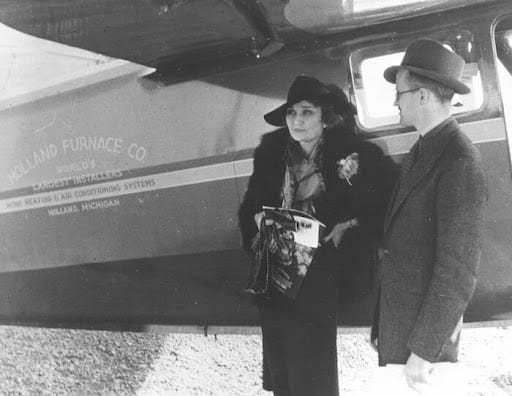
New priorities
Yet below the surface, under his leadership, the Holland Furnace Co.’s culture and values changed.
For one, Cheff’s management style was the opposite of August Landwehr’s: While Landwehr had been relational and inclusive, Cheff was autocratic and confrontational. According to Holland Furniture Co. legend, Cheff responded to foundry workers’ dissatisfaction with his leadership by saying they could have their way if they beat him in a physical fight.
They never challenged him.
Cheff’s business philosophy was also different from Landwehr’s. Instead of believing that successful business was built on service and the desire to do something worthwhile for humankind, Cheff seemed to think business was a boxing match, with the prize being customers’ money.
In 1935, reflecting that change in philosophy, Cheff changed the name of the company’s newsletter from “Warm Friend” to “Firepot,” and its editorial stance from educating and uplifting the sales force to reflecting Cheff’s competitive, winner-take-all nature and virile definition of manhood, which didn’t include Landwehr’s moral undertones.
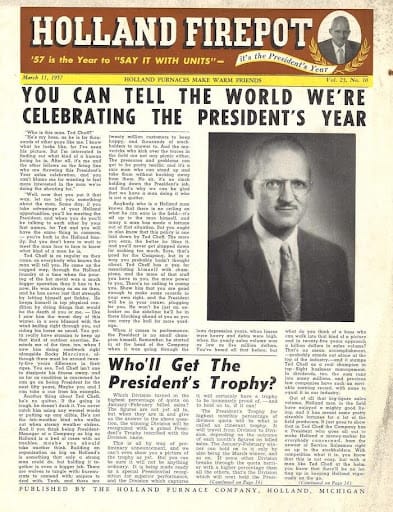
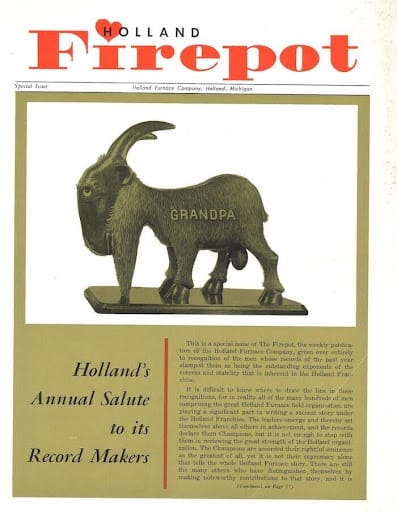
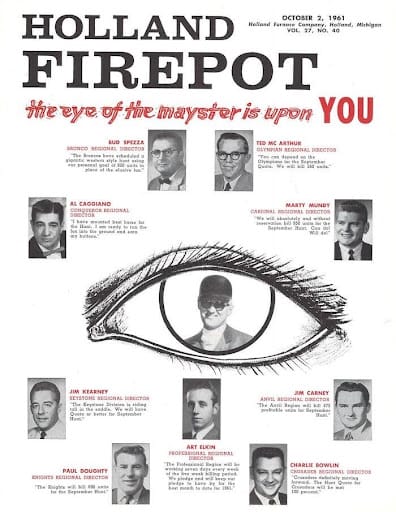
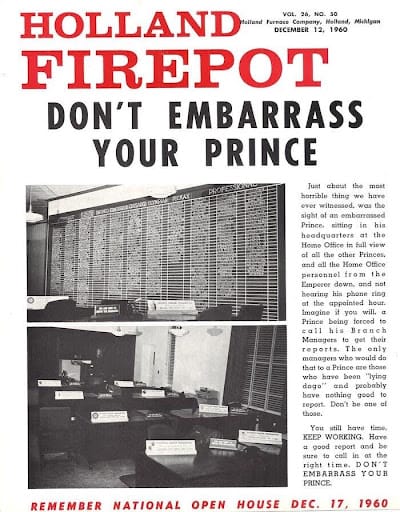
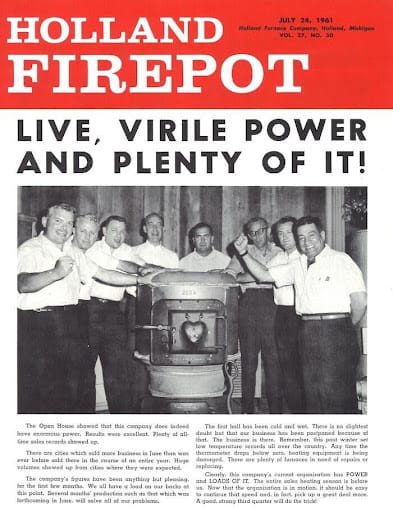
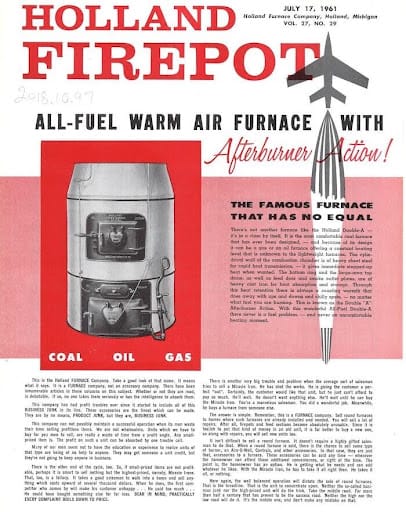
Clockwise from top left: Issues of "The Firepot," the internal newsletter of the Holland Furnace Co. [Courtesy/Holland Museum]
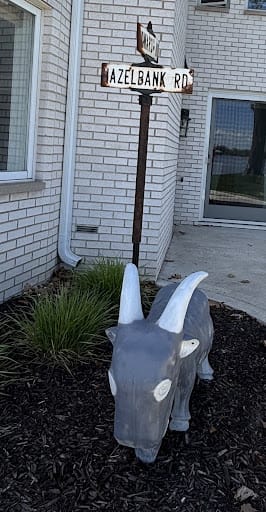
To motivate its salesmen, the Holland Furnace Co. utilized a commission and quota system. The quotas for each branch were set by the sales manager in the home office. Early on, each time a salesman would exceed their quota, they would receive part of the Holland Furnace Co.’s mascot, a six-piece, 9.25- by 7.75- 3.50-inch cast-iron penny bank that looked like a goat, including a leather collar with “Oscar” stamped on it.
Also available were a few larger cast-iron versions of Oscar the Goat. Salesmen who exceeded their quotas also were invited to the Goat Enclaves at the Warm Friend Tavern in Holland.
In the late 1930s and early 1940s, to spice up Holland’s Tulip Time Festival and the Goat Enclaves, Cheff brought movie stars to Holland. Soon his Exalted Goats — salesmen who had exceeded their sales quotas — were socializing with the likes of Richard Arlen, Mary Brian, Virginia Grey, Dorothy Lamour, Edmund Lowe, Professor Quiz, George Raft, and Fay Wray on Lake Michigan excursions on the S.S. Alabama and S.S. South American. Later, the Goat Enclaves took place in Florida.
In the short run, Cheff’s strategies seemed to work: So much so that, in 1940, when Lawrence Kolb Jr. was born to Larry and Helena Nystrom Kolb, the family believed that because he was the next male Kolla family member in line, the Holland Furnace Co. would one day be his kingdom.
Even during the rationing years of World War II, the Holland Furnace Co. remained prosperous, making armor plates for tanks and then anchor chains to support the war effort, and manufacturing furnaces from salvaged scrap iron from condemned and retired furnaces exchanged from customers.
It seemed a wise decision in 1946, when the Holland Furnace Co.’s board promoted Cheff to both company president and chairman.
Two years later, aided by the post-World War II housing boom, the Holland Furnace Co. had sales of more than $41 million ($568 million in 2026 dollars), profits of more than $4 million and a stock market valuation above $50 per share.
It would be its best year ever.
Sales practices
Both the rise and fall of the Holland Furnace Co. are due to its products, its branch system sales structure, its people, and its leadership — which influenced all three.
John Kolla initiated the Holland Furnace Co.’s success in the early 1900s with his uniquely designed cast-iron furnaces. At the base of each furnace was a plate, an ashpit, a firepot, the coal feed section, and the radiator.
Placed above the ashpit, in the firepot, a circular grate would turn to stir the coal ashes and keep the hotter coals in the center. The sides of the firepot also had holes bored into them to help the fire burn cleaner and hotter. Above the firepot and radiator, in the hood of the furnace, was his son-in-law Oscar Nystrom’s Air-U-Well fan, an airplane propeller-like device that would force the warm air through the ducts, also designed by Nystrom.
Later, the Holland Furnace Co. introduced a donut-shaped radiator that proved to be more efficient than the original version. In the late 1930s, the Holland Furnace Co. introduced oil- and gas-burning versions of the cast-iron furnaces. Over the years, it also introduced oil- and gas-burning 40-gallon water heaters and trash-burning incinerators. Although it never gave up on air conditioners, it didn’t invest heavily in them and relied on suppliers to complete its line.
That included a foray into central air conditioning in the 1950s: Walter Kimberley, an engineer, created a prototype of it in his house on West 20th Street. Unfortunately, product innovation was not highly valued by P.T. Cheff, and over time, compared to the competition, the Holland Furniture Co.’s offerings were inadequate.
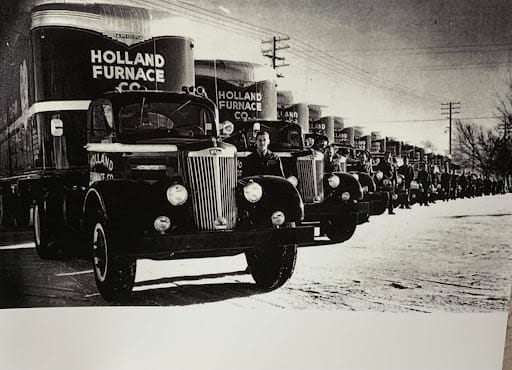
Instead, Cheff valued high-pressure door-to-door sales executed through the Holland Furnace Co.’s branch office system. By 1948, that system had grown to 700 branches that employed over 6,000 people, more than six times the number of people employed at the home office and factory in Holland. And, eventually, they all reported to Cheff.
Between the home office and the branch offices were division managers. Over the years, the number of divisions varied from six to 12. Each division manager was responsible for the branches in his division. For instance, the Empire (New York) Division might have 64 branches; the Chicago Division might have 108 branches.
Each branch, then, had a manager responsible for senior salesmen, called “sales engineers,” who sold furnaces; junior salesmen, who sold cleaning orders and replacement parts; and servicemen, who cleaned existing furnace systems or installed them.
Junior salesmen started the sales process by going door-to-door. If they got in the house and the furnace looked bad, they referred the homeowner to a senior salesman. The senior salesman would then visit the home, draw a floor plan of the house and draft a contract with the homeowner. Then he sent the floor plan and the contract to the home office in Holland. Although the home office provided sales support, it was the branch managers who were responsible for the hiring and training and monitoring of their salesmen.
Initially, for quality control, the sales manager visited the branch offices. As more branch offices were added, the sales manager would visit division managers, and division managers visited branch managers at their field offices. But over time, Cheff discouraged them from doing so.
Instead, when problems arose, the branch managers were called in to see Cheff. For the most part, no one knew how Cheff resolved such issues.

Cheating
Over time, the lack of product innovation made it more difficult for the Holland Furnace Co. salesmen to earn commissions and reach their quotas without cheating. As a result, some of them did. In fact, according to William Sikkel, who worked at the Holland Furnace Co. from 1937 to 1955, “Some of the biggest producers (in sales) were the biggest thieves.”
Already, in 1942, the Better Business Bureau’s Chicago office had issued a bulletin about Holland Furnace’s aggressive sales tactics, and the mayor of Cleveland ordered an investigation. Then, in 1949, the Michigan Corporation and Securities Commission requested a hearing because there were 25 allegations of unfair business tactics and failures to execute contracts in the Detroit area.
In correspondence with government authorities, Cheff vowed to investigate. But he also argued that, given the volume of branches and employees, the number of complaints did not justify government involvement, and that it was his disgruntled competitors who were inflating the importance of the accusations.
Still, the resignations inside the Holland Furnace Co. continued: In 1951, William Sikkel, then the only branch auditor, resigned upon learning that Cheff did not fire a branch manager who Sikkel discovered had been stealing; in 1952, Kelly Van Wieren, a regional sales manager, resigned.
Then, in 1953, four company executives — Secretary William Boer, who had taken over four years earlier when his boss, Bill Tahaney, had resigned; Treasurer George Tinholt; Sales Manager Fern Ault; and one other insider — confronted Cheff. They did so when they discovered that Cheff wanted to promote a division manager to Branch Expense Controller after his own branch managers had accused him of running a fraudulent scheme, and his division had incurred a $522,000 deficit! As a result, by the end of the year, Boer, Tinholt and Ault were no longer with the company.
In 1954, Larry Kolb, Cheff’s stepson, also confronted Cheff. Consequently, he was not reelected to the board of the Holland Furnace Co.
Meanwhile, the Holland Furnace Co. continued to receive bad publicity about its branch offices. In 1952, the “WE,” a news magazine published in Rochester, New York, did an exposé on the Holland Furnace Co. It stated that, according to the Office of Price Stabilization, or OPS, in Rochester, customers had been overcharged, furnaces were poorly constructed such that they didn’t heat properly, and furnaces were sold as new when they were in fact used.
OPS also claimed that some of the Holland Furnace Co. salesmen were recruited from jail, inexperienced, and had little heating knowledge. One salesman, it said, was transferred to the Rochester branch after being on probation for five years for grand larceny committed in Elmira, New York. Then, when exposed in Rochester, he was sent by the Holland Furnace Co. to its branch office in Pittsburgh.
And those were the findings after OPS had processed only 60% of the outstanding claims.
After publishing the story, the “WE” reported that someone in the Holland, Michigan office threatened one of their officials with a lawsuit. Still, “WE” kept publishing.
Next, it reported that Holland Furnace Co. (junior) salesmen would impersonate an inspector from Rochester Gas and Electric Corp., go into the basement of an unsuspecting housewife, tinker with the furnace, and then tell the housewife that the furnace appeared to be leaking gas and needed to be inspected again by someone else, who then condemned the furnace. That someone else was a Holland Furnace Co. (senior) salesman.
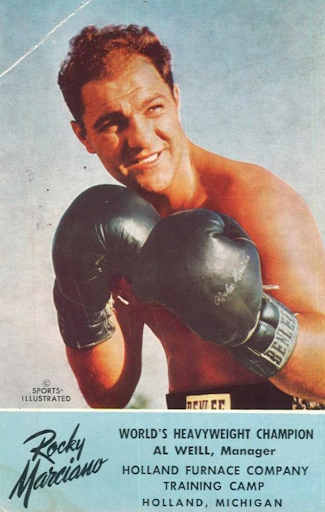
Possibly to boost morale and generate positive publicity, Cheff invited heavyweight boxing champion Rocky Marciano to set up a training camp at Leisure Acres, the Holland Furnace Co.’s property on Lakewood Boulevard near Tunnel Park. In addition, Cheff continued to indulge his other passion: buying and selling jumping horses and riding them at Hazelbank, the Ottawa County Fairgrounds, and Castle Park as well as at horse shows throughout Michigan and beyond.
Meanwhile, the Holland Furnace Co.’s legal entanglements grew more numerous and thicker. In response, Cheff and his attorneys continued to stonewall. As a result, in 1953, Moline, Illinois, revoked the company’s license to sell. In 1954, the Federal Trade Commission issued a complaint; in 1958, it issued a “cease-and-desist” order.
Still, Cheff and his attorneys continued to deny wrongdoing.
Bankruptcy
In 1957, the Holland Furnace Co. became a landmark case, but for a different reason. Arnold H. Maremount, president of Maremount Automotive Products Inc. and chairman of Motor Products Corp. and Allied Paper Corp., began accumulating shares of Holland Furniture Co. stock at approximately $10 per share, in hopes of gaining a seat on the board.
Apparently, his idea was to replace the Holland Furnace Co.’s direct distribution branch system with an indirect distribution system using wholesalers, reflective of the Holland Furnace Co.’s initial distribution strategy in 1906.
We can only guess at Maremount’s logic. Since 1948, the Holland Furnace Co.’s sales had fallen from $41 million to $30 million, yet the number of employees had grown from 7,000 to 8,500, with approximately 85% concentrated in the sales branch system. So, Maremount may have thought he could increase the Holland Furnace Co.’s profits, and therefore its stock price, by reducing its selling expenses, which were substantial.
But Cheff would have none of it, resulting in the Holland Furnace Co.’s board approving the purchase of Maremount’s 155,000 shares of stock at $14.40 per share, at a cost of $2.3 million.
While the lower court ruled that Holland Furnace Co. acted illegally in trying to preserve its management’s control, the Delaware Supreme Court ruled that the Holland Furnace Co. responded appropriately to an outside threat. The ruling, therefore, became a landmark case providing an early legal framework for the practice we now know as “greenmail,” the practice of buying out a dissident shareholder or corporate raider's stock at a premium price to stop a takeover attempt.
But it would have been better for the Holland Furnace Co. if Maremount had succeeded in creating a management shakeup and/or changing the way the Holland Furnace Co. conducted its business. And, on paper, it would have been better for P.T. Cheff, who held 6,000 shares; Katherine Kolla Nystrom Cheff, who held 5,800 shares; Edgar Landwehr, son of August Landwehr, who held 24,000 shares; and Hazelbank United Interests — almost 50% owned by Katherine Nystrom Cheff and 8.5% owned by Edgar Landwehr — which held 165,000 shares.
At the same time, it would seemingly have been worse for Cheff, who was collecting an annual salary of $77,000 ($915,000 in 2026 dollars) from the Holland Furnace Co.
By 1958, Larry Kolb Jr., the next male the Kolla family expected to run the Holland Furnace Co., was 18 years old. His grandmother, Katherine Kolla Nystrom Cheff, insisted that he meet and work with the heads of each department at the home office to learn the business. Larry enthusiastically agreed, unaware of what he was getting into. Cheff acquiesced, but monitored Larry’s activities.

When the time came for Larry to enter college, his father, Larry Kolb Sr., told him that the Holland Furnace Co. would be out of business by the time he graduated. That prediction came true. Here are snippets of the rest of the story:
- In 1961, Minnesota’s Attorney General Walter Mondale barred the Holland Furnace Co. from doing business in his state.
- By 1963, the Federal Trade Commission filed a petition; in 1965, the U.S. Court of Appeals found P.T. Cheff guilty of criminal contempt and sentenced him to six months in prison. Two months later, however, Cheff was granted a release to care for Katherine, who by then was terminally ill.
- In 1964, the New York Stock Exchange delisted Holland Furniture Co.’s stock.
- In 1965, the Holland Furnace Co. went bankrupt. That year, Jack and Arthur Vannette purchased the Warm Friend Tavern.
- In 1966, Katherine Kolla Nystrom Cheff died.
- In 1968, the Holland Suco Color Corp. purchased the Holland Furnace Co/ property on Columbia Avenue.
- In 1970, Cheff founded the Cheff Therapeutic Riding Center in Augusta, Michigan. In 1971, he married Holly Palmer, the daughter of his longtime assistant. He was 78; she was 31.
- In 1978, BASF acquired the Holland Furnace Co. property on Columbia Avenue.
- In 1981, Resthaven Patrons purchased the Hotel Warm Friend (formerly Warm Friend Tavern).
- In 1991, P.T. Cheff died.
- In 1993, Holly Palmer built a 17,900-square-foot home at Hazelbank.
- In 2002, BASF donated the Holland Furnace Co. property on Columbia Avenue to Black River Public School.
- In 2019, Holly Palmer sold her Hazelbank property. She died in 2022. Her mansion was razed, and the property turned into a lakeside housing development.
— Sources for this story include Robert Swierenga’s "Holland, Michigan," Donald Van Reken and Randy Vande Water’s “Holland Furnace Company,” Bill Boer’s “The Holland Furniture Company Tragedy: An Insider’s Lament” (which included the May 25, 1952 article from the Rochester, New York, “WE” newsmagazine), William Sikkel’s Oral History Interview, Doug Holm’s “1986 Hope College Summer History Project: The History of the Holland Furnace Company,” Rob Sligh’s 2017 presentation: “The Rise and Fall of the Holland Furnace Company,” “Penny Bank Post,” “Cheff v. Mathes," interviews with Don and Jodi (Landwehr) Heeringa and Larry Kolb Jr., and a conversation with my father, who was a neighbor of the Kimberleys on 20th Street.
— Steve VanderVeen ("dr v") is a biographer, educator, and learner, discovering history and developing future entrepreneurs. See start-upacademeinc.com.


