

The Business Next Door: The rise, the transition, and fall of the Holland Furnace Company I
In this three-part series, I write not only about two entrepreneurs who created one of Holland’s most successful and impactful enterprises, but also a manager who, according to most accounts, destroyed it.


EDITOR'S NOTE: This is the first in a three-part series delving into the history of the Holland Furnace Co.
I am a biographer, educator, and learner. Normally, I write stories about exceptional entrepreneurs who make the world a better place.
However, in this three-part series, I write not only about two entrepreneurs who created one of Holland’s most successful and impactful enterprises, but also a manager who, according to most accounts, destroyed it. Why do I do so? Because in both success and failure there are lessons to be learned.
I begin with the story of two exceptional entrepreneurs.
Part I: The Rise of the Holland Furnace Co.
During the first half of the 20th century, no company made a larger mark on Ottawa County than the Holland Furnace Co. The complementary leadership of two people made that happen: John P. Kolla and August Landwehr.
John Kolla and August Landwehr
John Pierre Kolla was born in 1860 in the Alsace-Lorraine region of France, a place of coal mines, forests, iron, and steel.
As a young man, Kolla had a great interest in music and made money playing his cornet. He also had an engineer’s mind and loved to tinker. To avoid compulsory military service, Kolla immigrated to the United States in 1879, to Massillon, Ohio, a prosperous mining region.
His parents, Willaim and Katerine Tommel Kolla, and his girlfriend, Caroline Mediger, soon followed. John and Caroline married in 1880. Together they had four daughters. Although one died at 3 years of age and another at 19, the other two, Louise and Katherine, would play a significant role in the future management of Kolla’s yet-to-be-born company.
In 1891, the Kolla family moved to Akron, Ohio, where Kolla worked for several furnace companies. When he wasn’t playing his cornet after work in the 8th Regiment Band, he was experimenting with a new type of coal furnace.
August Landwehr was the son of German immigrants. He was born in New Melle, Missouri, in 1880, the year of John and Caroline Mediger Kolla’s marriage. Although he grew up in St. Louis, Missouri, he attended the Gem City Business School in Quincy, Illinois.
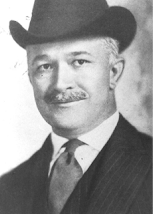
At age 16, Landwehr worked as a messenger with Dumont & Co., a St. Louis publisher, and then in other office roles. Next, Landwehr served the Werner Publishing Co. in Akron, Ohio.
While in Akron, Landwehr met Louise Kolla.
By the time he was 21, Landwehr was manager of a 128-person sales team at the R.S. Belcher Co. of Pittsburgh, another publishing company. For 16 months, he also invested in the Reliable Match Co. of Ashland, Ohio, and served as its treasurer and general manager.
He returned to St. Louis in 1902 to marry Louise.
Since meeting the Kollas, August dreamed not only of a happy life with Louise, but also of a prosperous business with her father that provided a better home-heating solution for the masses.
But where would they locate the enterprise?
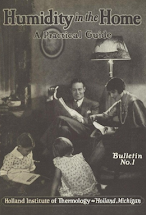
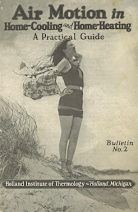
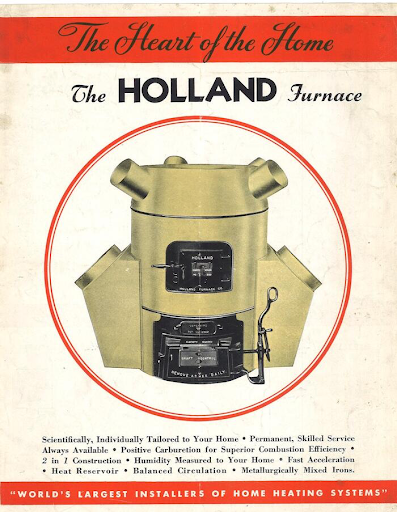
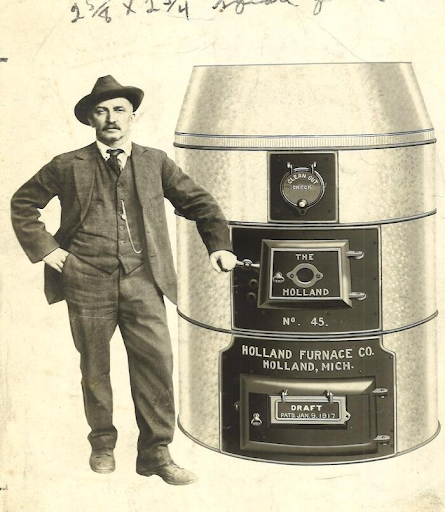
Promotional materials issued by the Holland Furnace Co. to its branch managers. [Courtesy/Holland Museum]
The Holland Improvement Committee
In 1895, a group of business leaders formed the Holland Improvement Committee and created the Industry Bonus Plan to attract businesses to Holland.
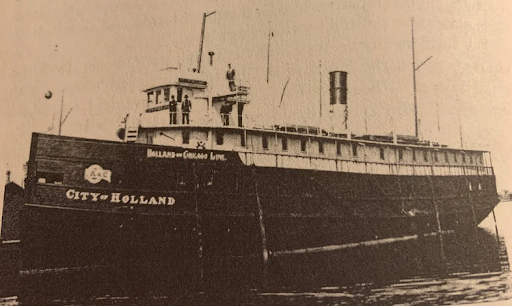
First, they created the Holland Transportation Co. and purchased a steamship from W.T. Rogers in Saugatuck to run between Holland and Chicago and support the tourist trade.
Next, they persuaded H.J. Heinz to build a pickle-processing plant in Holland. Then they created Prospect Park, an industrial and residential development on the hill between 20th and 24th streets, which ran east and west, and College and Lincoln Avenue, which ran north and south, parallel to a nearby railroad track.
Next, they persuaded William Bush and Walter Lane to move their Chicago-based Bush and Lane Piano Co. and 60 families to Holland. Then they got the attention of Guy Bowman.
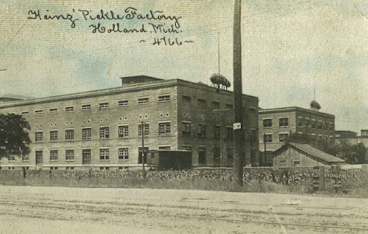
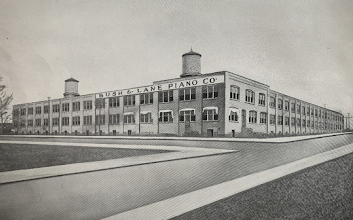
Left: Postcard of the Heinz Pickle Factory, 1912. Right: The Bush and Lane Piano Factory from a Holland Board of Trade brochure, circa 1920; it later became the home of Baker Furniture and then Baker Lofts. [Courtesy/Holand Museum and Holland Board of Trade]
Bowman was from Ohio. Not only did he have relatives in Holland, Michigan, but he had a connection with Kolla and Landwehr and convinced them to visit Holland.
In Holland, the Ohioans liked what they saw.
Holland’s location was ideal: pig iron could be shipped from Duluth, Minnesota, via the Great Lakes, furnaces could be shipped to the northern states by water or rail, and there was plenty of sand for making molds.
In addition, there was room in Prospect Park for a factory and homes, and there was a growing hard-working immigrant population for labor. Plus, members of the Holland Improvement Committee were ready to provide start-up capital.
The Holland Furnace Co.
The initial stockholders’ meeting of the Holland Furnace Co. occurred on Aug. 8, 1906.
Attendees included:
- Arend Visscher, a lawyer and insurance broker
- William Beach, president of the Beach Milling Co.
- J.H. Kleinheksel, a Hope College professor
- Heber Walsh, a drug store owner
- J.G. (“White Jake”) Van Putten, part owner of the Ottawa Furniture Co.
- P.H. McBride, an attorney
- Dr. Henry Kremers, a physician
- C.H. Howell
- And Bowman, the majority shareholder
At the meeting, Kolla, Landwehr, Bowman, Beach, Charles M. McLean — another local industrialist — Visscher, and Van Putten were elected to the board. The board then met and elected Visscher as president, Beach as vice president, McLean as secretary, and Bowman as treasurer.
Immediately the board voted to purchase — for $225 — a lot in Prospect Park for a factory and gave Bowman the assignment of building it. Kolla arrived in September with a freight car full of furniture, furnace parts, and engineering patterns, ready to make for the masses efficient warm air-circulating cast iron furnaces.
Landwehr arrived soon thereafter.
The family
Initially, the Kolla and Landwehr families — John, Caroline, and their 17-year-old daughter Katherine, as well as John’s mother; and August, Louise, and their 2-year-old daughter Donna — lived in a house on 78 W. 15th St. (since razed and replaced) and started experimenting in their basement.
After Kolla secured patents for the furnace’s grate, radiator, and fire pot, the board gave him additional shares of stock.
In 1907, John and Caroline Kolla’s daughter Katherine married Oscar Nystrom. Born in Sweden in 1883, Nystrom came from Chicago to Holland in 1905 with Walter Lane and the Bush and Lane Piano Co.
Nystrom, like Kolla, had an engineer’s mind and was a tinkerer. He soon became one of the Holland Furnace Co.’s most valuable employees.
Meanwhile, Kolla had moved his family to a more spacious abode at 373 Lincoln (corner of Lincoln Avenue and 16th Street). The Nystroms joined them, including Oscar and Katherine’s daughter Helena, who was born in 1909, and their son John Kolla Nystrom, who was born in 1913.
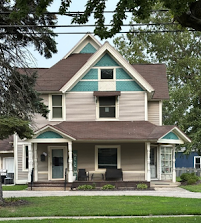
The clan stayed together, as Landwehr moved his family to the house next door at 369 Lincoln. August and Louise’s son Paul was born there in 1907; their son Edgar in 1913.
The Lincoln houses were conveniently close to the Holland Furnace Co.’s factory, where Bowman served as general manager, Kolla as superintendent of the factory, and Landwehr as salesman.
Tight with money, Kolla was able to walk to work along the railroad tracks that ran parallel to Lincoln Avenue and pick up scraps of iron, which had fallen from railroad cars, for his foundry.
Kolla seemed most comfortable wearing dirty overalls. Although a smallish man, he could be intimidating to his men. At the same time, he would endear himself to them by providing them with a keg of beer on the hottest of summer days. (One of his foundry workers was a recent immigrant named Hendrik Meijer, the future founder of Meijer stores.)
In contrast, August Landwehr seemed most comfortable in business-like attire, dreaming with people and charming them with his optimistic attitude. While Landwehr was aggressive, Kolla was conservative. While Kolla was feared, Landwehr was approachable and generous to a fault. Each was a genius in his own way; together, they were an unbeatable combination.
One example of their personalities may suffice: Kolla wanted to purchase a Cadillac automobile. Landwehr was willing to help. So, together they drove to Grand Rapids.
When he and Landwehr visited a dealership, the salesman assumed that Landwehr was the buyer and Kolla was a mechanic, because Kolla kept silently getting in and out of cars in his dirty overalls. The salesman was getting intimidated and annoyed with Kolla until he said, “I’ll take this one!” and made the purchase.
And as the Holland Furnace Co. prospered, its founding families moved to more elite locations.
In August 1921, Louise, Paul, and Edgar Landwehr bought the spacious home at 268 Maple Ave. (corner of Maple Avenue and 11th Street) from John Cappon, son of Holland pioneer and industrialist Isaac Cappon. There, August and Louise’s daughter Norma was born.
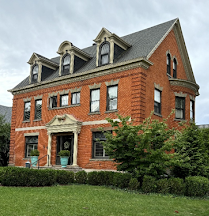
Then the Kollas bought 38 acres of property on the east side of Lake Macatawa’s Pine Creek Bay, which they named Hazelbank. Eventually, the Landwehrs joined them. On the property, they built three homes: John and Caroline’s house was in the middle, with August and Louise’s house to the north, and Katherine and Oscar Nystrom’s house to the south. For their transportation needs, they acquired eight Buicks, six for the families and two for the company.
However, all was not well in the family: In 1924, Oscar and Katherine Nystrom separated, and in 1926 they divorced.
In contrast, the Holland Furnace Co. was thriving, due to the engineering genius of Kolla and Nystrom and the marketing genius of August Landwehr.
The Branch System
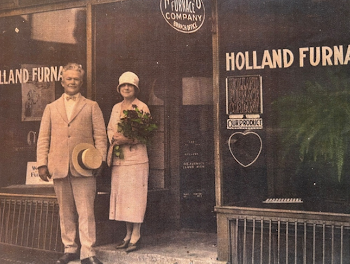
Initially, the Holland Furnace Co. sold its furnaces through dealers, such as hardware stores.
In its first year, the Holland Furnace Co. produced 240 furnaces and shipped 75, of which 40 went to the Grand Rapids area.
Unfortunately, some dealers installed the furnaces improperly, resulting in customer complaints and bad word-of-mouth, which encouraged dealers to focus on selling other brands.
In response, Landwehr tried an experiment: The Holland Furnace Co. would set up an independent branch office that would sell directly to customers through its own door-to-door sales force and then install the furnace with its own installation team. The idea was supported by Bowman. The experiment succeeded: In 1908, Grand Rapids sales tripled. So, Landwehr decided to roll out his branch office concept throughout the country.
Yet, mysteriously, in 1909, Bowman left the Holland Furnace Co. Kolla, Landwehr, and August’s brother Charles bought his stock, which not only demonstrated their growing wealth but also their belief in the company and their desire to maintain control.
But to grow, the Holland Furnace Co. needed outside capital. Fortunately, board members Arend Visscher and William Beach were also board members of Peoples State Bank, which provided a loan. Additional capital came from new stockholders. Among them:
- Isaac Marsilje and his son Thomas, insurance brokers
- Edward Meulenbrok
- Dr. J.W. Beardslee, a Hope College professor
- G. Cook
- Bastian Keppel, a coal and hardware dealer and a shareholder of Peoples State Bank.
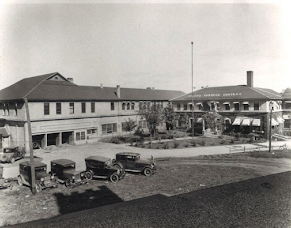
By 1911, the Holland Furnace Co.’s factory had doubled in size and was producing 10 furnaces per day as well as dustless ash and odorless garbage cans. By 1913, the Holland Furnace Co. had placed 1,000 furnaces in Ottawa County; by 1912, it had expanded its factory with six additions, doubled the size of its outstanding capital, and opened 30 branch offices throughout Michigan, Ohio, Indiana, Illinois, and Wisconsin.
In 1926, the Holland Furnace Co. introduced a specially equipped truck with a machine (called the “Sanivac”) that could clean, using strong suction, ducts, chimneys, and furnaces. Used by the Holland Furnace Co. branch offices, the service helped open many more doors for company salesmen.
In 1928, the Holland Furnace sold 46,000 furnaces through more than 500 branch offices across the United States and earned $2 million in profit on $18 million in sales ($365 million in 2026 dollars).
The Warm Friend, other Landwehr endeavors
We do not know much about Kolla’s activities beyond the foundry. Kolla, we might say, made furnaces, but Landwehr made rain.
To manufacture chains, pulleys, and dampers for the Holland Furnace Co., in 1914 Landwehr and Thomas Olinger created Federal Stamping Works (which they sold to Hart and Cooley in 1924; later, Hart and Cooley made registers for the Holland Furnace Co., its largest customer.)
Also in 1914, Landwehr invited 60 of Holland Furnace’s sales staff to Holland for a sales convention, called a “Goat Enclave,” to celebrate and induct the highest sales performers into the “Exalted Order of the Goats.” At first, Landwehr lodged them in Hermanus Boone’s aging Holland Hotel at 5 E. Eighth St., but the facility proved inadequate.
In 1915, Landwehr obtained a subsidy from the Holland Bonus Committee for the W.E. Dunn Manufacturing Co., which moved from Chicago to Holland. He also, along with Dirk Boonstra of Zeeland and other businessmen, formed the Holland Milk Products company, a creamery. As president of the Holland Chamber of Commerce, he influenced city leaders to purchase Dr. Henry Kremers’ home on 12th Street and Central Avenue for a public hospital. He also initiated Holland Furnace’s own employee-focused medical facility.
In 1916, Landwehr first used the phrase “Warm Friend” in a memo to describe the Holland Furnace Co. coal-burning furnace. That year, the Holland Furnace Co. opened a factory in Cedar Rapids, Iowa, which increased production by 40 furnaces a day. The Holland Furnace Co. further increased its production capacity when Oscar Nystom patented a machine that made various-sized molds for foundry castings. Later, Holland Furnace opened a plant in Bethlehem, Pennsylvania.
In 1917, Holland Furnace sold 50 “Warm Friends” to Holland citizens after opening a downtown Holland branch office; it also added branch offices in Marion, Ohio; Atlanta, Georgia; Sioux Falls, South Dakota; and Hancock, Michigan. August and Louise would often attend those openings.
In 1919, Landwehr wrote the following note to his sales staff:
“[Last month] sales closed with a magnificent total of [$512 million], a 79% increase over the previous [record] month. ... Golly! Boys! I’m pleased with the wonderful showing you made … and I want to thank each and every one of you for your part in bringing it about.”
As his wealth and prominence grew, Landwehr not only liberally funded companies and causes, but also loaned money to individuals. Between 1919 and 1920, Landwehr gave a large donation to fund construction of the Masonic Temple on 10th Street. He also became chairman of the local Victory Loan drive, which sold U.S. government bonds to help finance World War I.
When bankers refused to give Jacob Fris money to purchase his family’s business from his mother’s estate, Landwehr loaned him the money; then lent him more money so he could purchase the building at 30 W. Eighth St.
In 1920, Landwehr published the first installment of the “Warm Friend” magazine for his sales staff. Landwehr wrote: “Big successful business is built on Service — a desire in the heart to do something worthwhile for others.” Soon Holland Furnace Co. was known as the “World’s Largest Installers of Home Heating Equipment” and its furnace “The Heart of the Home.”
In 1921, Landwehr became a founding member of the Holland Country Club.
Also, in 1921, he held at least one Goat Enclave at the new Masonic Temple on 10th Street, but that facility too proved inadequate.
In 1922, Landwehr, Dirk Van Raalte (grandson of Holland’s founder A.C. Van Raalte) and Dirk’s grandfather, Dr. Leenhouts, and two other investors bought the struggling Charles Limbert Furniture Company (located where Freedom Village is today), redesigned its bedroom line, and launched a national advertising campaign in “The Saturday Evening Post” and “House and Garden.”
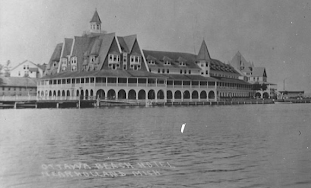
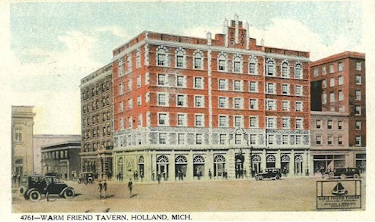
In 1923, Landwehr, George Getz, Charles Sligh, and Gerrit Diekema purchased the Ottawa Hotel near Ottawa Beach, and renamed it Ottawa Beach Hotel. But that winter, it burned to the ground. In response, Landwehr formed the Holland Hotel Co. to purchase the Holland Hotel and spearhead a fundraising drive to raze it and replace it with a new concept hotel called the Warm Friend Tavern.
Landwehr worked fast. On Dec. 6, 1923, one month after the Ottawa Hotel was destroyed, Landwehr posted a letter on the front page of The Holland Sentinel. The heading read: “New $500,000 Hotel Project to Be Put Over in Holland Now In A Short, Intensive Drive.” It would be a community project: although the Holland Furnace Co. would lend the project $200,000, Landwehr offered members of the Holland community the opportunity to subscribe for $300,000 of common stock. They readily did, at $100 per share.
The Holland Sentinel published the names of those community members who had signed on first. The Holland Chamber of Commerce sent out teams of men to canvass the city. By Jan. 2, 1924, Landwehr’s capitalization drive exceeded its goal. The Warm Friend Tavern opened in May 1925.
Meanwhile, Landwehr also served on the board of the Holland Maid Electric Washing Machine Co., Holland Country Club, Holland City State Bank, DePree Chemical Company, and the Holland Fish and Game Club.
In 1924, he helped persuade Miss Helen Clarke to relocate her Sunnycrest School for girls from Chelsea, Michigan, to 968 S. Shore Drive. He also generously supported Nellie Churchford’s Mission, forerunner of today’s Gateway Mission.
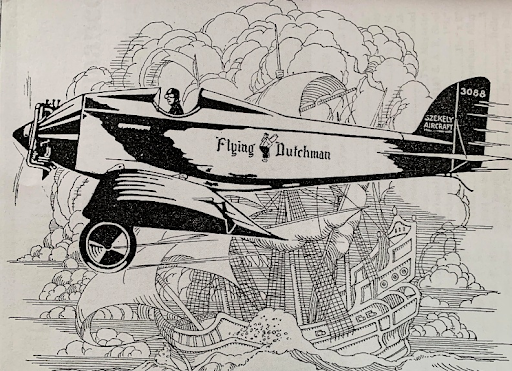
In 1926, Landwehr and the Holland Chamber of Commerce persuaded Otto Szekely to relocate his aircraft engine company to Holland from Moline, Illinois.
Szekely brought 20 engineers with him to help redesign the malfunctioning Holland Maid washing machine and build airplanes. His new company was called the Szekely Aircraft and Engine Co., and the pride of his fleet was “The Flying Dutchman.”
A few years before, in 1922, a 15-year-old boy began working under John Kolla in the foundry. Born in nearby Forest Grove, the son of the Rev. Paul B. Cheff, pastor of Hope Reformed Church in Holland, he reflected Kolla’s stingy toughness, with the personality of the famed Billy Sunday.
Rumor had it that the tall, thin, and well-built Paul Theodore (P.T.) Cheff, who loved to box and ride horses, had “parked” four other foundry workers on the washroom floor before the whistle blew on his first day of work, all of which helped him acquire the nickname “Kentucky Colonel.”
John Kolla was impressed with the colonel, so much so, that Cheff not only became foreman of the foundry, but also chauffeur to the Kolla family. He was said to have an answer for everything. But more intimidating was his temper, his 6-foot-4-inch frame, and his willingness to use them.
— Steve VanderVeen ("dr v") is a biographer, educator, and learner, discovering history and developing future entrepreneurs. See start-upacademeinc.com.