

The Business Next Door: The unfamiliar, unique story of manufacturer Hemco Gage
Most people are not familiar with Hemco Gage — although every day an estimated 10,000-15,000 vehicles pass by its building at 455 Douglas Ave. in Holland without knowing what happens inside.

Telling the history of Hemco Gage aligns with the purpose of The Business Next Door column because this forum shares unfamiliar and unique stories of entrepreneurs.
Most people are not familiar with Hemco Gage — although every day an estimated 10,000-15,000 vehicles pass by its building at 455 Douglas Ave. in Holland without knowing what happens inside. Nor do they know its history, even though the company has been in Holland for 80 years.
That may be because Hemco Gage occupies an unpretentious Korean War-era building in the shadow of modern boat storage warehouses and a former large-scale boat manufacturing complex.
Or it may be because Hemco Gage doesn’t sell products with recognizable brand names, even though it once made a consumer product and now builds a tool that is essential for manufacturing or transporting goods we consume. Because of the importance of what Hemco Gage does, we need to tell its story.

Here’s the punch line: Hemco Gage does what it does today by making a unique technological transfer from fountain pen manufacturing to industrial gage production. To understand how that happened, we first need to review the history of fountain pens.
Fountain pens evolved from quill pens, which were far more convenient to use than reed pens, but still inconvenient because they had to be dipped in ink, and the ink leaked, blotted, and smeared. Some of those problems were solved with the fountain pen.
We owe the creation of the first commercially viable fountain pen to Lewis Edson Waterman. Waterman was born in 1837 in Decatur, New York. As a young man, he was always on the move. When Lewis was 3 years old, his father, a wagon maker, died. Waterman’s mother then married a farmer. After attending a district school and seminary, Waterman moved from village to village earning money as a carpenter and by teaching stenography.
By 1862, he was selling insurance in Michigan. By 1864, he was living in Boston. In 1870, after divorcing his wife and leaving his family, he moved to New York. In 1883, he found work as a salesman for a man who had an idea for innovating fountain pens. But after only six weeks, his boss gave up.
Waterman not only took over the business but also figured out how to better control the flow of ink in pens. When Waterman received a patent for his "three fissure feed" design in 1884, the Ideal Pen Co., which he renamed the L.W. Waterman Co., was born. Waterman died in 1901, but not before his ideas made fountain pens reliable and fashionable enough that they would become an essential accessory for every businessperson in that era. But to fill his pens, the user needed an eyedropper.
One of Waterman’s competitors was the Sheaffer Pen Co. Walter Sheaffer was born in Bloomfield, Iowa, in 1867. In 1906, Sheaffer purchased a jewelry store in Fort Madison, Iowa. While working there, he discovered a way to refill pens without the eyedropper, thus making the process quicker and cleaner. He received a patent for his idea in 1908. He put his idea into production in 1912, and in 1913 founded the W.A. Sheaffer Pen Co. By the 1930s, his company was a leader in the luxury fountain pen market.
Henry Morse may have been one of Sheaffer’s suppliers. Henry Morse was born in 1915 in Six Lakes, Michigan, a village roughly 50 miles northeast of Grand Rapids. Later, he moved to the Detroit area, where he co-founded the H.E. Morse Co. to plate gold jewelry. While living and working there, he and his family vacationed in Holland. They liked the area of Holland so much that in 1946 Henry purchased property next to the Chris-Craft boat-building complex on the north side of Holland for his factory and Elmdale Court on the south side of Holland for his home.
With his deep knowledge of gold plating, Henry began experimenting with nibs, the tip of the fountain pen that touches the paper. Nibs, he learned, when plated with gold, have a smoother, softer finish than other metals, which results in the smoother flow of ink. Then, after plating nibs, his company began making nibs, and after that, began assembling fountain pens. Thereupon, the Morse Flo-Ball was born.
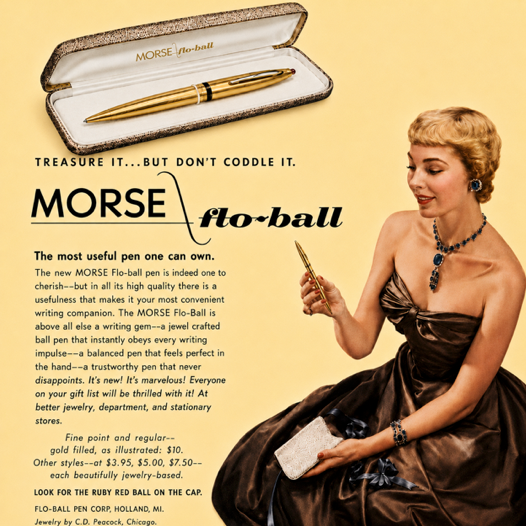
In the late 1940s and early 1950s, the H.E. Morse Co. manufactured and marketed the Morse Flo-Ball nationwide, positioning it as a "must-have," high-end accoutrement. H.E. Morse made the pen in assorted styles and colors, but all with a gold-plated ball tip. Selling for $10 ($125 in today’s dollars), but with options as low as $3.95, it was an aspirational product. Many of his pens, and their accompanying gold chains, found their way into bank lobbies.
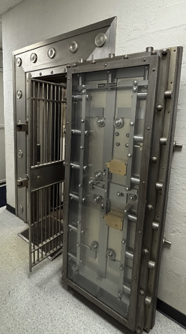
To keep his gold secure, Morse had a room-size bank-like vault built into his plant. The walls and ceiling around and above the vault were 24-36 inches thick. He purchased the vault door from famed automobile manufacturer Henry Ford, who used the safe at his Fairlane Estate in Dearborn, Michigan.
The business was doing well until a fountain pen salesperson named Marcel Bich, after years of research and development, created an inexpensive and reliable stainless-steel nib and a new variety of ink. When, in 1950, he launched the BIC Crystal ballpoint pen, the writing instrument industry was forever changed. Fortuitously, during the Korean War (1950-1953), the H.E. Morse Co. began to manufacture thread plug gages.
Interestingly, the thread plug gage industry also had a connection to Henry Ford. When automobiles were first invented, they were made one-by-one, a relatively expensive and time-consuming process. Although Henry Ford didn’t introduce assembly-line production, with his vision of making the automobile affordable for ordinary families, he perfected it. But such a mass production of goods requires a continuous supply of mass-produced interchangeable parts.
To ensure that threaded parts, such as screws, nuts, and bolts, were consistently made to exact specifications and therefore interchangeable, the output of the machines that made them had to be frequently tested to ensure that any part produced could be used on any vehicle on the assembly line. Gages were the tools that measured whether the machinery was making the standardized parts according to their appropriate specifications.
But the idea of interchangeable parts and mass production didn’t begin with Ford. Rather, it began more than 100 years earlier with French gunsmith Honore Blanc, who demonstrated his idea to Thomas Jefferson. But Blanc never made those guns. The person who produced guns with interchangeable parts was Eli Whitney, who, after showing government officials he could assemble them from randomly selected components, received an order in 1798 for 10,000 muskets.
To make the interchangeable parts for those guns, Whitney needed reference components, or templates, the forerunners of gauges. Those reference components became more advanced during the Civil War in John Hall’s armory in Harper’s Ferry, Virginia. About that time, Joseph Whitworth created a thread standard template in England, and William Sellers standardized American screw threads in America, which contributed to demand for thread gages. The thread gage (and its sibling, the non-thread cylindrical gage) emerged in the late 19th century, about the same time as the fountain pen.
Although unrelated, Henry Morse brought fountain pen and gage industries together in a unique way. While the fountain pen and gage industries are different, they both require precision machining, thread grinding, smooth finishing, and plating. For its part, not only did the U.S. Government give Morse an order for gages, but it also helped him build a manufacturing facility to make the gages. Then Morse determined how to adapt his electro-gold-plating technology to chrome-plating, difficult because chrome is thicker than gold and thread gages require more precise tolerance specifications than fountain pen nibs. With that successful adaptation, the “longer-lasting gage” was born.
Even so, Morse was not ready to completely switch production to thread gage manufacturing. Between 1951 and 1955, he applied for and received patents for the following designs:
- A die machine for making fountain pens
- The wall of an ink cartridge
- The ink feed connection between the ink storage compartment and the writing element
- How the ink reservoir accumulates ink after it is discharged from the ink storage chamber during a flooding condition in the pen
Interestingly, even his patent work had a connection to Henry Ford. Morse used the law firm Burton and Parker, whose founders, Clarence Burton and Ralzemond Parker, became famous for defending Ford against patent infringement. In 1903, the Association of Licensed Automobile Manufacturers (ALAM) sued Ford.
Their argument was that Ford had violated a patent issued in 1895 to George B. Selden for an internal combustion “road engine.” Instead of paying Selden royalties, Ford took the case to court. Although the court ruled against Ford in 1909, he appealed, and in 1911 the appellate court reversed the decision, saying that Selden’s patent was limited to a specific engine type, not the type of engines made by Ford.
Given the invention of the BIC pen and brand, and given manufacturers’ preference for a longer-lasting gage, over time the demand for Morse’s gages “crowded out” demand for Morse fountain pens. Thus, the Morse Flo-Ball pen is no more, and the H.E. Morse Co. is known only as Hemco Gage.
Here’s how the gage production process works: team members cut cylindrical steel stock into smaller pieces, “rough it out,” heat treat it to make it harder and less prone to change in size, grind grooves (threads) into it, “lapping” it to improve the surface finish and finished size, and chrome-plate it to make its surface harder and more lubricious.
In 1961, the local business community honored Henry Morse for his work. He received the Free Enterprise Award as a manufacturer of the year and the Award of Achievement. Unfortunately, Henry Morse prematurely died of a heart attack while working in his office in 1967.
Still, his company continued to flourish. In the 1970s, the American Petroleum Institute (API) licensed it to make master gages (gages that measure the accuracy of other gages), a prestigious honor. Next, it became involved in calibration services after the advent of the International Organization for Standardization (ISO).

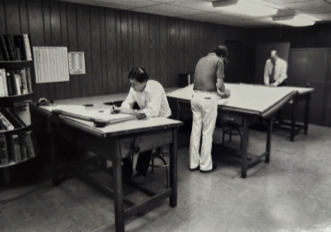
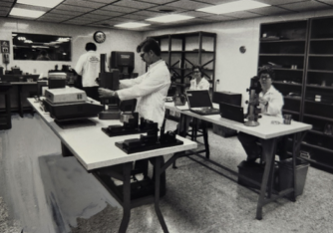
Hemco Gage Computer Department, c. 1970. [Courtesy/Hemco Gage]
Larry Wysong, who worked in engineering at Detroit Diesel before working on Wall Street, purchased the company and the Hemco Gage brand from the Morse family in 1977.
In 1995, Larry’s son Chris started at Hemco as a materials manager, while Larry’s daughter Renee focused on the family’s business interests in real estate and property management.
In 1999, the family acquired Plasma-Tec, a precision machining & thermal spraying company. In 2005, Chris became the President of Hemco Gage & VP of Plasma-Tec, overseeing the operations of both Plasma-Tec and Hemco Gage while Renee took on human resources responsibilities.

In 2007, Chris and Renee became minority co-owners of the family business.
In 2019-20, Plasma-Tec and the real estate and property management businesses were divested, and Renee and Chris took ownership of the remaining business, Hemco Gage.
Today, Hemco Gage makes both threaded and non-threaded (cylindrical) gages. Threaded gages test whether internal or external threads, such as on nuts, bolts, and pipes, were made correctly enough for mating parts to screw together properly. Cylindrical gages test the inside diameter of a hole or the outside diameter of a cylindrical part.
Both types of gages measure whether a machine is making parts according to its specifications. Hemco Gages can measure part specifications to ten thousandths or even to hundred-thousandths of an inch. Hemco Gage also offers calibration and re-plating services, which account for about 15% of its revenue.

While their competitors specialize in making a lot of a few things, Hemco Gage specializes in small lots of customized feature gages, and sells them both indirectly through manufacturers’ representatives in the northern United States and Canada, and directly to calibration laboratories, which verify and adjust the accuracy of diagnostic equipment. And Hemco Gage remains one of only two companies licensed by the API.
All told, Hemco Gage serves a cross-section of industries, including aerospace, agricultural, automotive, energy, heavy equipment, medical, nuclear power, and powersports, and companies such as Baker Hughes, Caterpillar, Harley Davidson, John Deere, Medtronic, SpaceX, and Stryker Medical.
It maintains its edge through team member development and training as well as customer service, including its ASAP, GageSaver, and Theory of Constraints-based Dynamic Leadtimes delivery approach.
All possible because of Henry Morse’s unique technological transfer.
Information for this story comes from Robert Swierenga’s "Holland, Michigan," Wikipedia, ChatGPT, Myron Kukla’s “Hemco Gage makes sure it fits, sometimes to 1/5,000 of an inch," the late Mike Hop, whom I interviewed in 2005, and Chris Wysong. Supplementary background information came from ChatGPT.
— Steve VanderVeen ("dr v") is a biographer, educator, and learner, discovering entrepreneurial leaders and sharing their stories and wisdom. You can find his articles at start-upacademeinc.com.


