

Flu tracker launched by Ottawa County health department, vaccines encouraged
The Ottawa County Department of Public Health launched its weekly Respiratory Illness Tracker this week, a visual dashboard designed to provide real-time data on the local prevalence of influenza, COVID-19 and RSV.

OTTAWA COUNTY — Public health officials in Ottawa County are introducing a new digital tool to help residents navigate a stubborn respiratory illness season, as influenza continues to circulate widely across West Michigan.
The Ottawa County Department of Public Health launched its weekly Respiratory Illness Tracker this week, a visual dashboard designed to provide real-time data on the local prevalence of influenza, COVID-19 and RSV. The move aims to replace anecdotal "word-of-mouth" illness reports with hard data.
While the most recent data indicates a slight dip in the number of residents seeking care for flu-like symptoms, officials warned that viral activity remains high, mirroring statewide and national trends.
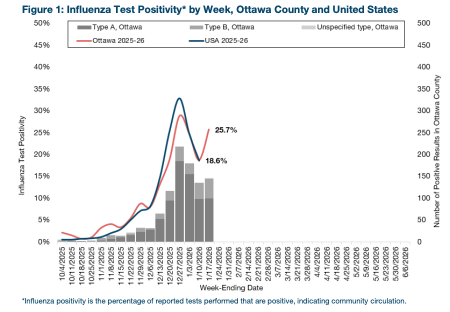
"At this time of year, it seems like everybody knows somebody who’s sick," said Dr. Gwen Unzicker, OCDPH medical director. "Checking out our website can give people an idea of what’s going around so they can take steps to keep themselves healthy."
The tracker categorizes viral activity as rising, steady, or declining, offering a snapshot for families making decisions about public gatherings or preventative care. For those seeking deeper analytics, the department is also releasing a comprehensive weekly Respiratory Illness Report.
Public health guidance remains focused on a "seatbelt" approach to vaccination.
While a new flu variant has emerged this season that is not a perfect match for the current vaccine, early data from the United Kingdom suggests the shot remains highly effective at preventing severe outcomes.
"A seatbelt doesn’t prevent every injury in an accident, but it can greatly reduce the risk of severe harm," Unzicker said.
Debunking the vaccine myth
Something Unzicker hopes to clarify for skeptics is the myth that getting the flu vaccine actually causes the flu or symptoms of the flu.
“The good news is that the flu vaccine cannot give you the flu,” she said. “The flu shot used kills a virus that can't infect you. The nasal spray uses weakened virus that only works in your nose, not your lungs, where flu causes disease.”
The main thing patients notice is some fatigue and maybe “achy for a day or two.”
“Think of it like being sore after a workout — your muscles were training to get stronger. The vaccine is training your immune system to recognize and fight the flu. That temporary achiness means it's working,” she said. “Real flu is very different — days of high fever, severe body aches, and exhaustion.”
But, she said, it’s not to say that some people don’t get sick after the vaccination. A lot of things can factor into that.
“Sometimes people do get sick right after vaccination. This could be because they were already exposed to flu before the vaccine could protect them. It takes about two weeks to be fully effective. Or maybe they caught one of the other viruses going around. That's where the dashboard can help — it shows what's actually circulating in our community so you and your healthcare provider can make sense of symptoms.”
Please consider becoming a monthly donor!
Health officials noted that the vaccine's ability to turn a "wild" case into a "mild" one is particularly critical for high-risk populations, including children under five, pregnant women, and adults over 65.
Because flu season often extends into the spring, the department maintains that mid-winter vaccination still offers significant protective value.
Beyond immunization, the OCDPH is reiterating "the basics" to curb transmission: staying home when symptomatic, frequent handwashing, and improving indoor ventilation.
For those who must venture out while unwell, officials recommend high-quality masks, such as N95 or KN95 respirators, to limit the spread of droplets.
Residents can access the new dashboard at miottawa.org/health/data or schedule vaccination appointments through local pharmacies or the health department at 616-396-5266.
— Heather VanDyke covers northern Ottawa County for the Ottawa News Network. Contact her at hvandyke@ottawanewsnetwork.org.


