

Midterm election brings renewed attention to family planning, crisis pregnancy centers in Ottawa County
Three years after county officials debated funding for family planning and sexual health services, access to reproductive healthcare remains a hot topic of discussion in Ottawa County.

OTTAWA COUNTY — Three years after county officials debated funding for family planning and sexual health services, access to reproductive healthcare remains a hot topic of discussion in Ottawa County.
Conversations surrounding family planning came to the forefront in 2023 when county commissioners, then led by a far-right majority known as Ottawa Impact, considered budget reductions that could have affected the Ottawa County Department of Public Health’s ability to meet state requirements.
Although funding was ultimately maintained in lieu of what might have resulted in the transition of some services to Planned Parenthood, other resources — including crisis pregnancy centers — continue to operate in the county.
Read More: Republicans to OI: This isn't the time to make abortion an issue
The presence of crisis pregnancy centers, alongside public health services and other reproductive healthcare providers, reflects the range of resources available to patients seeking pregnancy and family planning support.
However, the future allocation of funding for such services in Michigan could be shaped by the outcome of November’s midterm elections. The gubernatorial race could influence how state resources are directed to family planning programs in the years ahead, including the possible redirection of taxpayer funds to support crisis pregnancy centers.
Crisis pregnancy centers
In Ottawa County, crisis pregnancy centers, or CPCs, function as a resource that some residents turn toward for prenatal and child-rearing care.
The American College of Obstetricians and Gynecologists states that CPC is a term used to describe certain facilities that represent themselves as providing care for pregnant people, but in practice, may dissuade patients from accessing abortions and forms of contraception.
CPCs, the majority of which are nonprofits, are largely unregulated, with many staffers not licensed as healthcare technicians, according to CPC Map — a project published by public health researchers at the University of Georgia.
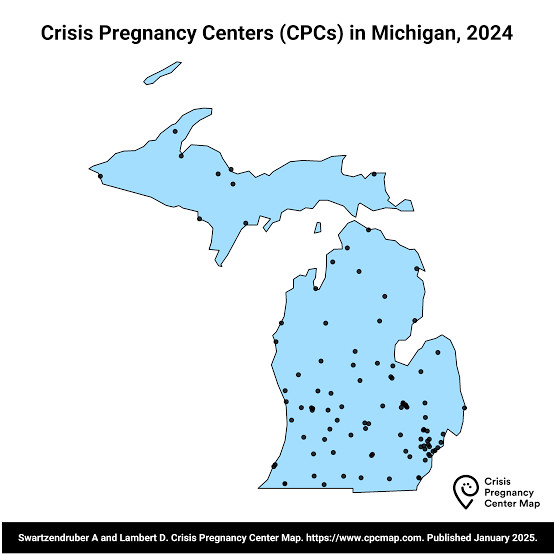
Michigan has the seventh-highest number of CPCs in the nation. As of 2023, 99 centers are located in the state, including three in Ottawa County. The clinics in Holland, Grand Haven and Allendale are run by Positive Options, a network of pregnancy resource centers based in West Michigan.
Positive Options began as a Birthright center in Holland in 1973 before transitioning to branding under Lakeshore Pregnancy Center Inc. and Positive Options. The Lake Michigan Drive location in Allendale near Grand Valley State University is the organization’s most recently constructed center.
Positive Options’ stated goal is to serve as a community resource by offering limited medical services, options education, material assistance, fatherhood programs and abortion after-care support.
According to Executive Director Chris Reuschel, the nonprofit works alongside healthcare providers, churches and social service agencies to help address the physical, emotional and material needs of families in Ottawa County.
“Our role is to provide education, practical assistance and emotional support so individuals can make informed decisions and feel empowered throughout their pregnancy journey,” Reuschel said.
Positive Options operates as a faith-based, nonprofit organization while maintaining “necessary” protocols and oversight for the medical services it provides, such as pregnancy testing and limited obstetrical ultrasounds, Reuschel said.
He added that services are offered free of charge to clients regardless of their background or religious beliefs.
Reuschel said that Positive Options is transparent in the services it does and does not provide, adding that the organization’s goal is not to make decisions for clients, but to ensure they have the resources necessary to make decisions for themselves.
“Our staff and volunteers are trained to provide factual information about pregnancy, fetal development, parenting, adoption and abortion procedures and risks, while creating a supportive environment free from coercion or pressure,” Reuschel said.

The organization is funded through individual donations, churches, foundations and community partners, Reuschel said. Positive Options is also affiliated with a national network of pregnancy help organizations that provide training, resources and best-practice standards.
Across the U.S., some states allocate funds for abortion alternative programs in the form of taxpayer dollars.
Between fiscal years 2022 and 2025, nearly a half-billion dollars of tax money in 21 states went to CPC organizations, according to an investigation by States Newsroom. This number does not include money that some states have diverted from federal programs like Temporary Assistance for Needy Families. Further, nearly $1.3 billion in local, state or federal government grants were awarded to CPCs from 2019 to 2024.
Read more: Taxpayer dollars flood pregnancy centers. Oversight hasn't followed.
In Michigan, taxpayer money currently does not go to CPCs, though that may soon change. In 2020, Democratic Gov. Gretchen Whitmer vetoed funding for abortion alternative programs, which have not received allocations since.
Michigan Attorney General Dana Nessel has also signed an open letter by a coalition of attorney generals supporting the review platform Yelp’s efforts to increase transparency surrounding CPCs.
The results of the upcoming gubernatorial election may alter the funding landscape for CPCs in the state. Republican gubernatorial candidate John James recently toured a nonprofit center in Grand Rapids, posting that the facility is answering a “true calling, walking alongside women and families with compassion, hope and practical support during some of life’s most difficult moments.”
Planned Parenthood
In West Michigan, the bulk of comprehensive reproductive and abortion services are located in Kent County. There are currently no Planned Parenthood locations in Ottawa County, with the nearest clinic being the Irwin/Martin Health Center in Grand Rapids.
Nationally, Planned Parenthood has spoken out against CPCs, stating that the centers spread “misinformation and propaganda.”
Planned Parenthood of Michigan did not respond to Ottawa News Network’s requests for comment.
Three years ago, the state put OCDPH officials in contact with Planned Parenthood of Michigan to discuss options for family planning services in the event the department’s budget was cut.
County commissioners considered a proposed budget in September 2023 that would have lowered funding for services such as family planning, health education and immunizations. Had the department not been able to meet the service requirements for Title X funding for family planning, services might have been transitioned to Planned Parenthood.
Ultimately, Ottawa County commissioners increased the health department’s funding for family planning services, meaning local agencies were able to continue providing services in line with state requirements without the possibility of Planned Parenthood of Michigan stepping in.
Ottawa County Department of Public Health
The OCDPH provides pregnancy and planning support, various forms of birth control and pregnancy testing, among other sexual health services.
The county continues to allocate funding for family planning and sexual health services.
Alison Clark, public information officer for OCDPH, said the county’s resources have been preserved in the years since the proposed budget cuts.
“State-mandated services, including family planning and sexual health services, have been preserved and funded with state funding and the required county match,” explained Clark.
The health department’s family planning and sexual health services are funded through a combination of sources — state and federal funds through the Michigan Department of Health and Human Services, including the federal Title X program, the county general fund, grants, Medicaid and private insurance billing, and fees for services.
Clark added that cost and insurance status remain the most common barriers to receiving care that Ottawa County residents face, including when it comes to reproductive healthcare.
She pointed toward the 2023 Community Health Needs Assessment, which identified access to care as one of the county’s top three health priorities, and noted the OCDPH continues to offer a sliding fee schedule to patients in its effort to administer affordable services.
While faith-based CPCs and Planned Parenthood often occupy opposing sides of the national debate over reproductive care, local health officials maintain that there are resources in place at the county level for community members to access.
Heading into the midterm elections, possible changes in statewide access to reproductive healthcare remain to be seen, adding another dimension to the ongoing debate over CPCs, abortion access and support for pregnant people and families.
— Contact ONN reporter Hailey Hentz at hhentz@ottawanewsnetwork.org.


