

Ottawa County population continues to grow, outpacing other Michigan counties
According to recent U.S. Census Bureau data, Ottawa County’s population has reached an estimated 308,459 people — nearly double the 157,174 residents recorded in 1980.

OTTAWA COUNTY — Driven by steady domestic migration and rare natural growth, Ottawa County continues its decades-long expansion, ranking among Michigan's fastest-growing counties while posing unique infrastructure and housing challenges for local leaders.
According to recent U.S. Census Bureau data, Ottawa County’s population has reached an estimated 308,459 people — nearly double the 157,174 residents recorded in 1980. Between 2020 and 2025, the county experienced a 3.9% population increase, making it the 10th fastest-growing county in the state.
This fast-paced growth can be associated with net domestic gains, movement between states or Michigan counties, and a natural increase (more births than deaths) of 674 people for natural increase and 1,166 for net domestic gains. Only 11 of Michigan's 83 counties saw natural increase, with the majority of them (95.2%) seeing a higher number of deaths than the previous year.
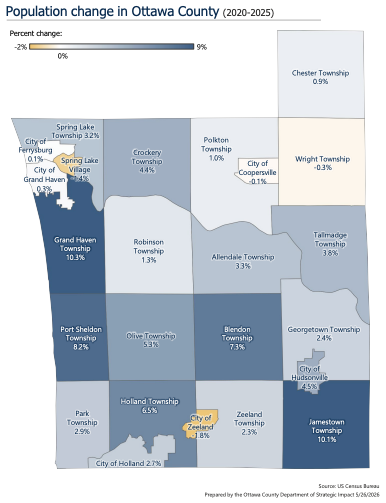
Specifically, between 2020 and 2025, Grand Haven Charter Township had the highest level of population growth, with a change of 10.3%. Between 2024 and 2025, Jamestown Charter Township had the highest percentage (2.4%) of population growth, according to the U.S. Census Bureau.
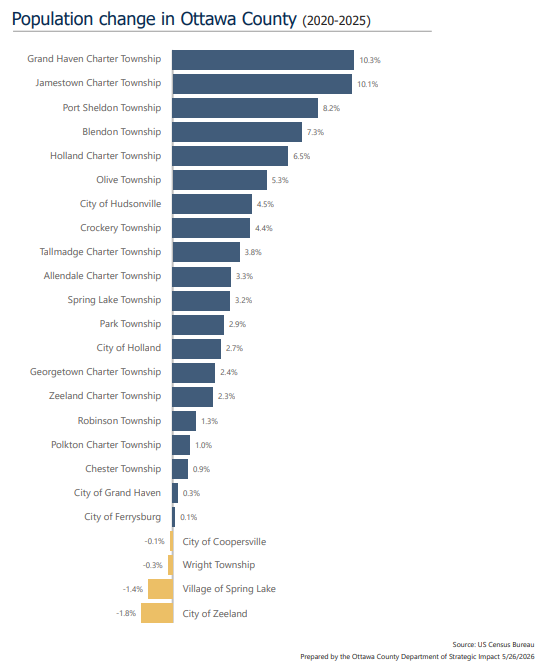
The City of Zeeland saw a net loss of population during 2024-5 period (-0.3%), and a -1.8% population loss between 2020 and 2025.
Out of the 24 cities, townships and villages in the county, all but four saw net growth from 2020 to 2025, with a range of growth from 0.1%- to 10.3%.
It is expected that Ottawa County will continue to see significant growth in population, while possibly not at the same rates.
“We do expect continued growth, but probably not at the same rate we have been seeing the last five to 10 years,” said Lakeshore Advantage spokesperson Grace Maiullo.
The estimated growth rate for 2030 is projected to be another 4% population jump, a percentage based on a linear population projection, and based on the idea that the current growth rates will stay the same or similar.
The population growth is something that could strain resources, such as a potential lack of housing, along with likely increases in housing prices.
“(Housing) is currently a challenge, especially regarding relative affordability for residents and workforce and could remain a challenge as the County’s population continues to grow, especially if such growth outpaces available housing supply,” said Paul Sachs, Department of Strategic Impact director.
Maintenance, water infrastructure and other potential obstacles are also being considered by the Ottawa County Board of Commissioners, which recently adopted a strategic plan to address and pursue "partnered, quality, growth” and to ensure “sustainable, countywide water supply.”
The strategic plan focuses on “facilitating more housing choice options, pursuing a Land Use Vision in cooperation with local governments, creating a forward-thinking road infrastructure plan with community partners and agencies, evaluating regional water systems capacities and expansion opportunities, among a bevy of other tasks and objectives,” said Sachs.
Stephanie Oesch, a data and research analyst with the DSI, noted that population growth shouldn't be viewed strictly as positive or negative, but rather as the current reality for Ottawa County residents.
“As the county continues to grow, it will need to continue to meet both the challenges and the benefits associated with that growth,” explained Oesch.
Michigan population growth
Michigan remains the 10th most populous state in the nation, with its population rising from 10,079,362 in 2020 to 10,127,884, according to U.S. Census Bureau estimates. The increase reflects a broader regional trend, as the Midwest was the only region in the country where every state saw population growth.
Data from the Michigan Center for Data and Analytics estimates that about half (56.6%) of Michigan’s counties grew from July 2024 to July 2025. In comparison, the Midwest had a percentage of 55.7 of counties growing.
According to the MCDA, 88% of Michigan counties experienced a decline in net international migration, with counties historically relying on foreign immigration seeing the sharpest growth slowdowns. Together, falling international migration and lower natural population gains are placing downward pressure on growth across the state.
Population growth at national level
Nationally, the U.S. population has increased only 1.8 million or .5% between July 1, 2024, and July 1, 2025, according to Vintage 2025 population estimates released in early 2026 by the U.S. Census Bureau. That puts the population at about 341.8 million people.
Despite the increase in population, the data shows a significant slowdown in population growth since the early COVID-19 pandemic, which showed a growth of .02% in 2021. The low increase comes shortly after a higher increase in population in 2024, with 3.2 million people added and a percentage increase of 1.0%, the highest population growth increase since 2006.

A historic decline in net international migration is the primary driver of the nation’s sluggish population growth. The U.S. Census Bureau calculates net international migration by tracking five distinct categories: foreign-born immigrants, emigrants leaving the U.S., native citizens moving abroad, movement to and from Puerto Rico, and military personnel deployed overseas.
With birth and death rates remaining relatively steady from 2024 to 2025, the drop in international arrivals was felt nationwide — slowing growth or accelerating decline in every state except Montana and Virginia.
For more information on the population in Michigan, visit michigan.gov/mcda.
For more information on the Ottawa County statistics about population growth, visit miottawa.org/dsi/statistics.
— Mallory Burt is a reporter for Ottawa News Network. Contact her at newsroom@ottawanewsnetwork.org.


