

Ottawa County’s water warning: Depleting aquifers, rising salinity, and the fight for a long-term fix
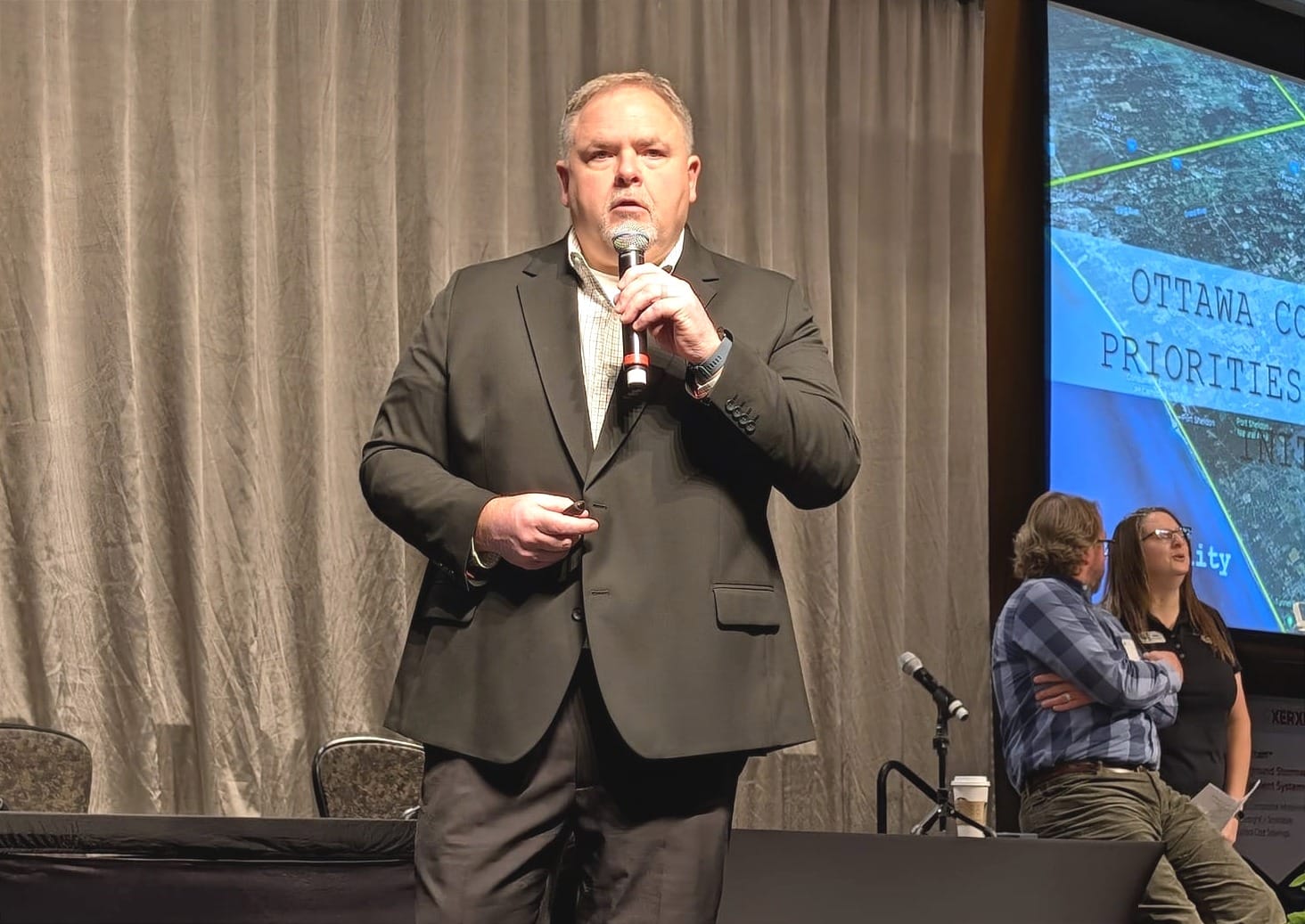
Water Resources Commissioner Joe Bush is exploring a potential solution — "recharging" the aquifer to keep the precious resource in Ottawa County. He is spearheading a $500,000 state grant project to see if the idea is feasible.

OTTAWA COUNTY — As Ottawa County grapples with declining water tables across its deep Marshall Aquifer, local officials face difficult choices regarding the region's long-term water supply.
Rapid suburban expansion and dense residential well drilling have placed unprecedented strain on underground reserves.
Read More: Ottawa County Water Forum outlines regional solutions for aquifer, watershed health
In response, Water Resources Commissioner Joe Bush is exploring a potential solution — "recharging" the aquifer to keep the precious resource in Ottawa County. He is spearheading a feasibility study with a $500,000 state grant to see if the idea is feasible.
"It’s never a problem until it’s a problem,” Bush said. “I’m the kind of guy that wants to get a solution — to figure out how to reuse, repurpose and recharge our water so Ottawa County has what it needs long-term."
What is ‘recharging’ and why does it matter?
Recharging is the hydrologic process where surface water from rain and snowmelt filters into the ground to replenish underground reservoirs known as aquifers.
In a healthy ecosystem, nature makes regular deposits of water, balancing out the withdrawals made by human wells. When communities pump out groundwater faster than it can recharge, the water table drops.
For most of Michigan, this cycle functions seamlessly. Ottawa County, however, is a geological anomaly.
Despite sitting directly adjacent to the boundless freshwater expanse of Lake Michigan, the county is locked in a severe groundwater crisis.
The region relies on two distinct underground systems: a shallow, glacial surface aquifer and a deep bedrock formation called the Marshall Aquifer. Separating the two is an 80-foot-thick layer of dense clay.
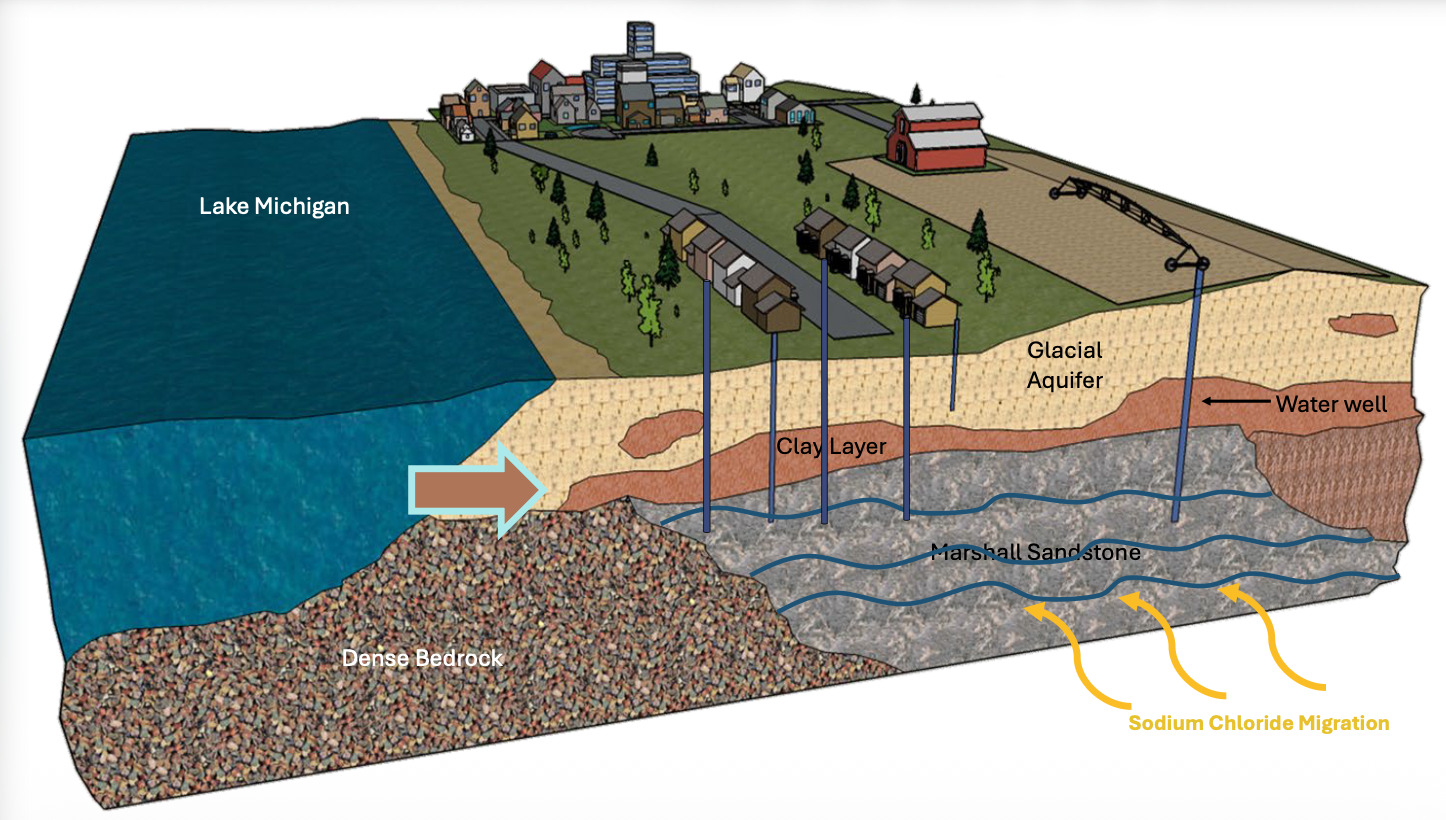
This subterranean clay acts like an impenetrable lid. When torrential rains hit the county, the water easily refills the shallow surface layer, but the clay blocks it from trickling into the deep Marshall Aquifer below.
Geologists estimate it takes 10 to 20 years for a single drop of water to naturally navigate the microscopic rock fissures to pass this barrier. For all practical purposes, the Marshall Aquifer is a frozen, non-replenishable historical reservoir.
Yet, Ottawa County is one of the fastest-growing and most agriculturally productive regions in the state.
According to U.S. Census Bureau estimates, Ottawa County’s population reached 308,459 by July 2025 — a nearly 17% jump since 2010 and an increase of roughly 70,000 residents since 2000. At the same time, the 2022 USDA Census of Agriculture ranks the county third statewide in production, generating $726.6 million in market value across more than 144,000 acres of farmland.
As residential sprawl accelerates, new subdivisions are bypassing municipal infrastructure and drilling straight into the earth, increasing demand.
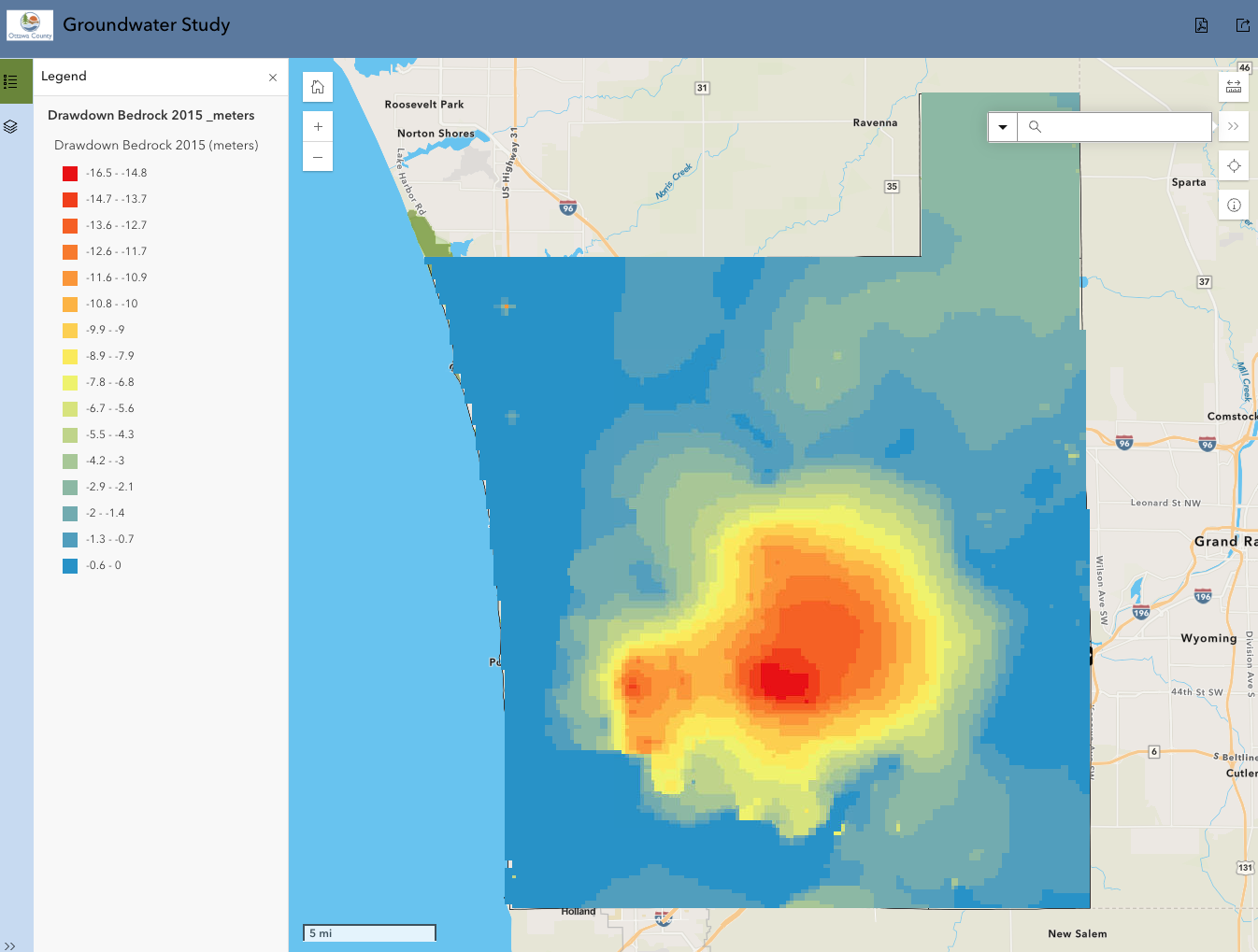
While agriculture remains a prominent industry in Ottawa County, Bush said residential irrigation and private well density are heavily driving the drawdown.
"Where's the aquifer? It's depleting. We know that it's a lot of irrigation, not so much agriculture, but it was residential,” he said. “By all these straws going into that bed — the deep bedrock Marshall Aquifer bed — that is sucking the water out, and it's not replenishing."
A long-term problem, possible solutions
Ottawa County’s Groundwater Board has examined the recharge issue for roughly 15 years, but Bush noted that early studies failed to deliver concrete solutions.
Reflecting on a key 2013 study by Michigan State University Extension, Bush pointed out its analytical limitations.
"When Michigan State did it, … it delivered some good information, but it really didn't give us some teeth to be like, 'Okay, here's the situation we're in,'" he said.
A primary administrative hurdle, Bush said, is the Groundwater Board's limited scope.
"One of the challenges that we've had on the Groundwater Board is again we're only advisory," he said. "We're not a board with any authority."
To evaluate alternatives, Bush traveled to Western states where aquifer recharge systems are standard practice due to persistent water scarcity.
"When you go west of the Mississippi, people recharge out there because it's a commodity," Bush said. "People pay you to recharge the aquifer because the aquifer is depleting out there as well."
One such example was Scottsdale, Arizona, which has established itself as a national pioneer in water sustainability by recharging over 70 billion gallons of water into regional aquifers since 1988.
Rather than allowing treated wastewater to evaporate in open surface basins, the city uses a subterranean injection process, pumping water deep underground between 1,000 and 1,600 feet. The stored water can later be pumped back out for drinking, irrigation or industrial use during dry periods.
The city also pumps purified municipal recycled water — using ozonation, reverse osmosis and ultraviolet photolysis — into a network of more than 60 vadose zone (dry) wells, where it trickles down through 400 feet of natural sand and gravel before blending safely into the drinking aquifer.
Similar efforts are currently in practice in water-challenged states like Texas and Florida, where aquifer recharging dates back as early as the mid-1980s.
Bush lauded the system as revolutionary given the geological challenges of Western states.
"Arizona is not just sand; they have a lot of rock formations, and they do aquifer recharge,” he said.
He also noted Mark Anthony Brewing, which operates a facility in Glendale, Arizona, that runs wastewater through an advanced on-site industrial treatment system. The treated water is discharged into a surface wash that eventually flows into the Agua Fria River.
Could Ottawa be the pioneer in Michigan?
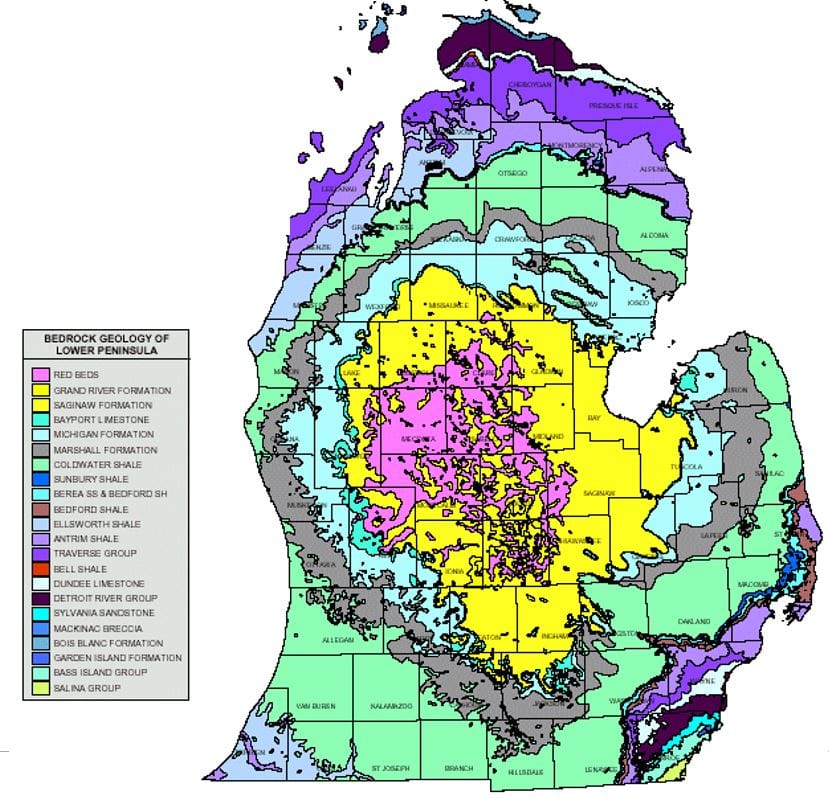
Bringing managed aquifer recharge to Michigan presents regulatory challenges.
State agencies currently lack specific permitting frameworks for injecting water back into drinking aquifers.
"When I talk to the higher-ups at [the Department of Environment, Great Lakes, and Energy] in Lansing, they're like, 'Joe, we don't even have a category to even do aquifer recharge for drinking water.'"
Because of these regulatory hurdles, Bush underscored the need for a comprehensive feasibility study to resolve technical, geological and hydrogeological questions.
"How deep do you go with that aquifer with recharge, and how many gallons do you pump down there without fracking or cross-water contamination because you're putting two water bodies that are separate together?” he said. “These are all the things we have to find out yet."
Bush pointed to a recent 16-county airborne electromagnetic survey, which uses low-flying helicopters with magnetic sensors to gather subsurface geological data.
Bush said the data, compiled by the U.S. Geological Survey, will help identify types of sediment and rock-forming aquifers below ground, helping officials understand where water is located and how to access it.
"With the helicopter flying over, we will use that. That's not a waste of money," Bush said. "That is valuable resources that we're going to use with our feasibility study to work with the EPA and EGLE.”
Bush believes localized pilot programs with major industrial water users, such as Allendale-based Leprino Foods or Coopersville-based fairlife, could demonstrate how clean process water can be safely reinjected.
"Laprino has two large water withdrawal wells, and they're hooked to city water," Bush said. "And I said, 'Can we just … do an injection with their own water instead of putting it right in the Grand River? It's clean water.'"
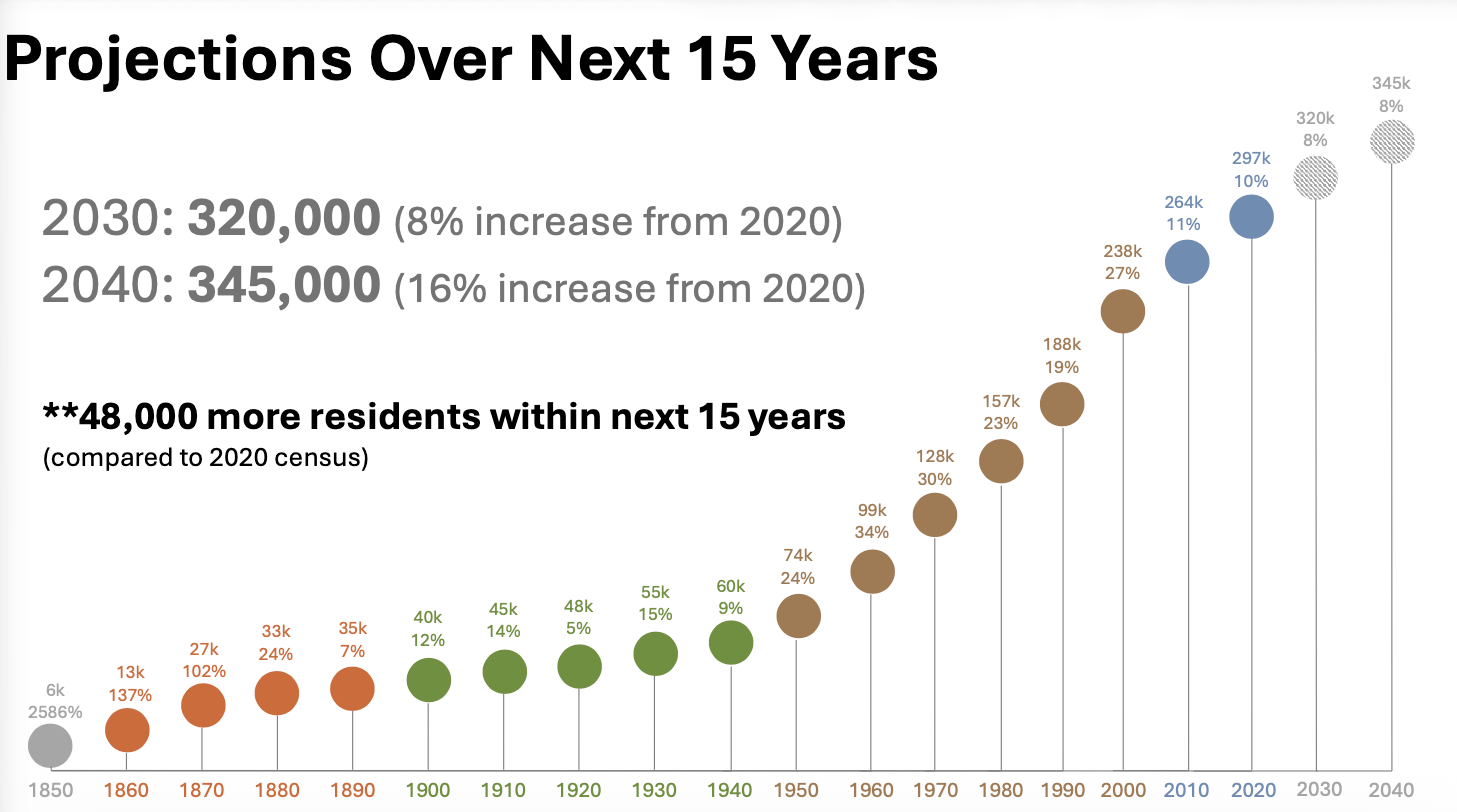
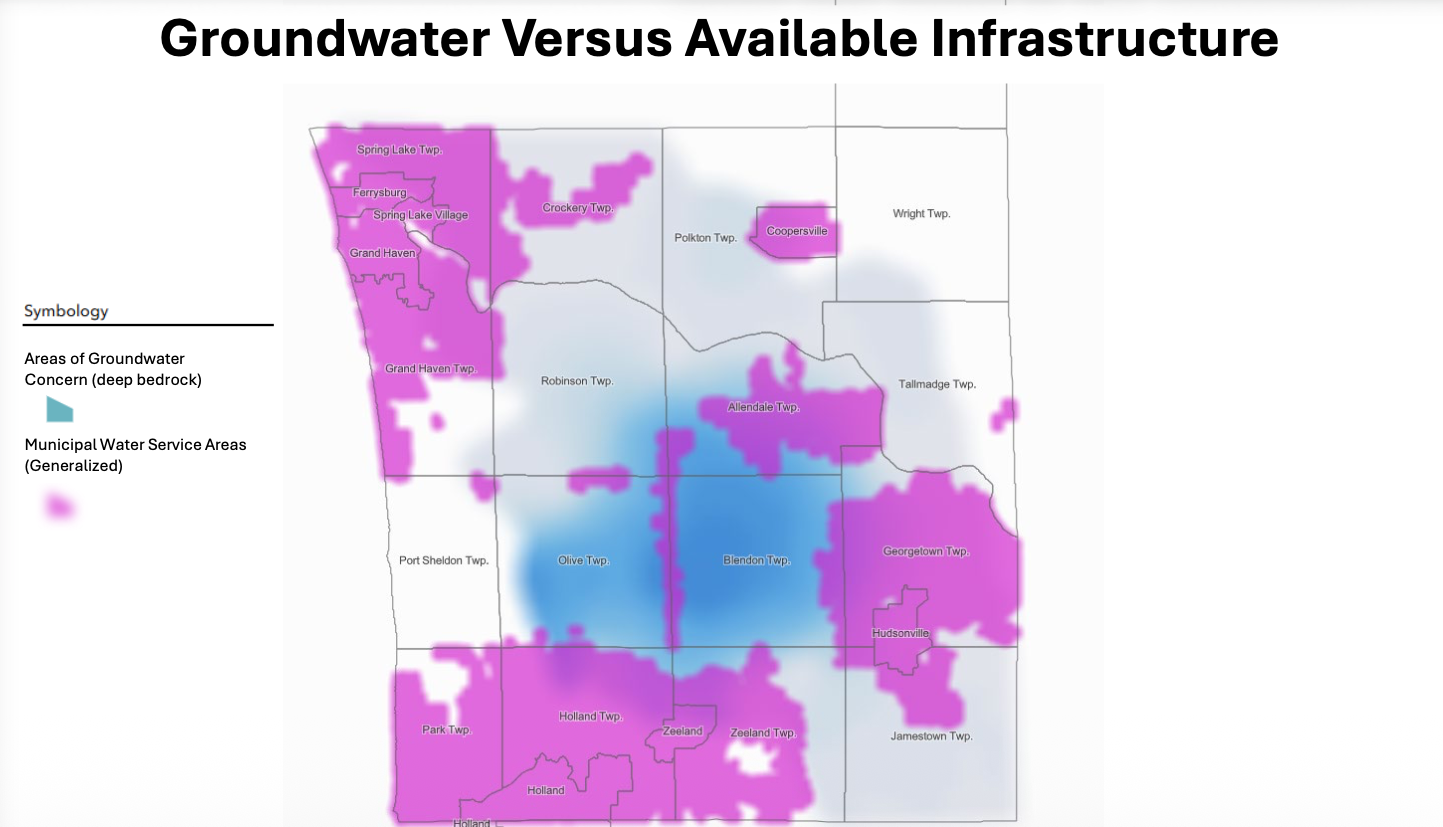
Ottawa County is expected to grow by 20% between 2020 and 2030, and 16% between 2020 and 2040. [Courtesy/Ottawa County]
Long-term planning vs. soft solutions
As a top agricultural producer — third in the state — with thousands of residential wells and rapid growth predicted for years to come, Ottawa County faces extreme pressure on its underlying Marshall Aquifer.
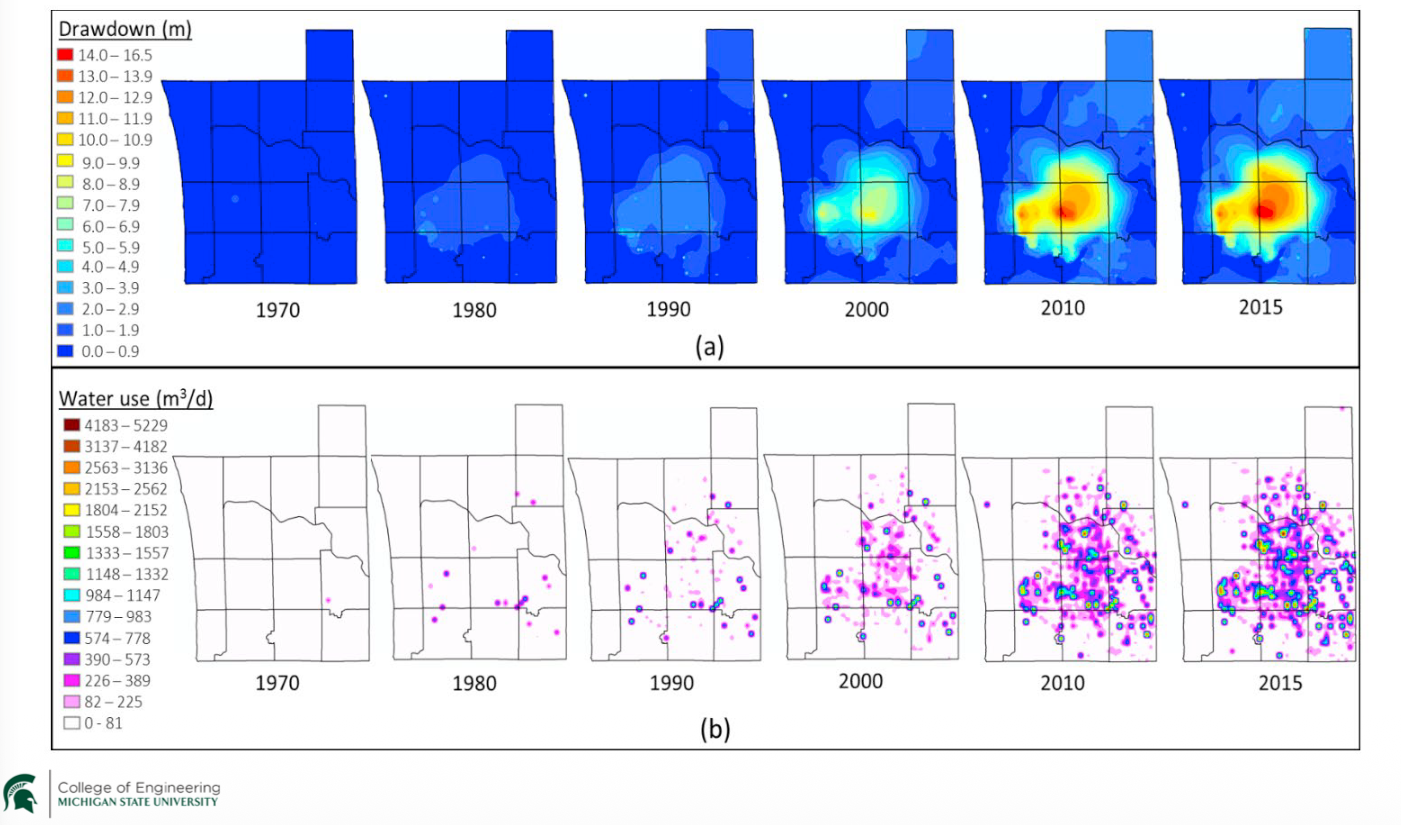
A dense central layer of clay severely restricts natural rainwater recharge, while thousands of residential wells, expanding suburban developments, commercial operations and intensive agricultural irrigation continuously draw millions of gallons of water per day.
The relentless demand has driven down groundwater levels and pulled up underlying sodium chloride deposits, contaminating wells with saltwater. Static groundwater levels in the bedrock Marshall Aquifer have dropped 40 to 45 feet since the 1970s, while slightly less than half of state residents rely on groundwater as their primary water supply.
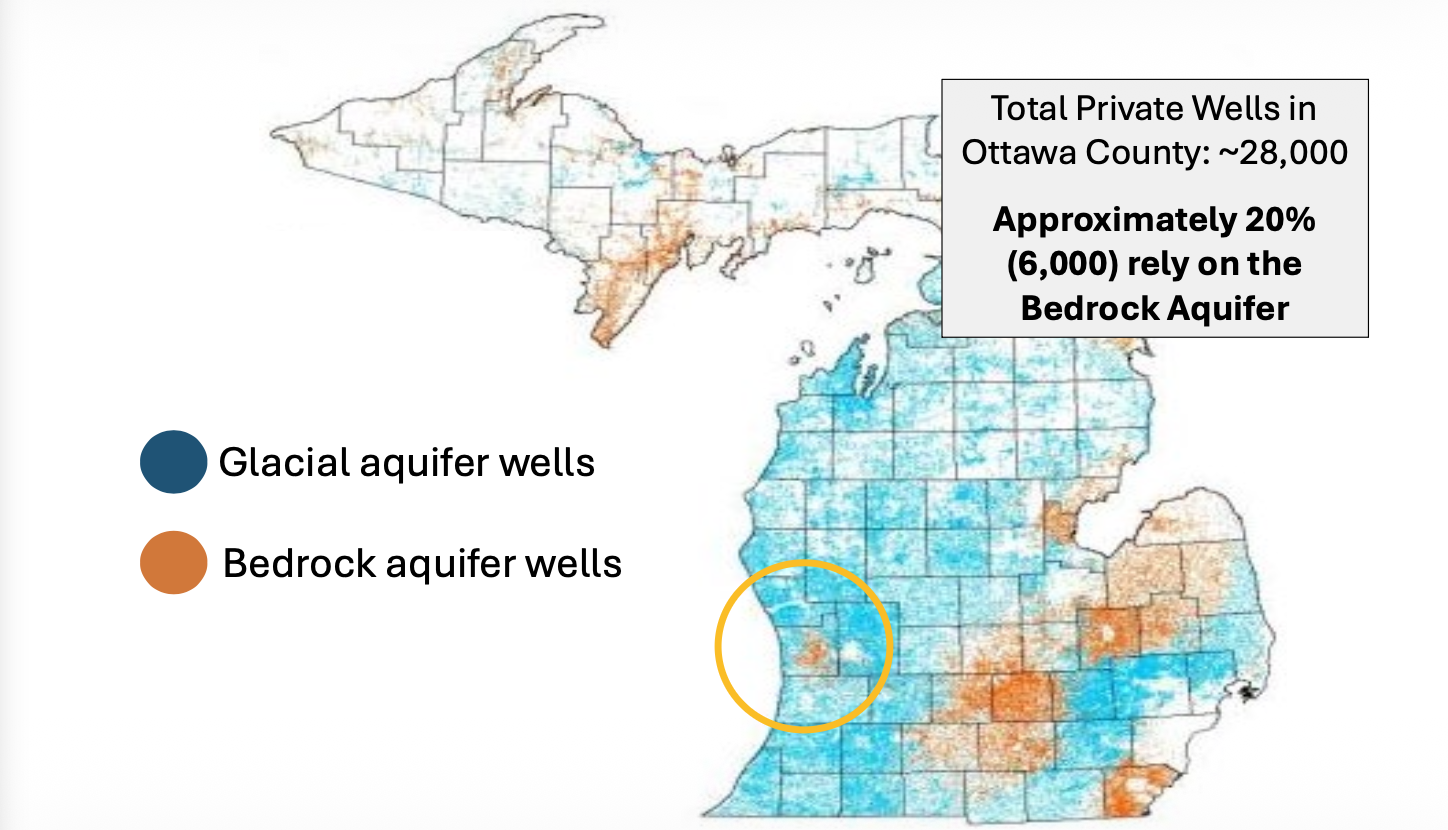
While conservation initiatives — such as replacing turf lawns with native plants — are widely encouraged, Bush argued they do not fully solve long-term supply challenges.
"I keep hearing [about] native grasses and plants — and that's good stuff, don't get me wrong — but while that is a long strategic plan, it doesn't recharge right for the future," Bush said. "I'm not talking about next year ... 10 months from now — I'm talking 10 years from now, 20 years from now, because we do know that our aquifer in Ottawa is depleting."
Expanding municipal pipe infrastructure to draw surface water from Lake Michigan is a common alternative, but the financial burden on homeowners and local municipalities is steep.
"We can't afford the infrastructure to keep putting, let's say, municipal water and pumping water out of Lake Michigan and running it to everywhere,” he said. “The cost of infrastructure to put in new piping is very, very expensive."
Brackish water, government response
Because the aquifer cannot recharge from the top down, heavy pumping has created a powerful underground vacuum.
Deep below the freshwater of the Marshall Aquifer lies a stagnant, prehistoric layer of ancient saltwater and chloride deposits. As the freshwater is drawn down, this heavy sodium chloride is pulled upward into the active water supply.
The consequences are already bubbling to the surface.
As early as 2006, local farmers began reporting damage to their fields, specifically noting that soybean leaves were being "burned" — turning brown and crispy along the edges — because water pumped from deep irrigation wells contained high concentrations of sodium chloride. When sprayed onto fields, the high salinity severely dehydrates and stunts plants.
While the drinking water standard for chloride is 250 milligrams per liter, agricultural crops can suffer damage at levels as low as 70 mg/L.
In certain central parts of the county, localized upwellings have pulled up ancient brine pockets that tests revealed could be nine times saltier than ocean water, rendering wells entirely unusable for farming. Farmers have also reported that saline water corrodes expensive irrigation infrastructure, pipes and pumps over time.
Meanwhile, homeowners are finding their plumbing corroded by brackish brine, reporting early appliance failures as well as noticeably foul, salty-tasting water coming from their taps.
Communities such as Allendale and Olive Township, which are located centrally within the county, have voted to ban housing developments that rely on new well connections.
Others, including Blendon and Robinson townships, have actively worked with the county’s Groundwater Board on localized ordinances. Instead of outright bans on developments, these communities use zoning policies and subdivision reviews to legally restrict how heavily a new project can depend on deep bedrock groundwater.
To back up the townships, the Ottawa County Department of Public Health has denied individual private well permits across the county if data shows a new neighborhood's combined water usage cannot be sustained over a 10-year period.
Despite current cooperation among local governments, Bush said he would like to see more coordination, such as a regional body that tackles water infrastructure and long-term supply issues.
"Why can't we have a water authority like a BPW?” he asked, referring to how some local governments, such as Holland and Grand Haven, have boards of public works. “Every township is having issues with raising the rates on water bills. When it comes to water and sewer, I think it should be a BPW, a water authority, where you have multiple people on a board, and you set rates, and it's accountability."
He said that would allow better communication with the public, avoiding contentious water rate hikes like those in Georgetown Township late last year that drew the ire of residents.
"There's one thing we should not be bringing politics into, and that's protecting our water,” Bush said. “It's a non-political issue; we should be looking at how we protect and recharge it for the future before it becomes a 911."

When will we have answers?
The two-year feasibility study will begin once the county issues a request for proposals to select an engineering and hydrogeological firm.
The project will evaluate groundwater conditions, diagnose causes of declining recharge, and establish data-driven recommendations by analyzing groundwater levels, withdrawal rates and aquifer health alongside stressors such as land-use changes, increased pumping and weather variability.
Bush hopes the study, paired with a decade of local effort, will give officials a clear roadmap for long-term groundwater sustainability.
"We keep studying this thing, but what are we actually going to do? What’s our next step? We’ve been so dependent on Lake Michigan that we’ve been ignoring the situation of our aquifer. This feasibility study is about getting real solutions."
— Sarah Leach is the executive editor of the Ottawa News Network. Contact her at sleach@ottawanewsnetwork.org. Follow her on Twitter @ONNLeach.


