

South Haven reinstates lifeguards as Ottawa County, cities monitor with technology
Ottawa County beach managers are monitoring South Haven’s rollout, but they remain committed to a strategy focused on public education and engineering controls rather than human surveillance.

SOUTH HAVEN — Lifeguards are back on duty at South Beach this summer, but the momentum to put trained eyes on the water stops at the county line.
The new initiative in the Van Buren County city, funded by a substantial restructuring of beach parking fees, stands in sharp contrast to the strategy in nearby Ottawa County, where local and state officials continue to resist a return to stationed lifeguards, pointing to financial liabilities, staffing shortages and the logistical challenges of managing high-volume public shorelines.
Instead, the policy split highlights a deepening regional debate over how to protect swimmers on a body of water often called the most dangerous of the Great Lakes. According to data from the Great Lakes Surf Rescue Project, there have been 23 drownings across the Great Lakes so far this year, with 12 occurring in Lake Michigan.
Two men — 24-year-old Philip LoChirco of Warrenville, Illinois, and 26-year-old Jalen Shaffer of Grand Rapids, Michigan — drowned in Lake Michigan last weekend near the Pigeon Lake channel.

Lifeguards return
South Haven’s new program deploys a crew of lifeguards trained in open-water surf rescue, first aid and navigation.
Led by Chief Lifeguard David Figueredo, a veteran of the municipal beach safety operations in Evanston, Illinois, the guards are on duty seven days a week from 11 a.m. to 7 p.m.
The city approved a contract with Double Haul Solutions to develop the program following an increase in drownings along the lakeshore.
South Haven had disbanded its original lifeguard program in 2001 and subsequently faced litigation over two separate drowning incidents. To fund the revival, the city council raised weekly beach parking passes to $50 and implemented a $3 hourly parking fee, a move expected to generate $800,000 annually.
Past litigation; recent updates
The Michigan Supreme Court has agreed to hear arguments on whether to reconsider a ruling that granted the City of South Haven governmental immunity in the wrongful death lawsuit.
The suit was filed by Crystal LeDuke following the 2020 drowning of her 18-year-old son, Brandon Chambers, at a municipal beach.
Since the initial filing, city officials have been trying to dismiss the lawsuit on grounds of governmental immunity — a law that renders government agencies immune from liability "if the governmental agency is engaged in the exercise or discharge of a governmental function."
In April, the Michigan Supreme Court agreed to consider hearing arguments about the governmental immunity issue.
South Haven has seen 12 drowning deaths and multiple lawsuits since disbanding its lifeguard program in 2001, including a pending case for a 2022 double drowning that is currently on hold awaiting the Chambers precedent, according to multiple previous media reports.
Prompted by these ongoing legal battles and a March 2025 United States Lifesaving Association safety report, South Haven voted to reverse its decades-old policy, officially hiring the new chief lifeguard to bring physical stands back to the water for the 2026 summer season.
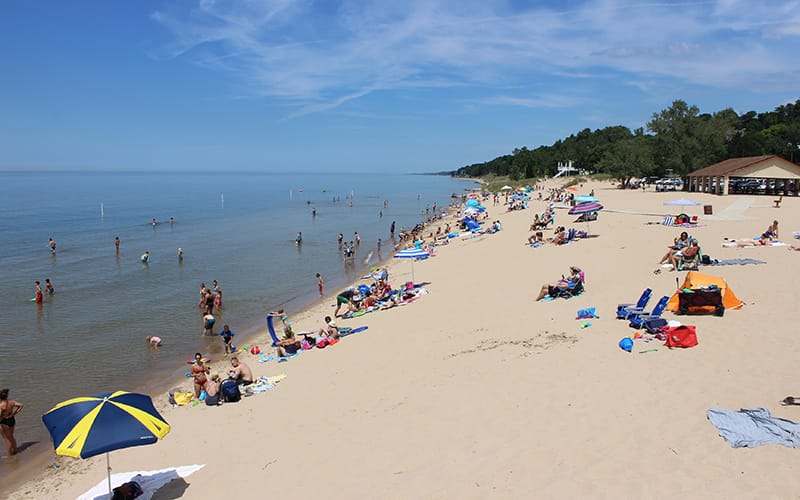
Could Ottawa County follow?
A short drive north, Ottawa County beach managers are monitoring South Haven’s rollout, but they remain committed to a strategy focused on public education and engineering controls rather than human surveillance.
"Ottawa County Parks has never had lifeguards stationed at our Lake Michigan beaches," said Jason Shamblin, director of Ottawa County Parks. "Our longstanding approach has been to promote caution, hazard awareness, and personal responsibility when swimming in open-water environments like Lake Michigan, where conditions can change rapidly and become hazardous."
Shamblin noted that lifeguarding a large and dynamic body of water presents significant operational hurdles.
"Conditions, including rip currents, wave activity, and cold-water temperatures, can vary dramatically from day to day and even hour to hour," Shamblin said. "Combined with the expansive shoreline and high visitation levels at many beaches, operating a lifeguard program can be both logistically complex and financially demanding."
While Ottawa County has no immediate plans to change course, Shamblin said his office is paying attention to neighboring communities.
"We will continue to monitor efforts underway at other Lake Michigan communities," Shamblin said. "We are particularly interested in following South Haven's new lifeguard program, which is being implemented initially at South Beach Park, one of the city's six Lake Michigan beaches, before any potential expansion to other locations."
For now, Ottawa County is betting on tech over personnel.
"We will also continue to monitor emerging technologies and safety tools, including the automated beach condition monitoring and warning systems being utilized at Grand Haven State Park and other Great Lakes beaches," Shamblin said. "These systems provide information regarding water conditions and hazards, complementing warning systems and public education efforts. In the meantime, our focus remains on public education, hazard awareness, and encouraging visitors to monitor beach conditions before entering the water."
That stance mirrors the long-held policy of the Michigan Department of Natural Resources, which phased out lifeguards at state parks in the late 1980s and early 1990s due to costs and staffing limitations.

Currently at Grand Haven State Park, there are eight orange towers, located on the beach, that feature an electronic light display that mimics the familiar double-red, red, yellow and green flag system visitors are used to seeing on the beach.
Additionally, life rings are stationed at each tower. If one of the rings is accessed to aid in helping someone in the water, 911 and park rangers will simultaneously be contacted. The towers can play pre-recorded messages to alert users to changing conditions, emergencies and other important information.
The four blue light towers, located along the sidewalk, feature an emergency phone that park staff and visitors can press to trigger an immediate emergency response. The blue light towers are equipped with a higher-power loudspeaker, video monitoring system and a direct line to the Ottawa County 911 center.
The loudspeaker system will work in conjunction with the prerecorded messages of the orange beach towers and allow park staff to broadcast live messages.
— Heather VanDyke covers northern Ottawa County for the Ottawa News Network. Contact her at hvandyke@ottawanewsnetwork.org.


