

West Michigan Native sparks awareness for rare tumor
September marks Desmoid Tumor Awareness Month, a time dedicated to educating, sharing patient stories and advancing research to find a cure for the currently incurable tumor.

GRAND HAVEN — September marks Desmoid Tumor Awareness Month, a time dedicated to educating, sharing patient stories and advancing research to find a cure for the currently incurable tumor.
Desmoid tumors, also known as aggressive fibromatosis, are rare, locally invasive soft tissue tumors that grow uncontrollably in the soft connective tissues of the body. Researchers estimate that five to six people per million are diagnosed with desmoid tumors each year (about 0.0005.5% of the U.S. population).
Misinformation about the tumors is widespread due to outdated and inconsistent language, causing confusion. This is due to the rarity of the tumor and the unpredictability of them, making research and standardized procedures difficult.
Older medical advice heavily favors surgery, whereas current best practices see surgery as a second or even last resort for the tumor depending on placement and if the tumor is failing observation.
Often thought of as benign tumors, the tumors are instead classified by the World Health Organization as intermediate, locally aggressive tumors.
Observation or active surveillance of the tumor tends to be the first approach, using MRI and CT technology due to the unpredictable nature of the tumors.
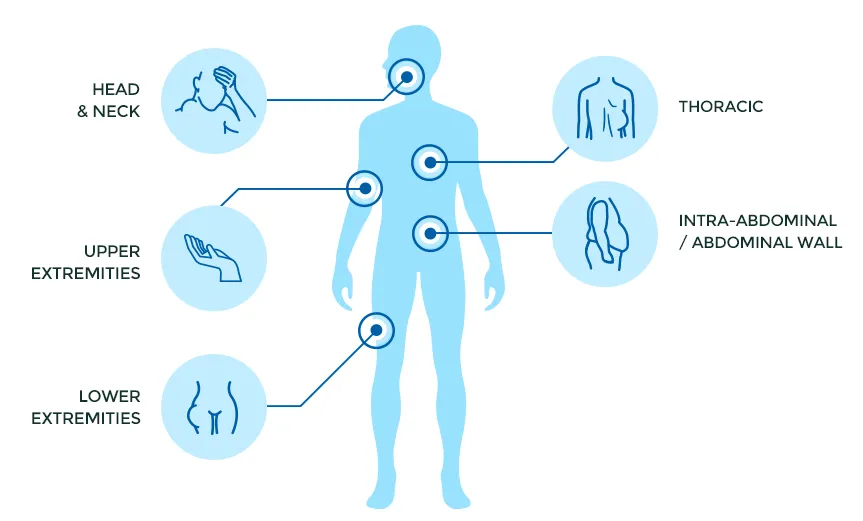
Surgery, once the initial step for treatment, is no longer recommended as the first-line treatment due to the way the tumors grow, with thin, long-rooted strands or tendrils that intertwin with the surrounding tissue. Removal tends to be a second-line treatment option for irregular desmoid tumors located in the abdominal wall that are failing observation.
The tumors have a high recurrence rate as well, with research suggesting the rate of recurrence is between 24 and 77 percent. Due to that recurrence rate, and the nature of the tumor, removal and then chemotherapy is more often than not a viable option for treatment.
“There are stories of people having them removed, and they just come back with vengeance,” said Megan Rose Kamsickas, a patient and advocate for desmoid tumor research.
Even with successful chemotherapy, Kamsickas told Ottawa News Network the tumors almost always come back as well.
“Sometimes you're lucky, and it's like 10-20 years,” said Kamsickas. “Some professionals classify them as a chronic cancer.”
Kamsickas was diagnosed with a desmoid tumor during a three-year remission routine scan after being diagnosed with Hodgkin’s lymphoma in July 2020 and entering remission in December 2020. Originally, doctors thought the tumor was a lymphoma relapse but, after a tissue sample, determined that it was a desmoid tumor.
“My tumor, in particular, is in my chest wall fused to my ribs,” said Kamsickas. “For some people, they don’t cause pain; for other people, they cause excruciating pain.”
Other treatment options for the tumor include Tyrosine kinase inhibitors (TKIs), a widely used targeted therapy to treat tumors and cancer. As of now, no TKIs have been FDA-approved to specifically treat desmoid tumors; rather, doctors prescribe them “off-label,” meaning that they are used for conditions other than for what they were originally approved.
Cryoblation, the use of probes inserted into the tumor that use coldness to damage and kill tumor cells, and high-intensity focused ultrasound (HIFU), which uses ultrasound waves directly onto the tumor, are both treatment options used as well. The treatments, however, are emerging techniques, and experience with both treatments is limited, and the long-term results are not known yet.
As of Nov. 27, 2023, the FDA approved OGSIVEO (nirogacestat) for the treatment of adults with progressing desmoid tumors. The drug works to block the enzyme gamma-secretase, preventing it from activating another protein called Notch. Researchers believe that Notch is used by desmoid tumors to grow and divide.
The drug is the first-ever FDA-approved medication for desmoid tumors and is seen as a hope for desmoid tumor patients.
“This isn’t something that is going to have an end date; this is always going to be a part of me. It's just a matter of finding ways to live my life despite it,” said Kamsickas about her tumor. “If we, as patients, aren’t talking about it, then no one is, and that really lit a fire under me to start fundraising because there’s so much outside of our control as patients, but one thing in my control is using my voice to spread awareness.”
To raise awareness for desmoid tumors and Desmoid Tumor Awareness Month, Kamsickas is partnering with West Michigan Nutrition, 1705 W. Beacon Blvd. in Grand Haven.
The fundraiser is set for 8 a.m.-1 p.m. Oct. 10. At the event, there will be raffle prizes from various businesses. More Love Collective will also have bracelets on sale benefiting desmoid tumor research.
A portion of the sales and tips will be donated toward the Desmoid Tumor Research Foundation (DTRF), which is dedicated to finding answers through research, advocacy, attention and awareness.
Founded in September 2005, the foundation has invested over $4 million into desmoid tumor research and has had 59 researchers supported by DTRF-funded grants. Currently, 12 countries around the world contribute to the collaborative effort to both raise awareness and find a cure for desmoid tumors. And 37 institutions are contributing to the progress across a global network.
Katie Doyle Myers is the current executive director of DTRF and is a patient herself.
“She’s talked to me about carrying the torch with this diagnosis,” said Kamsickas. “There are seasons of life where you're able to carry the torch and really light the way for other people also having this diagnosis, so it's really cool to see the momentum she has (as a patient and advocate).”
For more information on desmoid tumors, visit DTRF’s website. For more information about the fundraiser, visit Facebook. To donate directly to DTRF, visit donate.dtrf.org.
— Mallory Burt is a reporter for Ottawa News Network. Contact her at newsroom@ottawanewsnetwork.org.


