

Tornado activity surpasses yearly average in Michigan as peak season begins through July
The state has already exceeded its average annual tornado count, according to the National Weather Service. The active season comes as communities across the state continue recovering from severe weather that has left behind widespread damage.

By Demonte Thomas
Capital News Service
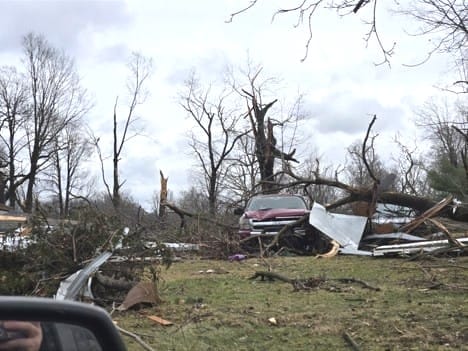
LANSING — Three months after an EF-2 tornado tore through Three Rivers, Mayor Angel Johnston still remembers walking streets she knew by heart and being shocked.
“There were streets in the aftermath that were absolutely unrecognizable,” Johnston said.
The community is still rebuilding after the storm, one of 16 tornadoes reported in Michigan so far this year, as the state enters the peak of tornado season.
As tornado season continues, the state has already exceeded its average annual tornado count, according to the National Weather Service. The active season comes as communities across the state continue recovering from severe weather that has left behind widespread damage.
Read More: Tornadoes march through southwest Michigan; several counties still under watch alerts
Michigan averages 14 tornadoes per year based on data collected between 1996 and 2025, says National Weather Service Grand Rapids meteorologist Rebecca Hansen.
“We’re currently above average for that 30-year average,” Hansen said.
So far, places like Montcalm and Gratiot counties have also become victims of a tornado’s destructive nature.
Hansen said most of the state’s tornado activity this year has been concentrated in the southern half of the Lower Peninsula, mainly south of US-10, across the state. East and Southeast Michigan, including the Detroit area, saw the most at around six tornadoes. “Otherwise, the Grand Rapids area — for our forecast area in western Michigan, we’ve seen four, and then along with northern Indiana, that covers several counties.”
Hansen added that June is typically Michigan’s peak month for tornado activity, meaning the potential for additional severe weather remains elevated.
Recent forecasts from the Climate Prediction Center indicate an 82% chance that El Niño conditions will develop between May and July and continue through the Northern Hemisphere winter. The forecast places the likelihood of El Niño at 96% between December and February 2027.
Earlier this year, Ryan Harriott, the president and founder of Michigan Storm Chasers, predicted a more active severe weather season because of shifting climate patterns in the Pacific Ocean that influence weather across the United States.
Still regrouping
One community still recovering from this year’s severe weather is Three Rivers, where an EF-2 tornado caused extensive damage. Despite the destruction, Johnston — the mayor — said residents have continued to rebuild with the support of volunteers and relief organizations.
“We had so much help,” Johnston said. “It was an overwhelming amount of love and support poured over our community. Immediately from the Red Cross, they were here within just a couple of hours. Then many organizations, one called Samaritan’s Purse, also came and stayed a couple of weeks, organizing volunteers.”
“They brought in their own volunteers, giving our residents and our locals the infrastructure and support that they needed to be effective volunteers,” she said.
Some homes sustained significant damage, some had moderate and some saw minor damage.
“Pretty much everybody in the path had something they had to deal with. There are folks who will not be back in their homes for over a year because the damage was so significant,” she said.
Johnston said a resident told her he wasn’t aware of the tornado’s path making its way towards the town until his house started to come apart around him. All that was left was rubble where his garage once stood.
Johnston said the town is still estimating how much repairs will cost, but it will be “millions and millions and millions of dollars.”
Talking about her love for following the weather and calling herself a “weather nerd,” Johnston offered advice on how to prepare for severe weather.
“The most important thing anybody can do is follow the Michigan Storm Chasers,” Johnston said. “They are the reasons that so many people were able to take cover during our storm, and they cover every single warning from start to finish.”
“Any storm year-round, whether it’s snow or hazardous weather in terms of tornadoes or wind or thunderstorms, they’re always going to cover you start to finish.”
Johnston said the organization taught her something important that ultimately saved her and her dog’s life during a storm last year when straight-line winds damaged her home.
“I knew there was a storm coming, but we would have been outside. And they said, treat this like a tornado.”
“I was standing near a window and realized I should back up. When they gave that warning, I looked outside. As soon as I saw the wind kick up, I grabbed my dog, my purse and the most important thing, my shoes and I rounded the corner into my kitchen as my neighbor’s tree fell into my tree and then into my dining room,” she said.
“My entire house was full of glass.”
Johnston said if she hadn’t brought her shoes with her, she wouldn’t know what to do. Since then, she keeps a pair of boots in her basement in case of another severe weather event.

“You never know what you might walk back out into,” Johnston said. “Even if your house is in one piece, bring some shoes when you go into your basement. It’s so important.”
Another crucial tip she offered was to buy whistles and keep them around their necks during a storm.
“If you’re under rubble, a whistle is going to help a rescuer find you,” Johnston said. “That’s something else that I have in my storm kit. Again, follow the Michigan Storm Chasers. They have saved countless lives, including my own.”
— Demonte Thomas is an environmental reporting intern at WKAR in collaboration with Michigan State University’s Knight Center for Environmental Journalism and Capital News Service.


